Air Fryer Salmon Time Calculator
Estimate air fryer salmon timing from portion shape, thickest point, basket load, temperature, preheat, frozen or chilled start, skin placement, glaze style, and doneness target.
🐟 Salmon Air Fryer Presets
Pick a real salmon setup, then adjust the shape, load, glaze, and doneness to match your basket.
⚖ Portion And Air Fryer Inputs
Your Salmon Air Fryer Plan
Adjust the inputs, then calculate for a basket-specific timing estimate.
Timing Breakdown
Cooking Steps
- Preheat if selected.
- Cook skin side down when possible.
- Probe the thickest center.
- Rest before flaking.
🌡 Salmon Time Reference Cards
📊 Portion Shape Comparison
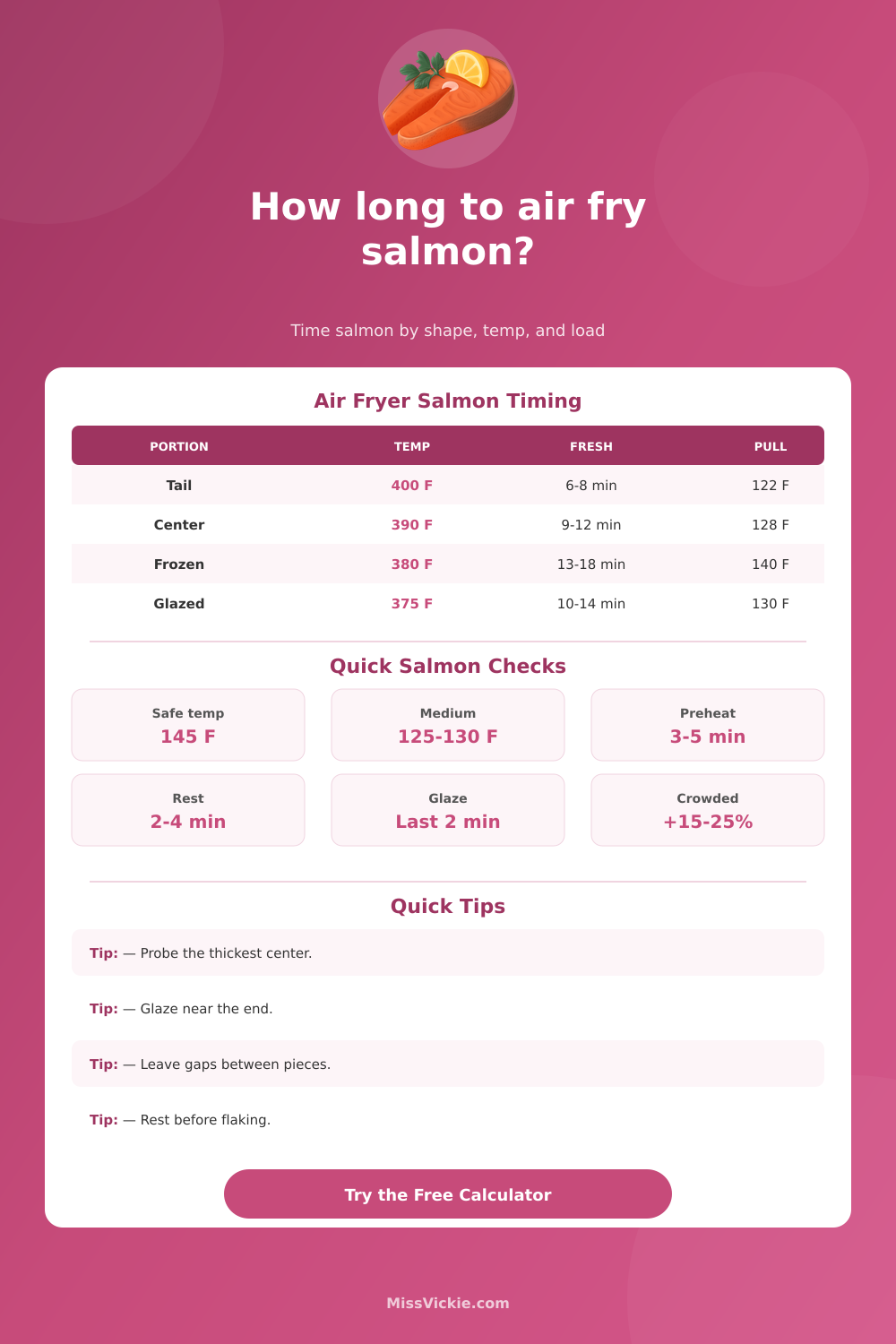
Best at 390 to 400 F with an early probe because the tapered end dries first.
Needs a longer center cook and a gentler pull temperature for moist flakes.
Large pieces may brown on top before the middle catches up, especially on trays.
Small cubes cook quickly and need turning so corners do not over-brown.
🍴 Air Fryer Salmon Timing Table
| Salmon Setup | Typical Temp | Fresh Timing | Best Check | Notes |
|---|---|---|---|---|
| Thin tail, 0.5 to 0.7 inch | 390 to 400 F | 6 to 8 minutes | At 5 minutes | Protect the thin end with oil and pull early. |
| Even portion, 0.8 to 1 inch | 385 to 400 F | 8 to 11 minutes | At 7 minutes | Skin side down works for most baskets. |
| Center-cut block, 1.1 to 1.4 inches | 375 to 390 F | 10 to 14 minutes | At 9 minutes | Lower heat helps the middle finish without harsh edges. |
| Frozen raw portion | 370 to 385 F | 13 to 18 minutes | After 10 minutes | Season after frost melts; separate pieces if stuck. |
| Salmon bites or cubes | 390 to 400 F | 5 to 8 minutes | At 4 minutes | Turn once and avoid sticky glaze until the end. |
🔥 Basket Load And Airflow Table
| Basket Setup | Time Effect | Texture Effect | What To Do |
|---|---|---|---|
| Open single layer with gaps | Baseline | Best top browning | Use the calculator result as written. |
| Edges touching | Add about 8% | Paler sides | Rotate pieces after the first check. |
| Full basket, limited gaps | Add 15 to 25% | Steamier finish | Use a lower temp and probe carefully. |
| Air fryer oven tray | Add 8 to 15% | Gentler bottom heat | Preheat the oven style fryer fully. |
| Split into batches | Per-batch baseline | Most even | Cook fewer pieces at once for better surface color. |
🧈 Skin, Glaze, And Doneness Table
| Choice | Timing Change | Best Practice | Pull Cue |
|---|---|---|---|
| Skin-on, skin side down | Slightly steadier | Oil the skin and avoid moving early. | Top flakes but center is glossy. |
| Skinless portion | Check earlier | Oil the basket or use perforated parchment. | Edges separate with a fork. |
| Honey or teriyaki glaze | Lower heat or delay glaze | Brush during the last 1 to 3 minutes. | Glaze bubbles, not blackens. |
| Miso or yogurt marinade | Moderate heat | Wipe off heavy excess before cooking. | Surface browns evenly. |
| FDA safe minimum | Longer finish | Cook to 145 F and rest briefly. | Opaque center with firm flakes. |
Timing is an estimate. Use an instant-read thermometer for the safest result, especially with frozen pieces, thick center cuts, and crowded baskets.
💡 Air Fryer Salmon Tips
It’s Tuesday night; you want dinner fast and you want it to taste like something a chef made. Rubbery? No, thank you. You pull some salmon out of freezer, but you also want it crispy. The air fryer promises speed and crispiness in equal measure. The air fryer promises to deliver both, speed, and crisp… But most people use it as if it were nothing more than an oven with a fan. This typically result in a cold center and dry edges.
Knowing how heat travels through fish can mean the difference between a meal you’re proud to put on the table, and one you end up eating standing up over the sink. Not all salmon are equal. Because it’s just salmon, there are certain pieces that is thicker or thinner than others. There’s more or less mass for the hot air to reach, so a thin tail piece may only need half as much cooking time than a chunky block of center cut.
How to Cook Salmon in an Air Fryer
If you throw them in oven together at the same temp for the same amount of time, one comes out perfect while the other turn into mush. By defining the real-world geometry of your portion (it lets you tell it what shape and thickness), the calculator up top help you work that out. Why? Those physical characteristics determine how quickly heat reach the center. A tapered, uneven-shaped piece has a hot side and a cold side, so that needs a slightly different approach different than something more uniform like a rectangle.
Thickness is the most important variable. A half-inch slice will cook through before you even finish chopping vegetables for your side dish; meanwhile, a two-inch thick filet requires some time for the heat to reach the center without burning outer edges. This adjustment saves you from guessing how your specific cut fits into the general rule of ‘a minute per inch.’ It is better to know what you’re dealing with than to assume all fish are the same and hope a ten-minute window works.
There’s also the question of doneness: Where do you stand? The FDA says that fish should be cooked to 145 degrees Fahrenheit, at this point, it will be solid and opaque. Home cooks often like theirs medium (think: still moist and translucent on the inside), about 125 degrees. To accommodate your preferred doneness, the calculator let you pick a target temp, adjusting the pull time accordingly. It factors in any carryover cooking so that when the fish comes out of the basket, it continues to rise to the temperature you specified.
More people than I’d like to admit don’t understand that basket load does matter. Piling in 4 portions on one layer will cramp them together so that they block airflow. That’s not what an air fryer is supposed to do! It circulates hot air all over the surface of whatever’s inside. So when items are touching or overlapping, instead of roasting, they end up steaming themselves, resulting in a pale and soggy exterior while being cooked through the middle.
The calculator takes account of how many portions you’re cooking at once, and whether they’ll sit in the basket separately from each other. If you cram them in, it adjusts the estimated time upwards, because cramming results in less efficiency. Then there are all those glazes. Teriyaki and other sweet sauces burn easily over high heat. Brushing them on early typically leads to a burnt, bitter crust because the fish take time to cook all the way through.
A better approach is to cook salmon mostly plain at first, and brush on your glaze(es) during the last few minutes. If you intend on slathering something sticky, the calculator knows to suggest when to apply the glaze. That way, the outside doesn’t get scorched before the inside has warmed up.
You can cook the salmon frozen; no need to thaw. Just make sure you give it some extra time and drop your temp down a bit. If you use high heat with frozen fish, you will just form a crust. This will insulate the inside, which stays icy cold. By starting lower, you let the ice start melting and evaporating slowly. When you choose to start frozen, the tool adjusts for you. It’s one of those little tweaks that keeps the outside moist as it waits for the inside to defrost.
Texture is key and resting the fish is not negotiable. Salmon will keep cooking after coming off of the heat source (yes, just like steak). If you flake it while it is hot, all of those juices will run out and you’ll have no flavor; let it rest for a couple of minutes so they redistribute. This rest time is factored into the total time on the calculator so you know exactly how long everything needs to finish up and be ready to serve with your side dishes.
Time matters almost as much as temperature. So how do you cook salmon in an air fryer? You need patience and you need to know when to apply more heat. That’s the balance, wanting a crisp outside but not at the expense of tender flesh inside. Accounting for thickness, load size, and desired doneness makes it easy.
You can eliminate all guesswork by plugging in your numbers and letting the calculator above figure out the rest. Now go enjoy some dinner, with fish treated with respect rather than rushed. And your guests will know the differance.