Air Fry vs Deep Fry Time Calculator
Convert a known deep-fry time into an air-fryer plan with category, piece thickness, fryer temperatures, preheat, loading, flipping, oil spray, frozen or fresh state, crispness target, and a manual conversion delta.
🍳 Conversion Presets
Each preset loads a complete comparison: the original deep-fry time and temperature plus the air-fryer setup that changes the final estimate.
🌡 Deep-Fry Recipe And Air-Fryer Setup
Air-fryer conversion
Estimate appears after calculation.
Conversion Inputs
Method Comparison
📊 Air-Fry Conversion Snapshot
📋 Food Category Reference
| Food category | Typical deep fry | Air-fryer target | Conversion behavior |
|---|---|---|---|
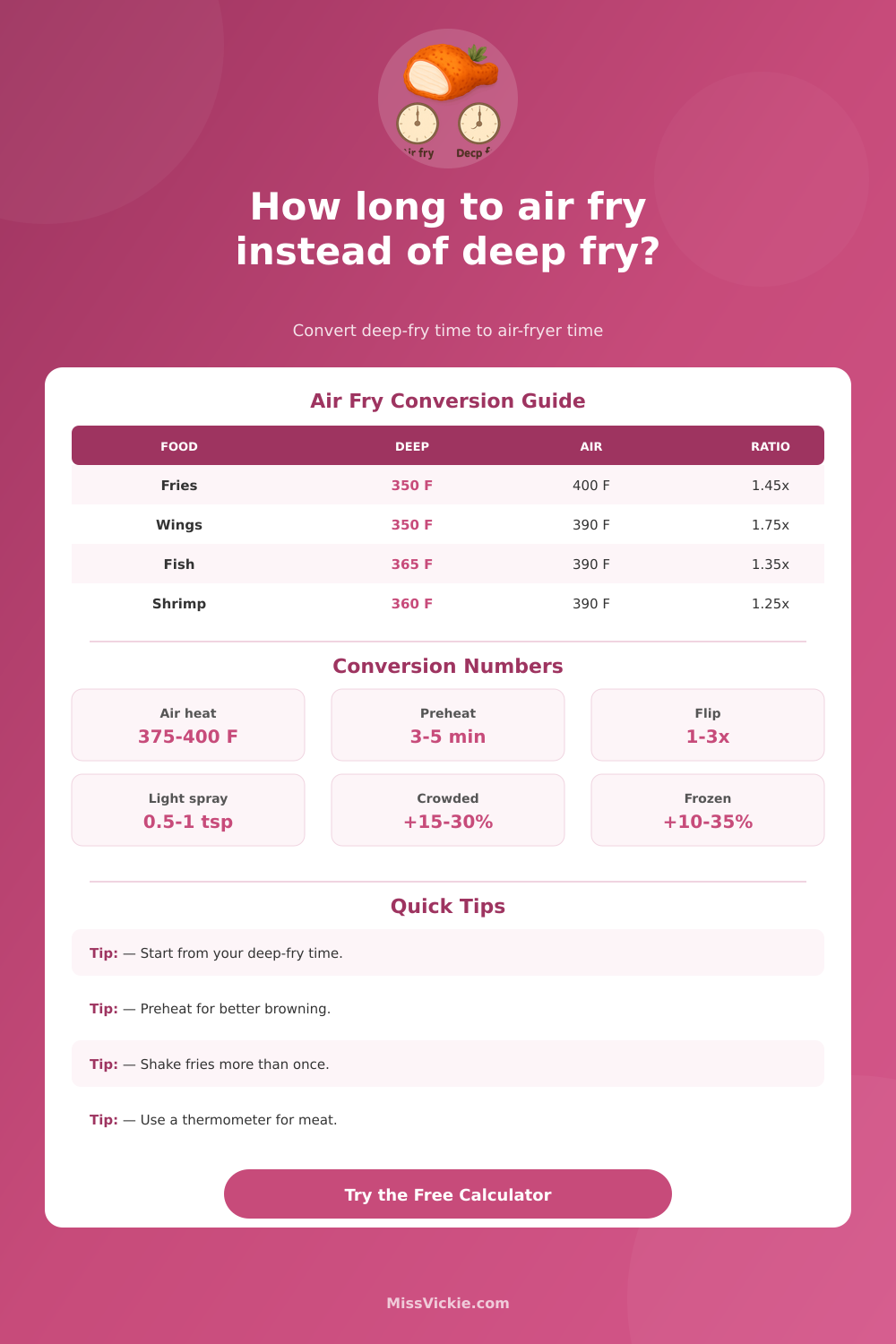
| French fries or wedges | 350 to 365°F for 3 to 8 min | 390 to 400°F | Air time is longer; shakes matter more than oil temperature alone. |
| Chicken wings | 350°F for 8 to 12 min | 380 to 400°F | Air frying renders skin slowly, so time can nearly double. |
| Fish fillets | 360 to 375°F for 3 to 6 min | 380 to 390°F | Thin fish converts well, but fragile breading needs light spray. |
| Shrimp | 350 to 365°F for 2 to 4 min | 385 to 400°F | Small pieces convert quickly; avoid overcooking the center. |
| Chicken tenders | 350°F for 4 to 6 min | 385 to 400°F | Air frying needs a center-temperature check on thick tenders. |
| Onion rings | 365 to 375°F for 2 to 4 min | 375 to 390°F | Air frying crisps edges well if the rings do not overlap. |
The ratios are starting points, not food-safety guarantees. For poultry, pork, and seafood, verify doneness with a thermometer or visual doneness check appropriate to the food.
🌡 Method Temperature And Time Multiplier Table
| Food group | Deep-fry temp | Air-fry temp | Time multiplier | Oil spray | Crispness target |
|---|---|---|---|---|---|
| Thin fries | 350 to 365°F | 390 to 400°F | 1.35x to 1.55x | Light mist | Golden edges, tender center |
| Chicken wings | 350°F | 380 to 400°F | 1.65x to 1.90x | Light mist | Rendered skin and 165°F minimum |
| Breaded tenders | 350°F | 385 to 400°F | 1.45x to 1.70x | Even mist | Dry coating and 165°F center |
| Fish fillets | 360 to 375°F | 380 to 390°F | 1.25x to 1.45x | Light mist | Flaky center, coating not scorched |
| Shrimp | 350 to 365°F | 385 to 400°F | 1.15x to 1.35x | Light mist | Opaque center before edges toughen |
| Cheese sticks | 350 to 360°F | 360 to 375°F | 1.10x to 1.30x | None | Melted middle before cheese leaks |
🧺 Basket Loading And Flip Guide
| Air-fryer setup | Time impact | Flip or shake target | Texture note |
|---|---|---|---|
| Loose single layer | About 5% faster | 1 flip or shake | Best airflow and most even browning. |
| Normal single layer | Baseline | 1 to 2 flips | Good everyday conversion for most foods. |
| Full basket | Add 8 to 15% | 2 to 3 shakes | Works for fries, less ideal for breaded meat. |
| Crowded pieces | Add 15 to 25% | 3 shakes or split batch | Steam softens crust where pieces touch. |
| Stacked food | Add 25 to 35% | Shake often or split | Deep-fry timing converts poorly when air cannot circulate. |
🔄 Airflow, Fullness, And Shake Reference
| Basket fullness | Best food categories | Flip or shake | Time multiplier | Deep-fry comparison |
|---|---|---|---|---|
| Loose single layer | Fish, shrimp, cheese sticks | Flip once gently | 0.95x to 1.00x setup factor | Closest airflow match to oil coverage. |
| Normal single layer | Tenders, wings, pork cutlets | Flip once or twice | 1.00x setup factor | Most reliable deep-fry conversion baseline. |
| Full but flat | Fries, wedges, onion rings | Shake 2 to 3 times | 1.08x to 1.15x setup factor | Needs movement because air reaches fewer surfaces. |
| Crowded pieces | Fries only if needed | Shake often or split | 1.15x to 1.25x setup factor | Deep-fry times underpredict because food steams. |
| Stacked batch | Avoid for breaded meat | Shake 3+ times | 1.25x to 1.35x setup factor | Least like deep frying; split for crispness. |
🔁 Deep Fry vs Air Fry Tradeoffs
Hot oil contacts every surface, so browning and heat transfer happen quickly.
Hot air needs circulation, flipping, and surface oil to mimic a fryer crust.
A hot basket narrows the gap between deep-fried and air-fried results.
Oil spray improves color, but heavy oil can soften breaded coatings.
💡 Conversion Tips
Based off thickness, target crispness, and temperature, this calculator (above) transforms your previous deep-fry timing into air-fry timings. That’s why you’re using this thing: Because it does the numbers for you.
Air frying isn’t just replacing a timer with a dial, it’s about learning to manipulate heat. Deep frying submerges food in hot oil, which cook fast and evenly. An air fryer exposes food to hot air circulating all around it instead. Because oil and air conduct heat different, you end up with pale fries or dry chicken.
How to Use Your Air Fryer Calculator
Why does oil work? It is great at conducting energy and storing it (heat capacity). It transfers that heat right back to the outer layer of whatever you’re cooking. Air is so thin; it can’t soak into the coating as efficient. That’s why air fried foods typically take longer then the amount recommended on the package.
To make up for this, the tool include multipliers for various types of food. Small items like shrimp will just have a slight adjustment in cook time. Items with more bones (and therefore more material for the heat to pass through before hitting the fat) like bone-in wings almost double due to rendering fat effectivly.
Pick the original deep-fry time and temp, then choose your air fry setting. The system will adjust to compensate for things like how crowded your basket is or if you sprayed oil beforehand.
Air can’t circulate as well around crowded items; there are no air gap for the moisture to escape, and you get steamed-out crumb rather than crispy crust. You can choose the load style (loose single layer, stacked basket) on the calculator. If you select crowded, it will add a lot to the estimated cook time. This is because the appliance must work much harder to dry out all those surfaces it can’t reach.
This is a little thing, but it makes a big difference in how the cooked product feel: you’ll think you’re saving time by throwing two loads into one basket, but what you actualy have is soggier goods which still need to be made crispy again anyhow. Cook in smaller batches and let the air work on them.
But here’s something about air frying: Preheating is important. If the basket is cold, those initial several minutes will be spent heating it up, not browning anything. It’ll prompt you to answer how well you preheated, completely? Maybe somewhat? Not at all? Skipping this will result in a delay in the Maillard reaction, the process that makes food taste so good and get its golden-brown hue. So while your food may be cooked through, it won’t have any crispy exterior.
It is also helpful to lightly spray with oil, particularly on things like breaded foods that don’t have their own fat. Even in an air fryer, oil helps transfer heat, aiding in browning all parts of the coating evenly without burning.
And then there’s the crispness target setting, which allow you to dial into just how far you want to push the cook time. To get lighter-colored, more tender food, the calculator will trim down its estimate. For that deep-fry crunch, it’ll add on a good bit of extra time. That’s when the experimenting part kicks in, as each air fryer heats different and has different strengths of fans.
It’ll give you a starting point; your eyeballs must finish the job. Check if it is done around the end of the recommended time. For meats, use a meat thermometer to be safe, even if they look golden brown from the outside.
There are no hard and fast rules when it comes to converting your favorite recipes; it’s all about setting your expectations. Air frying will never replicate results from a vat of oil, but you can come pretty darn close. And most people won’t be able to tell the difference.
It’s all about airflow and patience. Know what goes into making this or that, and you’ll know how to cook intentionally instead of guessing. Give the heat time to work its way through, and you’re going to have some golden crust on your hands.