How Much Agar Agar per Cup of Liquid Calculator
Estimate agar agar powder per cup and for the whole batch using your target texture, liquid base, acidity, sugar level, alcohol, agar strength, and setting margin.
Pick a kitchen scenario to load realistic cup ratios, then fine tune the liquid and texture before cooking.
Full Agar Per Cup Breakdown
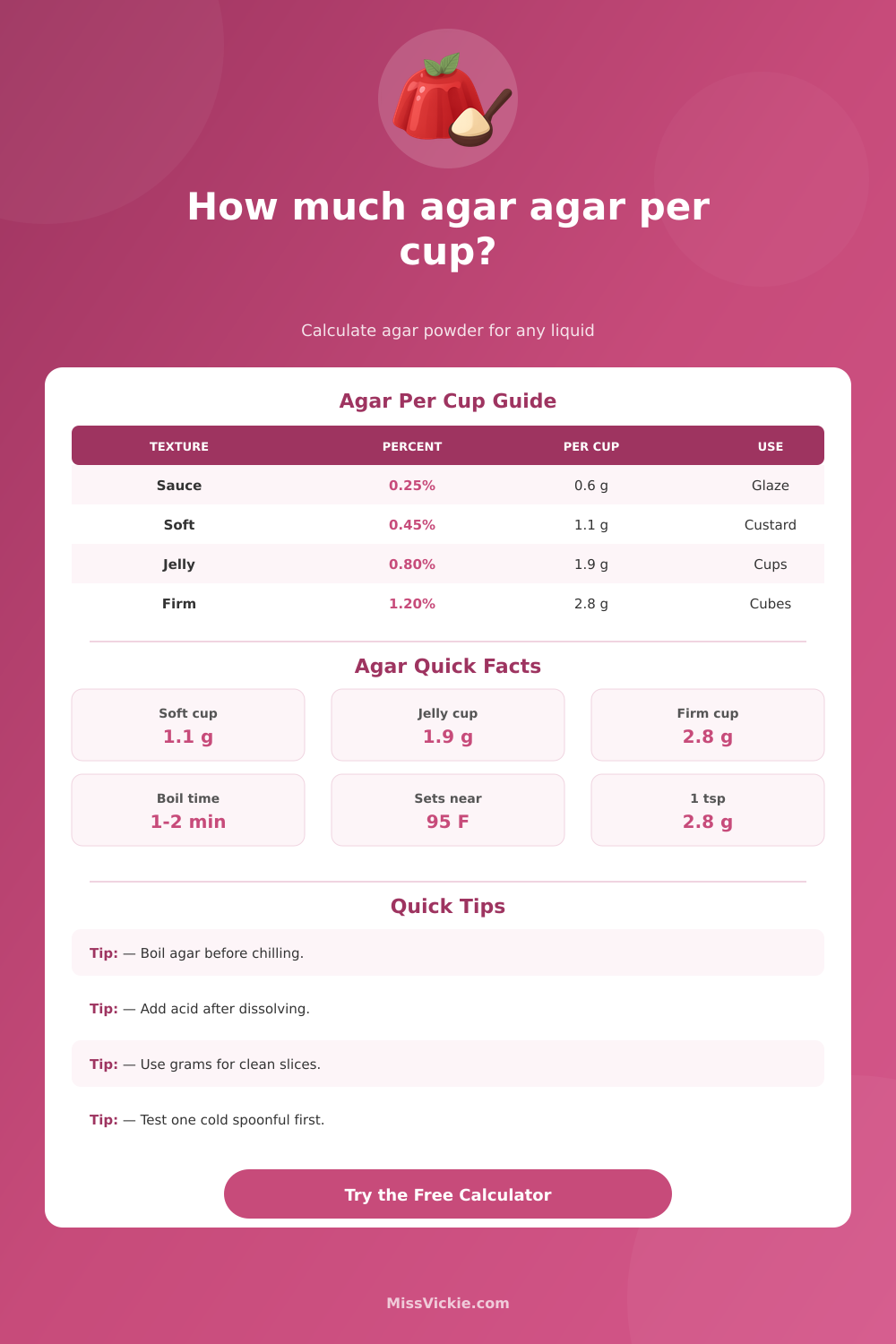
| Texture Goal | Agar Percent | Grams per Cup | Best Uses |
|---|---|---|---|
| Barely set sauce | 0.20-0.30% | 0.5-0.7 g | Fluid gels, light dessert sauces, thin glazes |
| Soft custard set | 0.35-0.55% | 0.8-1.3 g | Panna cotta-style cups, coconut desserts, spooned creams |
| Spoonable jelly | 0.65-0.85% | 1.5-2.0 g | Tea jelly, coffee jelly, fruit cups, layered desserts |
| Clean slice jelly | 0.90-1.10% | 2.1-2.6 g | Bars, molded desserts, neat plated slices |
| Firm molded gel | 1.15-1.40% | 2.7-3.3 g | Cubes, buffet trays, inserts, decorative molds |
| Extra firm sheets | 1.50-1.80% | 3.6-4.3 g | Agar noodles, sheets, firm savory gels |
| Liquid Base | Per Cup Behavior | Adjustment | Kitchen Note |
|---|---|---|---|
| Water, tea, clear juice | Cleanest gel | Base amount | Good for testing a new agar brand. |
| Fruit juice | Slight acid and sugar | Add 0-8% | Acidic juices may need a small cushion. |
| Coconut milk | Creamy, rich mouthfeel | Reduce 2-5% | Too much agar can make creamy cups brittle. |
| Fruit puree | Dense pulp weakens clean slices | Add 5-15% | Strain fibrous purees for smoother gel. |
| Wine or cocktail base | Alcohol slows structure | Add 8-22% | Keep the boil brief after alcohol is included. |
| Stock or broth | Sets clearly when strained | Base amount | Skim fat for a cleaner aspic texture. |
| Liquid Amount | Soft Set 0.45% | Jelly Set 0.80% | Firm Set 1.20% |
|---|---|---|---|
| 1 cup / 236.6 ml | 1.1 g | 1.9 g | 2.8 g |
| 2 cups / 473 ml | 2.1 g | 3.8 g | 5.7 g |
| 4 cups / 946 ml | 4.3 g | 7.6 g | 11.4 g |
| 6 cups / 1.42 L | 6.4 g | 11.4 g | 17.0 g |
| 8 cups / 1.89 L | 8.5 g | 15.1 g | 22.7 g |
| 16 cups / 3.79 L | 17.0 g | 30.3 g | 45.4 g |
| Spoon Measure | Approx Powder | Liquid It Sets | Accuracy Note |
|---|---|---|---|
| 1/8 teaspoon | 0.35 g | Half cup light set | Level the spoon carefully. |
| 1/4 teaspoon | 0.7 g | One cup loose gel | Good for tiny test batches. |
| 1/2 teaspoon | 1.4 g | One cup soft jelly | Close to many dessert cup ratios. |
| 1 teaspoon | 2.8 g | One cup firm gel | Powder density varies by brand. |
| 1 tablespoon | 8.4 g | About 4 cups jelly | Use grams for trays and molded desserts. |
Plant-based, sets at room temperature, and needs a full simmer to hydrate.
Animal-based and softer, with a melt that feels warmer and less brittle.
Best for fruit jams where sugar, acidity, or calcium match the pectin type.
Thickens fillings and sauces but does not make the same clean agar cut.
The amount of agar agar you use per cup of liquids will determine how the dessert set. The amount of agar agar you use will also determine how the dessert slices or wobble when you serve it. Using too little agar agar will prevent the dessert from set properly.
Using much agar agar will make the dessert turn into a rubbery block. The texture of the dessert depend on the exact gram of agar agar that you use in the liquid. Measuring the agar agar properly will give you the texture that you want for your agar agar dessert.
How to make agar agar set well
The type of liquid you use in your agar agar dessert will also determine how the agar agar function within that liquid. Using clear liquids will allow the agar agar to perform as it should. Using other liquids such as fruit juice will have the acidity and sugar content of the fruit impact the setting of your agar agar.
Using liquids such as coconut milk and dairy products will introduce fat and protein to your agar agar dessert. The fat and protein content of liquids such as coconut milk can soften the texture of your agar agar dessert. In this case, you will have to adjust the amount of agar agar that you use in your recipe.
Using alcohol in your agar agar dessert will slow the setting of the agar agar and weaken the structure of the agar agar. Therefore, if your recipe includes alcohol, you will have to use more agar agar in your recipe for the agar agar to properly set. The acidity and sugar content of the liquid you use will also change how the agar agar set into your dessert.
Using liquids with high acidity levels such as an pH level of around 3 will cause the agar agar to set very quick. However, the agar agar will become brittle once it has set. Sugar has a different effect than acidity.
Using high level of sugar will soften the agar agar structure. Therefore, you will have to increase the amount of agar agar that you use in your dessert. The goal that you use for your agar agar dessert will determine the amount of agar agar you use.
If you are making a mirror glaze, you will use a small amount of agar agar in your recipe. A mirror glaze has to be quite liquid. On the other hand, if you are making molded agar agar cube, you will have to use a large amount of agar agar so that the agar agar set properly into molded cubes.
Spoonable jellies will require a medium amount of agar agar. Spoonable jellies have to be firm enough to not fall apart when picked up with a spoon, but soft enough to allow for easy picking. Before you begin the recipe, determine if you would like your agar agar to behave as a sauce, molded agar agar cubes, or agar agar that will not need to be molded when setting out on the dessert table.
This will inform you of the proper amount of agar agar to use in your recipe. The size of the batch of agar agar that you prepare will affect how the agar agar sets within your dessert. If you are going from one cup of agar agar to several liters, the agar agar will not behave similar.
A large batch prepared in a large tray may require an extra amount of agar agar so that the edges of the tray of agar agar will set similarly to the center of the tray. Additionally, if you are preparing agar agar for a buffet setting where the agar agar may experience various changes in temperature, you may have to add extra agar agar to the batch so that the agar agar will not change in texture once served. Many people often confuse agar agar with gelatin.
However, agar agar and gelatin are not similar in their properties. Gelatin will melt at the temperature of the human body, whereas agar agar will set when it is much warmer then the body. Therefore, agar agar and gelatin cannot be used in the same percentages within the same dessert recipe.
Additionally, you must fully simmer agar agar before use to allow the agar agar to dissolve in the liquid, whereas gelatin does not have to be fully simmermed before use. If you do not fully simmer the agar agar before use, the agar agar will not dissolve and will not set properly once poured into the serving container. The best way to measure the agar agar is by weight.
Using teaspoons of agar agar is not accurate because a teaspoon of agar agar could contain a large amount of air or could be compacted together so that it takes up less than a teaspoon of space. Using grams will provide a more accurate and consistent measurement of the agar agar in your recipe. To test your agar agar, you can make a portion of your agar agar mixture and place a small portion of the mixture on a chilled plate.
This will allow you to determine the texture of your agar agar before you must make the entire batch of the dessert. Using this process, if the agar agar is too firm, you can heat it with some hot liquid to loosen it. If the agar agar is too loose, you can add more agar agar to the batch and simmer the mixture to allow the agar agar to properly dissolve.
Understanding how acidity, sugar, alcohol, and fat impact your agar agar will allow you to use agar agar successfully in your recipes. Although the calculator will help you to calculate the proper amount of agar agar needed by your dessert, you must understand the impact of acidity, sugar, alcohol, and fat on your agar agar dessert. Whether you are preparing a small amount or a large amount of agar agar dessert, the rules regarding acidity, sugar, alcohol, and fat are the same.