Tangzhong Calculator
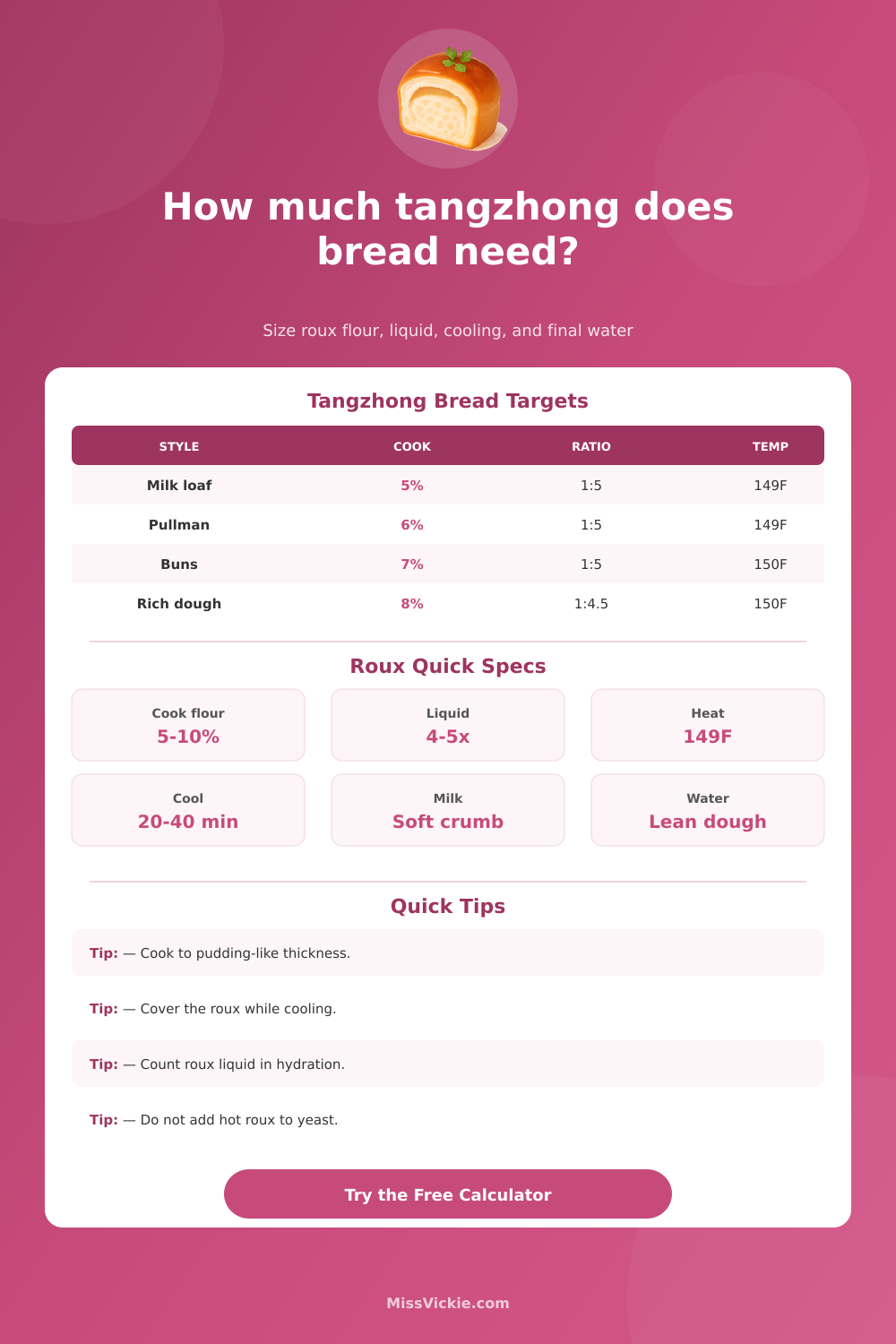
Scale a tangzhong bread formula by total flour, percent flour cooked, milk or water roux liquid, dough style, hydration adjustment, loaf count, roux temperature, cooling time, and final dough water.
Choose a loaf style to load practical starting values, then fine-tune the cooked flour percent, roux ratio, and final dough hydration.
Tangzhong Formula Breakdown
Mixing order
- Whisk flour and liquid cold before heating.
- Cook to 149 F, stirring until pudding-like.
- Cover and cool before adding yeast.
- Add the final dough water slowly during mixing.
| Dough style | Starting hydration | Cooked flour | Tangzhong liquid | Crumb goal |
|---|---|---|---|---|
| Japanese milk bread or shokupan | 64-68% | 5-7% | Milk at 1:5 | Feathery, shreddable slices |
| Pullman sandwich loaf | 60-64% | 5-6% | Milk or half milk at 1:5 | Square slices with fine grain |
| Burger buns and dinner rolls | 62-68% | 6-8% | Milk at 1:4.5 to 1:5 | Soft bite that stays moist |
| Sweet enriched bread | 64-72% | 7-9% | Milk at 1:4.5 | Tender crumb under sugar and fat |
| Whole wheat pan bread | 70-78% | 6-10% | Water or milk at 1:5 | Moist slices with less crumbling |
| Lean toast bread | 62-66% | 4-6% | Water at 1:5 | Open but sliceable sandwich crumb |
| Stage | What to watch | Temperature | Timing cue | Why it matters |
|---|---|---|---|---|
| Cold whisk | No dry flour pockets | Room temp | Before heat | Prevents lumps that stay in the dough |
| Gelatinizing | Whisk trails appear | 145-150 F | 1-3 minutes | Starch swells and holds extra water |
| Finished roux | Pudding-like paste | 149-153 F | Pull from heat | Avoids scorching milk and over-thickening |
| Covered cooling | Surface stays moist | Below 95 F | 20-40 minutes | Protects yeast and keeps hydration accurate |
| Final mix | Soft but elastic dough | Warm room | Add water gradually | Lets flour absorb before judging stickiness |
| Roux liquid | Water credit | Best for | Flavor effect | Adjustment tip |
|---|---|---|---|---|
| Whole milk | About 87% | Milk bread, rolls, buns | Richer and slightly sweeter | May brown faster because of milk solids |
| Skim milk | About 90% | Lighter sandwich loaves | Milk flavor with less fat | Use the same roux ratio as whole milk |
| Water | 100% | Lean toast and wheat breads | Cleaner wheat flavor | Often needs a little butter for softness |
| Half milk, half water | About 94% | Balanced everyday loaves | Soft but not very rich | Useful when dough already has egg |
| Egg-rich dough | Variable | Brioche-like breads | Rich, tender, yellow crumb | Add final liquid in stages |
Soft milk bread needs a lot of liquid to be plush once baked; bread dough can’t have endless amounts of water in it or else it will turn into soup. The solution is tangzhong, which pre-gelatinizes a bit of flour with some liquid before incorporating it into the rest. Starch granules swells up and capture additional moisture in that precooked paste, resulting in a tender final loaf rather than a dry one, even if total hydration level seems moderate on paper.
Once you know which percentage of your flour, or total amount of flour, you wish to cook, the calculator does the math. Home bakers generally fall between five and eight percent. Lower numbers keep the crumb well-structured for sandwich loaves. Higher numbers push the dough more toward the custardy state of Japanese milk bread.
How to Use the Tangzhong Calculator
That’s the ratio setting, the percentage of liquid to go with all that cooked flour. The classic pick is one-to-five. This creates a thick pudding that won’t leave visible streaks in the finished dough. Melts right in. Turns out liquid is also an important factor; far more than most assume. Lactose and fat in milk get cooked into browning more quickly (the brown part) and give it some subtle sweetness. Using water maintains a purer taste and is preferable if you’ll be including eggs/butter/etc. This happens later in the process.
Because of the built-in milk-water content, your total hydration value will remain correct (not gradually fall short). Are you switching midway through a mix from milk to water? The calculator tell you precisely what additional amount of final water is required to achieve desired dough consistency.
Another thing that throws bakers off is cooling time. Steam continues to escape as the hot roux cools. This can cause hydration problems because yeast will be killed on contact. It can also cause cooling problems because steam keeps coming off until it’s below about body temperature. The 20-40 minute window given by the calculator is generally enough for the roux to cool to a safe-mixing temp but not so long as to risk drying out the surface. To prevent this evaporation (which reduces your total liquid), cover the bowl while resting.
If you’re up to making more than one loaf, there’s even more scaling to consider. If you give it a number of loaves, the tool split your leftover water and roux in equal amounts across all pans. Every single pan gets the exact same percentage of cooked flour. This matters when you have things on both sides of oven at once. A slightly-rouxier loaf will puff sooner then its neighbor, and brown darker too; precisely what leads people to believe they have an uneven oven.
That said, the reason I have the reference tables on that page is primarily to provide a bit of context for those decisions. It will demonstrate typical ranges for final hydration, liquid ratio, and cooked flour based off the style of dough. Use them as guides not hard and fast rules. When you get a sense for why each input is there, you’ll be able to move the inputs around to fit your preference, climate, or type of flour and not feel like you’re just guessing.
Then there’s the moment when it all works again and again, week after week. That’s when the math becomes more than just a metaphor. You don’t even have to think about if the dough is too stiff or too wet anymore, because the calculator has figured out what you once scribbled into marginal notes and crossed out. It’s simply time for the bread, which emerges soft, and the whole thing no longer seems so mysterious.