Focaccia Hydration Calculator
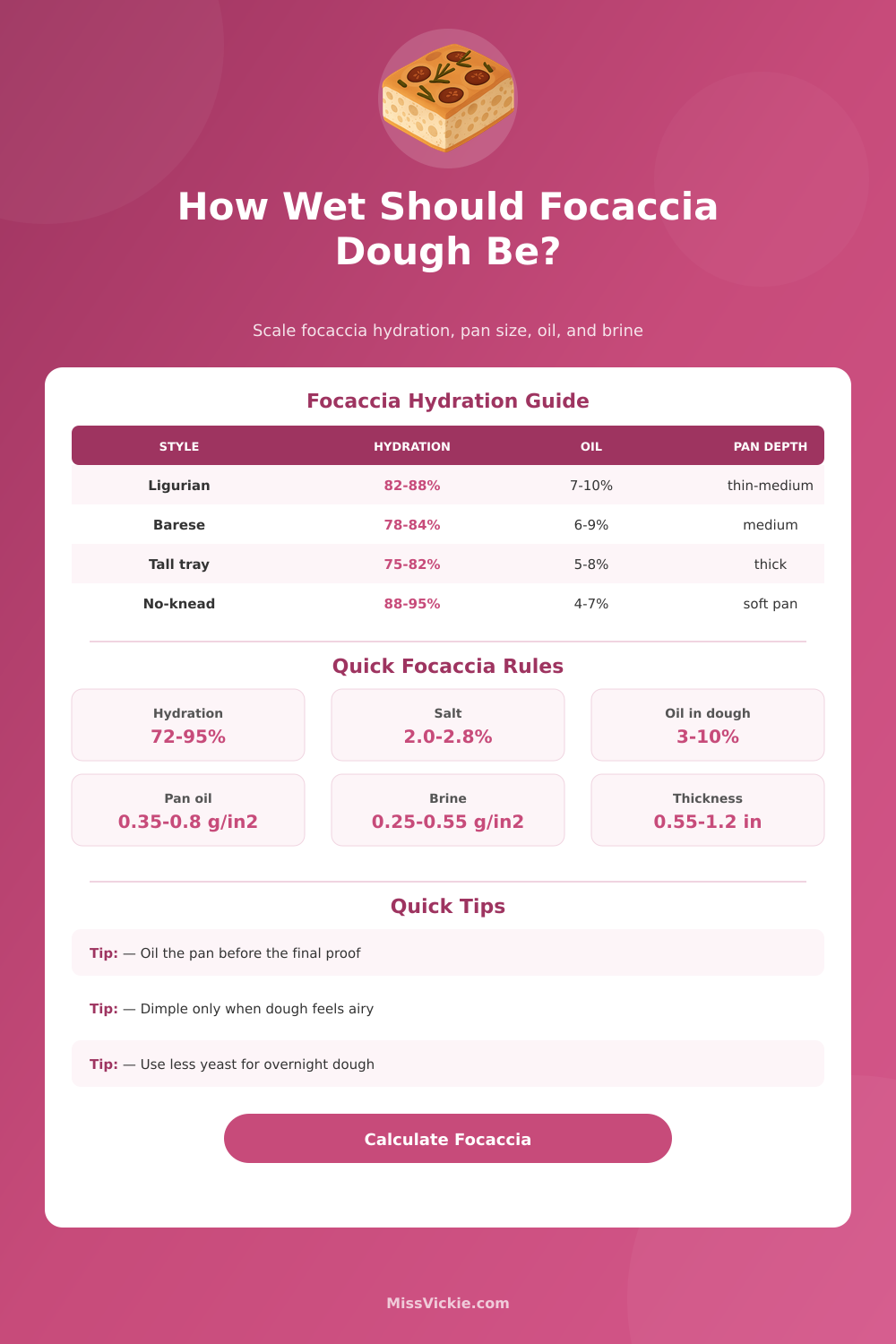
Build a complete focaccia formula from pan size and dough thickness: flour, water, oil, salt, yeast, fermentation timing, pan oil, dimpling oil, and salty brine.
Choose a style to load realistic dough weight per pan area, hydration, oil, salt, yeast, proof timing, and finishing liquid. Every value remains editable for your pan and schedule.
Formula Breakdown
| Hydration | Feel | Best method | What to watch |
|---|---|---|---|
| 68-74% | Soft but shapeable | Short mix, folds, easy transfer | Can bake bready if spread too thin or underproofed. |
| 75-82% | Classic wet focaccia dough | Stretch and folds with oiled hands | Needs enough pan oil to prevent sticking and dry edges. |
| 83-90% | Very extensible and bubbly | Coil folds, long rest, gentle pan proof | Do not add flour at shaping or the crust turns chalky. |
| 91-100% | Pourable, almost batter-like | No-knead tub folds and long fermentation | Works best with strong flour and careful dimpling. |
| Pan | Area | Thin slab | Medium focaccia | Tall squares |
|---|---|---|---|---|
| 8 in round skillet | 50 in2 | 300-360 g | 420-500 g | 560-650 g |
| 8 x 8 square | 64 in2 | 385-460 g | 540-640 g | 720-830 g |
| 9 x 13 quarter sheet | 117 in2 | 700-840 g | 980-1180 g | 1320-1520 g |
| 12 x 17 half sheet | 204 in2 | 1220-1470 g | 1710-2050 g | 2300-2650 g |
| 13 x 18 baker half sheet | 234 in2 | 1400-1680 g | 1960-2350 g | 2630-3040 g |
| Component | Typical rate | Calculator role | Flavor and texture effect |
|---|---|---|---|
| Oil in dough | 3-10% of flour | Included in dough weight formula | Tender crumb, richer flavor, slower drying, softer bite. |
| Pan oil | 0.35-0.8 g per in2 | Added outside dough total | Fried bottom crust, easier release, golden edge color. |
| Dimpling oil | 0.15-0.4 g per in2 | Surface finish before toppings | Glossy wells, aromatic surface, less tearing while dimpling. |
| Brine water | 0.25-0.55 g per in2 | Finish liquid, separate from hydration | Salty dimples, moist top crust, classic Ligurian texture. |
| Brine salt | 3-7% of brine | Separate from dough salt | Punchy surface seasoning without over-tightening dough. |
| Schedule | Instant yeast | Room time | Cold time | Best use |
|---|---|---|---|---|
| Same day fast | 0.6-1.2% | 3-5 hr | 0 hr | Weeknight focaccia when flavor is less important than speed. |
| Same day gentle | 0.3-0.6% | 5-8 hr | 0 hr | Good balance of flavor, bubbles, and predictable timing. |
| Overnight cold | 0.08-0.25% | 1-3 hr | 12-36 hr | Better aroma, easier digestion, strong pan proof control. |
| Long cold | 0.03-0.12% | 0.5-2 hr | 36-72 hr | Use strong flour, gentle folds, and a long warm final proof. |
Wet dough, generous olive oil, salty brine, light dimples, and a flexible medium thickness.
Potato or tomato-friendly dough that holds toppings while staying plush and moist.
Lower height and higher pan contact make a crisp appetizer-style sheet.
More dough per square inch creates lofty slices that can be split for sandwiches.
High hydration and time replace heavy mixing; use gentle folds and a well-oiled pan.
Bran absorbs more water, so the dough may need extra hydration and a longer rest.
Predictable pan coverage, sturdy squares, and moderate brine help the tray travel well.
Smaller area and stronger bottom heat reward a slightly lower hydration and plenty of oil.
Focaccia is a type of bread that sit between a standard bread and a flatbread. To make focaccia succesful, there is several different variables that must be managed. These variables include the size of the baking pan in which the focaccia is baked, the amount of olive oil that is included in the focaccia recipe, the amount of water that is included in the focaccia dough, and how long the focaccia dough ferment.
Many focaccia recipes is written to suit one specific size of baking pan. However, the recipe that is designed for one size of baking pan may not create the best result if a different size of baking pan is used. To ensure best results with any size baking pan, a focaccia recipe calculator can be use to adjust the recipe to any size baking pan that is desired.
How Pan Size, Water, Oil and Time Change Focaccia Bread
One of the variables for focaccia that is often measured is the hydration levels of the focaccia dough. The hydration level of focaccia bread is an indication of the amount of water present in the focaccia dough in relation to the amount of flour in the focaccia dough. The hydration level of focaccia will change the texture of the focaccia bread, as well as the way in which the focaccia dough should be handled.
For example, focaccia dough with seventy-five percent hydration will be soft to the touch yet still workable with oiled hands. However, focaccia dough with ninety percent hydration will behave more like a thick baking batter. High hydration focaccia bread recipes will produce focaccia bread with larger holes in the crumb structure of the focaccia, as well as a soft center to the focaccia bread.
Low hydration focaccia recipes, in contrast, will produce focaccia bread with a tighter crumb and a crust that stays crisp for a longer period of time. Olive oil is used in focaccia in two different ways. First, someone mixes olive oil into the focaccia dough to tenderize the crumb of the focaccia bread and to slow the staling process of the focaccia.
Second, someone places olive oil underneath the focaccia dough in the baking pan prior to pour the focaccia into the pan. This olive oil will fry the bottom of the focaccia bread during the first few minutes of baking. The olive oil underneath the focaccia dough will enable the focaccia bread to develop a nice color, as well as to release from the baking pan with which it was baked.
Each of these ingredients must be tracked separate from one another. Another ingredient that can be added to focaccia is brine. Brine is a mixture of salt and water that is poured over the focaccia bread prior to baking.
Adding brine to focaccia will season the focaccia bread, as well as ensure that the focaccia bread remain moist during the first few minutes of baking. By keeping the focaccia moist, the dimples that are created in the focaccia will hold their shape. If focaccia is prepared without using brine, the dimples may be shallow dents due to the drying of the focaccia during baking.
The process of fermentation is another variable in the baking process. Fermentation is the process of the yeast acting upon the focaccia dough. The length of time that the focaccia ferments will affect the flavor of the focaccia bread, as well as the digestibility of the focaccia.
For instance, a long rest of the focaccia dough at cold temperature will allow the enzymes in the focaccia to develop the strength of the focaccia. However, the final proofing of the focaccia in the baking pan may differ from the proofing of the focaccia in the refrigerator. A focaccia recipe calculator allows for the room temperature time and the cold fermentation time to be entered into the calculator, as each of these times can affect the focaccia in different manner.
The ingredients of focaccia, as well as the environment in which focaccia is prepared, can impact the results of the focaccia recipe. For instance, the strength of the flour is one ingredient in focaccia that can affect the results of focaccia. High protein flour will hold more water than other types of flour, such as all-purpose flour.
Additionally, another environment variable is the material of the baking pan. Steel pans will hold heat different than cast iron pans. Finally, the temperature of the kitchen can also affect focaccia.
For instance, focaccia dough may require more time to reach proofing when baked in a kitchen with a lower temperature than those where the focaccia dough reaches the proper proofing temperature. It is also important to visually observe the focaccia dough prior to baking it. If the dimples that are pressed into the focaccia dough spring back immediately after being press into the focaccia, the focaccia dough may require more fermentation time to reach the proper settings.
However, if the dimples remain flat after being pressed into the focaccia dough, the focaccia may have fermented for too long. Finally, watching the focaccia dough during fermentation is more important then establishing the target hydration level for the focaccia dough. By watching the focaccia dough, an individual can understand the requirements of the focaccia dough within that specific kitchen and at that specific time.