
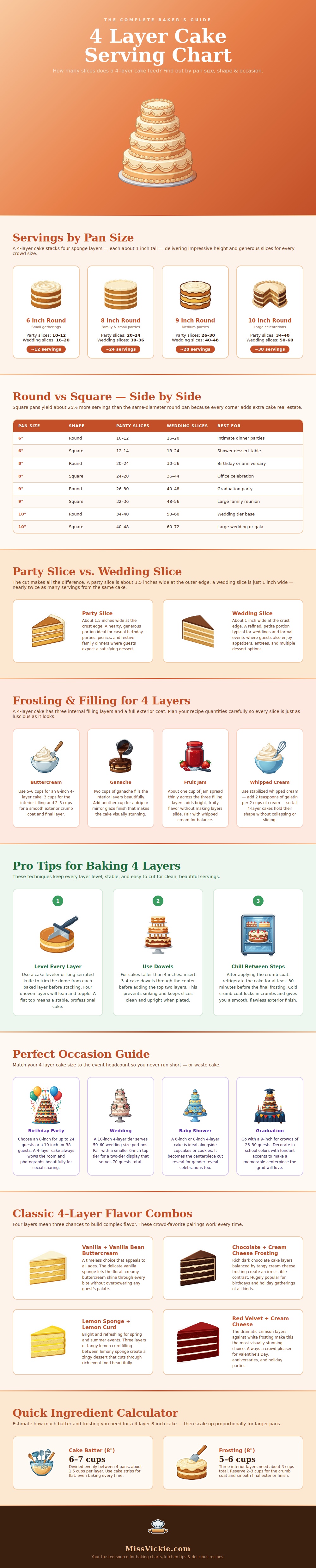
There’s one type of panic that strikes when you remember that your guest list have expanded since last Tuesday. You got out the flour. You preheated the oven. And now here you are: standing in kitchen, wondering whether or not there’ll be enough cake for all your guests (or too much?).
In such cases, planning trumps decorating. Sure, a four layer cake sounds fancy (but first things first); do the math before you stir up the batter. How does the pan size impact your yield? What’s the yield? This is where the serving chart comes into play. It explains it all, and it spares you the guesswork of counting guest by feel.
How to Plan Your Four Layer Cake
It’s a matter of how formal the event is and the shape of the slice. When you go to someone’s backyard for a birthday party, you’re not surprised when they serve a thick, one and a half inch-wide piece of cake with a generous crust. It’s a full meal, it’s filling, and it can be consumed on its own, the highlight of your evening.
Wedding receptions function on very different terms. The food has already been eaten: appetizers, salads, massive entrees. Instead of gorging on a single dish, people pick and choose, taking smaller pieces (typically only an inch across), while sampling multiple courses. This slight variation in size almost double the servings from the exact same wedding cake. It is a little tweak to accommodate a big issue.
Pan shape matters more than most home baker realize. Roughly speaking: Square pans of any given diameter produce about twenty-five percent more servings then the equivalent round pan. That’s because the corners retain extra cake, which wastes space (or must be shaved off) when baked in a round form. So if you’re baking to celebrate with your coworkers, and every bite counts, the square pan will provide you with more space for same amount of work. But if you’re hosting a romantic dinner party, well, there’s nothing quite as traditional or warm as the old round shape. Aesthetics vs. Efficiency is about what you prioritize.
When we get up to four layers, there’s an issue with stacking them: They’ll bend under their own weight (something that doesn’t happen in a two-layer cake). Weight is cumulative; every layer increase gravity’s pull until they all collapse together. Avoid this by leveling each dome, but don’t sit down yet, otherwise your cake will be as slanted as the Tower of Pisa. Use a cake leveler or even just a serrated knife to create flat surfaces that let the whole stack stand tall. This isn’t just for looks; it also allows for cleaner slices and ensures you get the right number of servings. The last thing you want when trying to feed Aunt Linda is to battle a collapsing tier.
Tall cakes require dowels. Insert three to four supports through the middle of the cake to distribute the weight so they don’t sink into the bottom layer. These also ensure the top layers won’t slide off when you transport the finished creation.
Another no-brainer: chilling the cake between each step of frosting helps lock in any loose crumbs. Then you’ll have a nice smooth final finish, not just patches glued on… And you’ll look like a pro!
The amount of frosting required depends on how tall the cake is (not necessarily its width). If you’re filling three layers inside and frosting it completely on the outside, you’ll want plenty. For buttercreams (like this one), expect five to six cups for an eight-inch four-layer cake. You will need only slightly more for jams or ganaches, which will provide a different texture instead.
Red velvet begs for something tart to balance its sweetness: cream cheese is the obvious choice; lemon curd cuts through richness beautifuly. Familiar comfort combinations like these are crowd pleasers, and can’t help but make you happy.
There’s something so hospitable in baking a four-layer cake. It’s an exercise in geometry and hospitality. You calculate the slices and reinforce the structure. The frosting goes on confidently. And then there it sits… A centerpiece. It is a celebration of the food without buckling under the weight of the meal itself.
The first slice emerges from your grasp, and you see the layers all hold firm and distinct. All the work paid off. You should of known it would be hard. It’s about more than just feeding people; it’s about being present.