MissVickie pizza dough math
00 Flour for Pizza Calculator
Calculate total 00 flour, blended flour, hydration water, salt, yeast, bench flour, and process loss from dough ball count, dough ball weight, pizza style, oven temperature, and fermentation plan.
🍕Choose a pizza dough preset
Each preset loads a practical 00 flour pizza profile. Adjust the ball weight, hydration, blend, protein strength, fermentation, oven temperature, bench flour, and loss afterward.
⚖Units and dough target
🧂Dough balls, flour, and fermentation
📊00 flour dough style reference
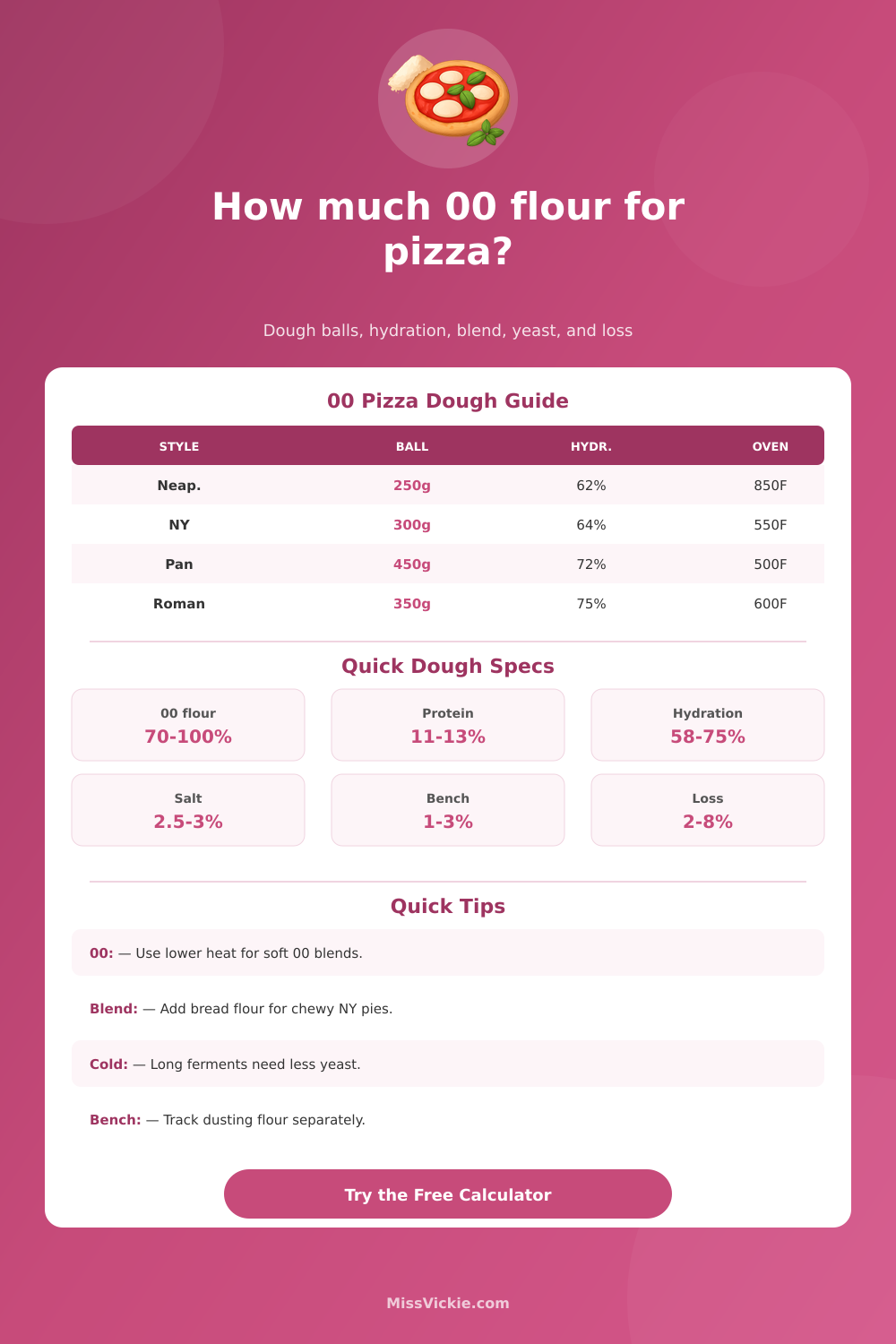
The reference ranges are practical kitchen targets. Flour brand, humidity, mixer friction, and oven heat can move the best number.
🍞Pizza style guide
| Pizza style | Typical ball | Hydration | 00 flour share | Oven target | Notes |
|---|---|---|---|---|---|
| Neapolitan 00 | 240-270 g | 58-64% | 90-100% | 750-950 F | Minimal oil and sugar; fast bake, soft rim, tender center. |
| Home Neapolitan-style | 250-300 g | 62-68% | 70-100% | 500-600 F | A touch of oil or malt can help browning in a home oven. |
| New York blend | 300-400 g | 60-65% | 40-70% | 525-650 F | Bread flour raises chew and helps slices hold shape. |
| Roman slab | 300-450 g | 70-80% | 50-90% | 550-700 F | Higher hydration and longer rest make an open, crisp crumb. |
| Pan pizza | 350-600 g | 68-78% | 30-80% | 450-550 F | Oil in the dough and pan drives tenderness and fry-like edges. |
| Thin crust | 180-260 g | 52-60% | 30-80% | 475-600 F | Lower hydration and more blend flour support crisp rolling. |
🧪Flour strength and blend guide
| Flour | Protein estimate | Best use with 00 | Blend effect | Hydration note |
|---|---|---|---|---|
| Pizza 00 flour | 11.5-12.8% | Neapolitan, tender crusts, high heat | Soft bite and extensibility | May feel slack if overhydrated |
| Bread flour | 12.5-13.5% | NY, home oven, longer bakes | More chew and structure | Can accept a little more water |
| All-purpose flour | 10.5-11.7% | Balanced home pizza blends | Moderates strong or tender flour | Keep hydration moderate |
| Whole wheat flour | 12-14% | Nutty flavor in small percentages | Absorbs more water, roughens gluten | Add 1-3 points hydration |
| Semolina | 12-13% | Small blend or bench dusting | Crunch, color, rustic bite | Needs rest to soften |
| High-gluten flour | 13.5-14.5% | Large NY slices, long cold dough | Strong chew and tolerance | Rest longer before opening |
⏲Fermentation and yeast reference
| Plan | Approx. time | Instant yeast % | Fresh yeast % | 00 flour note |
|---|---|---|---|---|
| Same-day room temp | 4-6 hours | 0.25-0.50% | 0.75-1.50% | Use moderate salt and watch dough temperature. |
| Overnight cold | 12-18 hours | 0.08-0.16% | 0.24-0.48% | Works well for 00 if dough is not too wet. |
| Two-day cold | 24-36 hours | 0.04-0.09% | 0.12-0.27% | Blend stronger flour if protein is under 12%. |
| Long cold | 48-72 hours | 0.02-0.05% | 0.06-0.15% | Salt and cold control extensibility and spread. |
| Sourdough 00 | 8-24 hours | starter only | starter only | Starter flour and water are included in formula totals. |
📝Bench flour, loss, and bake planning tips
Making pizza at home require a few different ingredient, and one of the essential ingredient is 00 flour. 00 flour is ground to be more fine than bread flour. Because 00 flour is ground up more fine, it change the way the dough works during the mixing of the dough, while it rests, and when it is stretched.
Using 00 flour will allow for a tender center to the pizza with a structured rim. However, the other ingredient must match the properties of the 00 flour. A calculator is helpful for adjusting the parameter of the pizza dough with 00 flour.
Make Pizza Dough with 00 Flour and a Calculator
A calculator is more efficient than using separate note to adjust the ingredient because all the variable for making pizza dough with 00 flour are displayed in one location. The input for the calculator are essential to understanding the variable that impact the dough in the kitchen and the oven. The weight of the ball of dough is essential to the pizza making process because it will determine the thickness of the pizza once it is baked.
The hydration level are essential to create dough with the proper amount of extensibility for the pizza. The percentage of 00 flour in the dough is essential because the 00 flour will impact the flavor of the pizza dough as well as the structure of the dough. Using 100% 00 flour will create soft dough, but adding bread flour will add chewiness to the dough that will allow it to hold the topping.
The fermentation length and the temperature at which the dough ferment are essential variable because they will impact the amount of yeast that is needed to activate the dough and the flavor of the pizza. The calculator can perform the calculation necessary for each variable once the ingredient are set. The calculator will save you and you’re kitchen from guesswork in the recipe for pizza dough using 00 flour.
Bench flour and handling loss is often overlooked when making pizza dough with 00 flour. Bench flour is the amount of flour used to dust the counter and the peel. This flour will not become part of the pizza dough.
If you do not account for bench flour in your recipe, you may find that you need to purchase more flour than you have accounted for. Handling loss can be caused by any portion of dough that stick to the mixing bowl or trimmings from the dough being shaped into ball. Additionally, any error in weighing the ingredient will contribute to the dough loss.
Allow a few percent for handling loss in your recipe. The calculator for 00 flour account for both bench flour and handling loss so that you will not run out of dough once you are ready to begin making your pizza. The temperature of the oven in which the pizza will be baked impact the type of pizza dough that should be used.
Very hot oven work best with lean pizza doughs that contain little oil or sugar. This allow the pizza to brown evenly. In lower-temperature oven, such as home ranges, it is necessary to use a small amount of oil or a small amount of sugar in the pizza dough so that it will brown evenly throughout the longer baking period.
There are two reference table on this page that include typical hydration and ball weight for different type of pizza. Use these table to determine whether your oven can perform the type of pizza that you are intending to make. The length that the dough ferment will change the amount of yeast that must be used in the dough.
Same-day dough ferment will require more yeast than overnight ferment because the dough will need more time for the yeast to activate and the flavor to develop. Additionally, same-day dough require careful control over the temperature of the dough so that the dough does not overproof. Ferment that occur overnight or over several day will require less yeast to activate the flour.
Additionally, the flavor will be deeper because the yeast will have had more time to interact with the flavor of the pizza. However, the flour will need to have a higher protein content than 00 flour so that the gluten will hold up over time. If using 00 flour with a low protein content, blend in another flour that is more stronger in protein content so that it can better hold the dough together when stretched.
The calculator adjust for the fermentation time to provide an estimate of the amount of yeast that should be used in the pizza dough. This amount can be adjusted with experience with the specific 00 flour and pizza oven. Common mistake when making pizza dough with 00 flour are changing one variable while leaving other the same.
If hydration is increased without increasing the bench flour, the dough may feel too wet when resting. If the fermentation time is increased without the adjustment of the amount of yeast, the dough ball may collapse during the shaping of the pizzas. Additionally, using only 00 flour with low-temperature oven baking will create a pale crust.
Prior to beginning to make the pizza dough, run the number through the calculator to determine the setting that will work best in your kitchen. Seeing how the different variable interact allow you to better prepare for the adjustment in the recipe. Use the calculator to plan the pizza dough rather than using it as a one-time calculator.
Once you have established your preferred weight of each ball of dough and your preferred fermentation schedule, you can use the calculator to determine the adjustment needed to make a batch of pizza dough for two or for twelve. The calculator will save you time by allowing you to avoid reentering the calculation for the recipes. The calculator will provide the total amount of flour, water, salt, and leaven that is needed to make the batch of pizza dough.
Additionally, it will provide the amount of bench flour that will be needed for your batch of pizza dough to allow for kneading the dough. With experience with the 00 flour and your kitchen and pizza oven, you will be able to determine which number is the most accurate. Using this calculator as a planning tool will turn pizza making into a repeatable process with the foundation of the pizza established before adding the ingredient.