🧀 Yeast Conversion Calculator
Convert between Active Dry, Instant & Fresh yeast — in teaspoons, tablespoons & grams
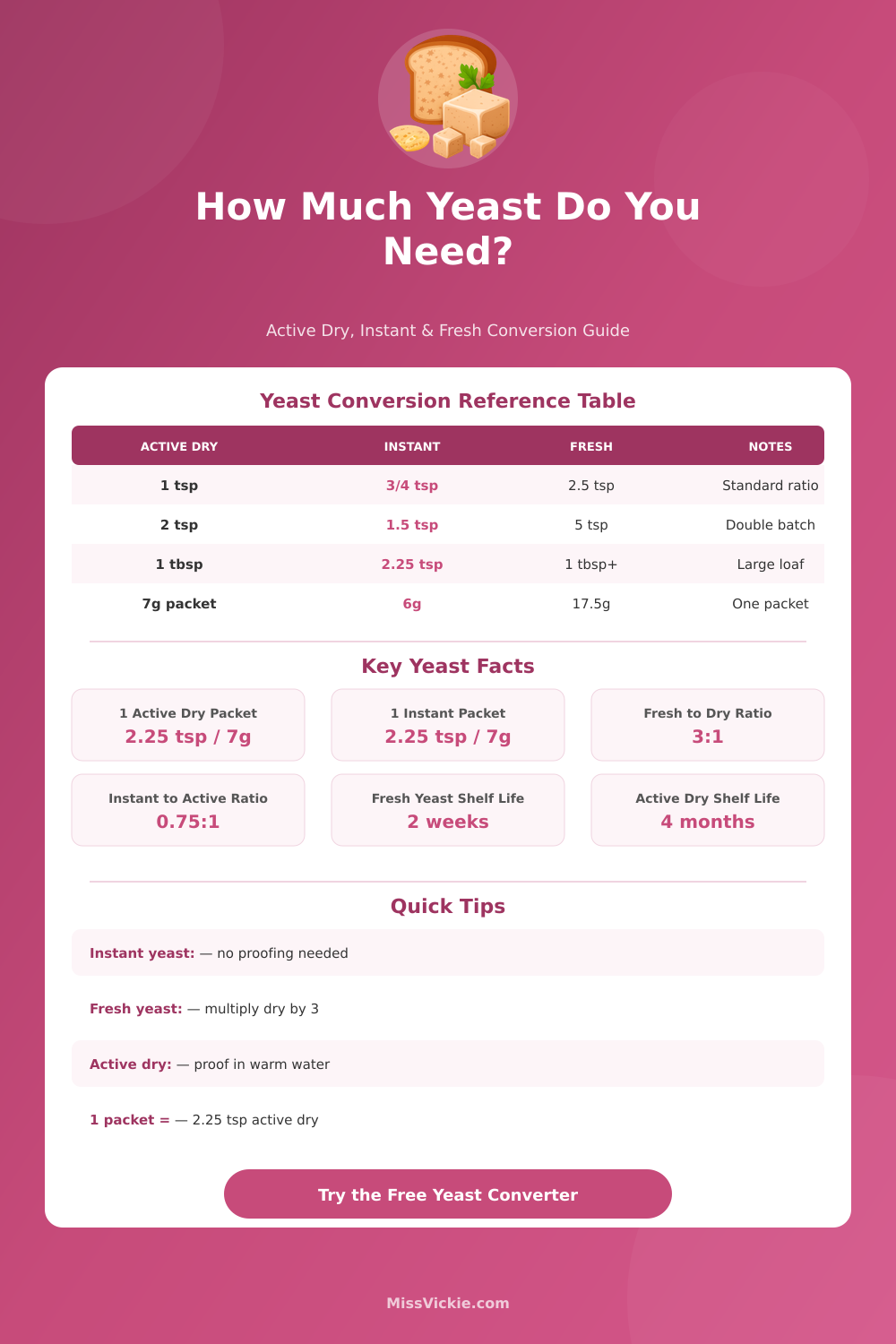
| Active Dry (tsp) | Instant (tsp) | Fresh (tsp) | Grams (Active Dry) | Packets |
|---|---|---|---|---|
| 0.5 tsp | 0.375 tsp | 1.25 tsp | 1.55g | 0.22 packets |
| 0.75 tsp | 0.56 tsp | 1.875 tsp | 2.33g | 0.33 packets |
| 1 tsp | 0.75 tsp | 2.5 tsp | 3.1g | 0.44 packets |
| 1.25 tsp | 0.94 tsp | 3.125 tsp | 3.88g | 0.56 packets |
| 1.5 tsp | 1.125 tsp | 3.75 tsp | 4.65g | 0.67 packets |
| 2 tsp | 1.5 tsp | 5 tsp | 6.2g | 0.89 packets |
| 2.25 tsp (1 pkt) | 1.69 tsp | 5.625 tsp | 7g | 1 packet |
| 3 tsp (1 tbsp) | 2.25 tsp | 7.5 tsp | 9.3g | 1.33 packets |
| 4.5 tsp | 3.375 tsp | 11.25 tsp | 14g | 2 packets |
| 6 tsp (2 tbsp) | 4.5 tsp | 15 tsp | 18.6g | 2.67 packets |
| Active Dry (g) | Instant (g) | Fresh (g) | Active Dry (tsp) | Packets |
|---|---|---|---|---|
| 1g | 0.83g | 3g | 0.32 tsp | 0.14 packets |
| 2g | 1.66g | 6g | 0.65 tsp | 0.29 packets |
| 3g | 2.5g | 9g | 0.97 tsp | 0.43 packets |
| 5g | 4.15g | 15g | 1.61 tsp | 0.71 packets |
| 7g (1 pkt) | 5.81g | 21g | 2.25 tsp | 1 packet |
| 10g | 8.3g | 30g | 3.23 tsp | 1.43 packets |
| 14g (2 pkts) | 11.62g | 42g | 4.5 tsp | 2 packets |
| 21g | 17.43g | 63g | 6.77 tsp | 3 packets |
| Measurement | Active Dry | Instant | Fresh |
|---|---|---|---|
| 1 packet | 2.25 tsp / 7g | 2.25 tsp / 7g | ~0.6 oz / 17g |
| 1 teaspoon | 3.1g | 3g | 8.4g |
| 1 tablespoon | 9.3g | 9g | 25.2g |
| 1 oz (28g) | 9 tsp | 6.75 tsp | 3.33 tsp active dry equiv. |
| Conversion factor | Base (x1) | x0.75 of active dry | x3 of active dry vol. |
| Proofing required? | Yes (5–10 min) | No | No (dissolve first) |
Fermentation is made up of a kind of fungus. This single-celled organism grows and spreads by budding or cell division. They are tiny organisms that have existed for tens of millions of years.
Currently one recognizes at least 1 500 species that form more than 1 % of all described fungal species. One finds them everywhere in the world, in the ground and on man-made surfaces especially in sugary places like nectar of flowers.
Yeast: What It Is and How It Helps Baking
The most famous species is Saccharomyces cerevisiae. Folks used it during thousands of years to prepare bread, beer and wine. Even one called that Yeast the first tamed organism.
Candida albicans is another species, harmful, that causes infections because of Yeast.
In bakery one uses Yeast as a rising agent. To work it requires sugar, space, heat and moisture. In warm and wet surroundings with food Yeast sits, starts feeding and spreading.
While it consumes sugar, a process called anaerobic fermentatoin starts. From that process results alcohol and carbon dioxide. Thanks to that gas the thick clumps of dough rise into a puffy loaf.
Yeast helps also as flavoring for dough and creation of tastes, giving rich flavors and nice smells.
For baking their exist some common kinds of Yeast. The active dry Yeast is the most used type, that one sells in grocery stores. It has a grainy form, similar to cornstarch.
That living thing stays sleepy, until one activates it or dissolves it in a bit of warm water. Fast Yeast is a bit stronger and mixes directly with dry ingredients. If one switches between those two, do not need to activate the fast kind like the other, so one must adjust the recipe for any liquid, that would serve for setting.
One knows fresh Yeast also as cube Yeast, pressed or moist. It sits somewhere between modern dried Yeast and the ancient sour dough. Fresh Yeast one can buy instead of grow at home, but dried kinds are so common now, that fresh Yeast seems truly outdated.
One trouble with fresh Yeast from groceries is, that its freshness often is doubtful because of slow sale.
In United States a normal packet holds two and half teaspoons of Yeast, what matches to a quarter ounce or seven grams. That amount stays same through almost all major brands in the supermarket. One packet widely covers a recipe with three to four cups of flour.
To check, whether Yeast is fresh and good, one lays it in warm water with a bit of sugar. If it foams up and grows in size after ten to fifteen minutes, thenYeast is good.