🪵 Wood Pellet Calculator
Calculate exactly how many bags or tons of wood pellets you need for your stove, insert, or boiler
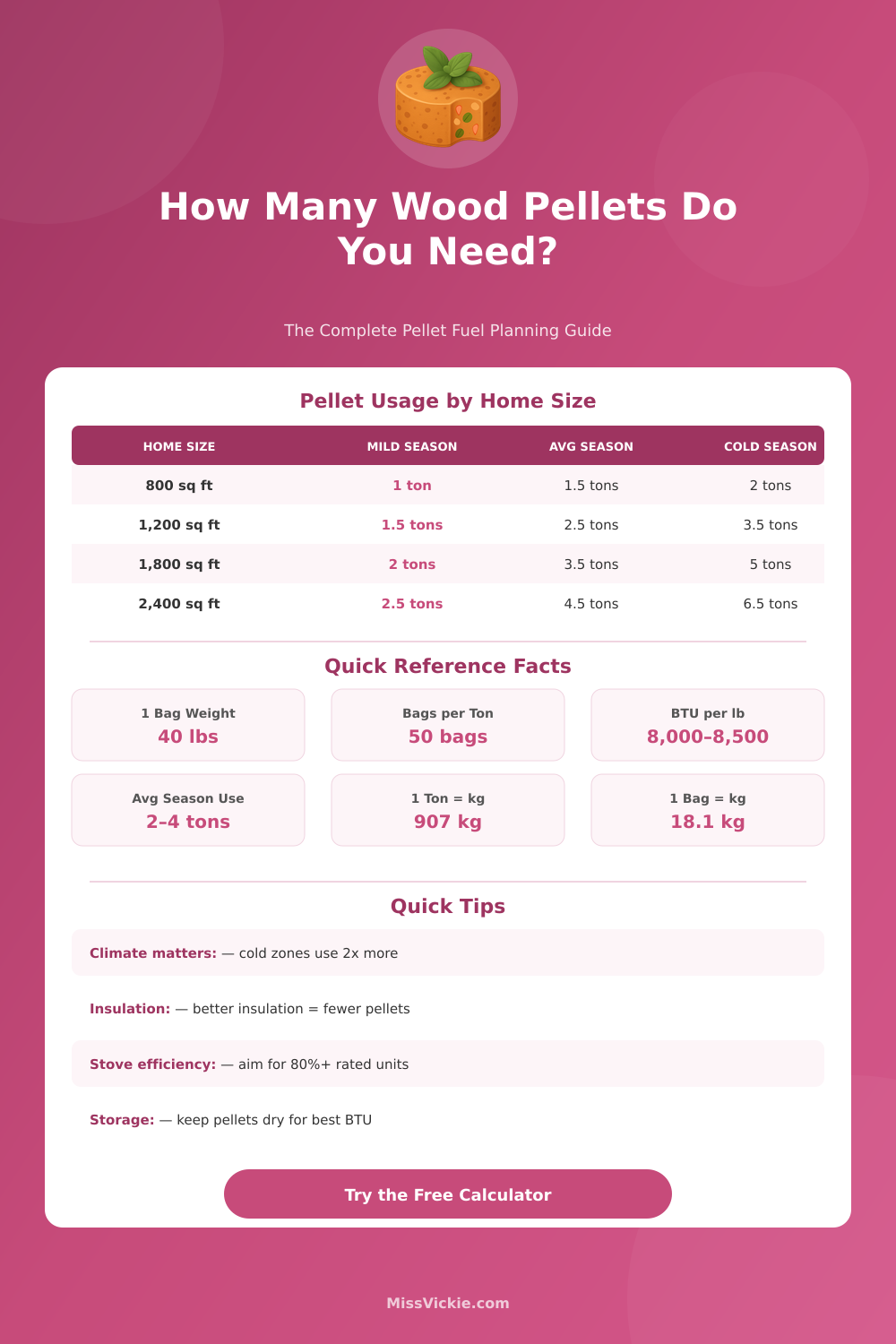
| Home Size | Mild Winter | Average Winter | Cold Winter | Very Cold |
|---|---|---|---|---|
| 800 sq ft (74 m²) | 1 ton / 50 bags | 1.5 tons / 75 bags | 2 tons / 100 bags | 2.5 tons / 125 bags |
| 1,200 sq ft (111 m²) | 1.5 tons / 75 bags | 2.5 tons / 125 bags | 3.5 tons / 175 bags | 4.5 tons / 225 bags |
| 1,500 sq ft (139 m²) | 2 tons / 100 bags | 3 tons / 150 bags | 4.5 tons / 225 bags | 5.5 tons / 275 bags |
| 1,800 sq ft (167 m²) | 2.5 tons / 125 bags | 3.5 tons / 175 bags | 5 tons / 250 bags | 6.5 tons / 325 bags |
| 2,400 sq ft (223 m²) | 3 tons / 150 bags | 4.5 tons / 225 bags | 6.5 tons / 325 bags | 8 tons / 400 bags |
| 3,000 sq ft (279 m²) | 3.5 tons / 175 bags | 5.5 tons / 275 bags | 8 tons / 400 bags | 10 tons / 500 bags |
| Measurement | Imperial | Metric | Notes |
|---|---|---|---|
| Standard bag weight | 40 lbs | 18.1 kg | Most US / Canadian bags |
| Bags per ton | 50 bags | 55 bags (metric ton) | 1 short ton = 2,000 lbs |
| BTU per pound of pellets | 8,000–8,500 BTU/lb | 18.6–19.8 MJ/kg | Premium hardwood pellets |
| BTU per ton (at 80% eff.) | ~13.5 million BTU | 14,230 MJ | Net usable heat |
| Pellets per heating hour | 1.5–3 lbs/hr | 0.7–1.4 kg/hr | Depends on stove setting |
| Average daily use (cold day) | 30–50 lbs | 14–23 kg | Full heating load |
| Pellets vs. heating oil equiv. | 1 ton ≈ 120 gal oil | 1 tonne ≈ 455 L oil | At equal efficiency |
| Pellets vs. natural gas equiv. | 1 ton ≈ 14,000 cu ft | 1 tonne ≈ 396 m² | Approximate equivalent |
| Climate Zone | Typical Region | Heating Degree Days | Pellets/1,000 sq ft |
|---|---|---|---|
| Mild | Southern US, Pacific Coast | < 3,000 HDD | 0.8–1.2 tons |
| Average | Midwest, Mid-Atlantic, UK | 3,000–5,000 HDD | 1.5–2.5 tons |
| Cold | Northern US, Northern Europe | 5,000–7,000 HDD | 2.5–3.5 tons |
| Very Cold | Canada, Alaska, Scandinavia | > 7,000 HDD | 3.5–5+ tons |
wood pellet fuel is made from biofuels, that come from packed wood fiber. In many places they are made mainly from leftovers of the process. The wood is cut while it is still fresh later it is packed in the form of pellets and dried in a boiler.
You do not need glue, because the high pressure through crushing triggers the lignin in the wood, that binds the pellets together. That wood pellet fuel offers a renewable and clean burning way to heat homes, using only broken wood waste.
Wood Pellets: What They Are and How to Use Them
wood pellet fuel helps the environment and makes only a bit of ash or smoke, what leaves behind only clean fire. The high BTU-value of the fuel means that you must use fewer pellets to heat a home. Sold in bags of 40 pounds, one bag is enough for around 24 hours of heat, depending on the home size and the use of the boiler.
An avreage 40-pound bag, lying on the floor, has rough measures of 27 by 18 by 5 inches.
All wood pellets have the same diameter, however the length ranges between 0.25 and almost 1.5 inches. A too dark color usually points out that bark was mixed during the making, and such pellets usually carry a lot of ash. To check the quality of pellets, you can look at the bag for dirty bits and dust.
In a 40-pound bag their should not be more than half a cup of dust at the bottom.
Some pellets mix hardwood and soft wood. For instance, good quality has around 80 percent hardwood and 20 percent soft wood, with an ash amount of about 0.56 percent. Soft wood in pellets usually burns with less ash and gives more heat than hardwood.
Shorter pellets sometimes heat more well than long ones, although you must use more material in the process.
Except for home heating, wood pellets are useful for grilling and smoking of foods. Barbecue pellets meant for foods are made from 100 percent hardwood without fillers, stuffings or chemical additives. Pellets from soft wood have more lignin and resin, what stops good cooking.
For grilling with pellets, hardwood is the best. Cherry gives a tender sweet fruity taste, that goes well with pork and birds, and it helps the meat reach a nice color. Hickory offers bold smoky flavors, that work for beef, pork and birds.
Apple leaves a sweet, gentle wood taste with light smoke.
Pellets work also where you would use wood chips, simply to add smoky taste. Use a layered packet with one punched hole up to help well. Douglas Fir is soft wood full of pitch and resin, what can give bad taste to foods.
Pellets for heating do not match those for foods, so it matters to choose the right type for the grill.
Storage is also important. If you keep them bad, pellets will not even light. The best way is to lay them in a closed bag inside a safe tin, in a cool and dry place.
Wood pellets also work as basic bedding for animals. The rules for making pellets sold as waste are actually more strict about toxic tests thanfor those used as fuel.