🍣 Fish for Sushi Per Person Calculator
Calculate exactly how much sushi-grade fish you need for any gathering
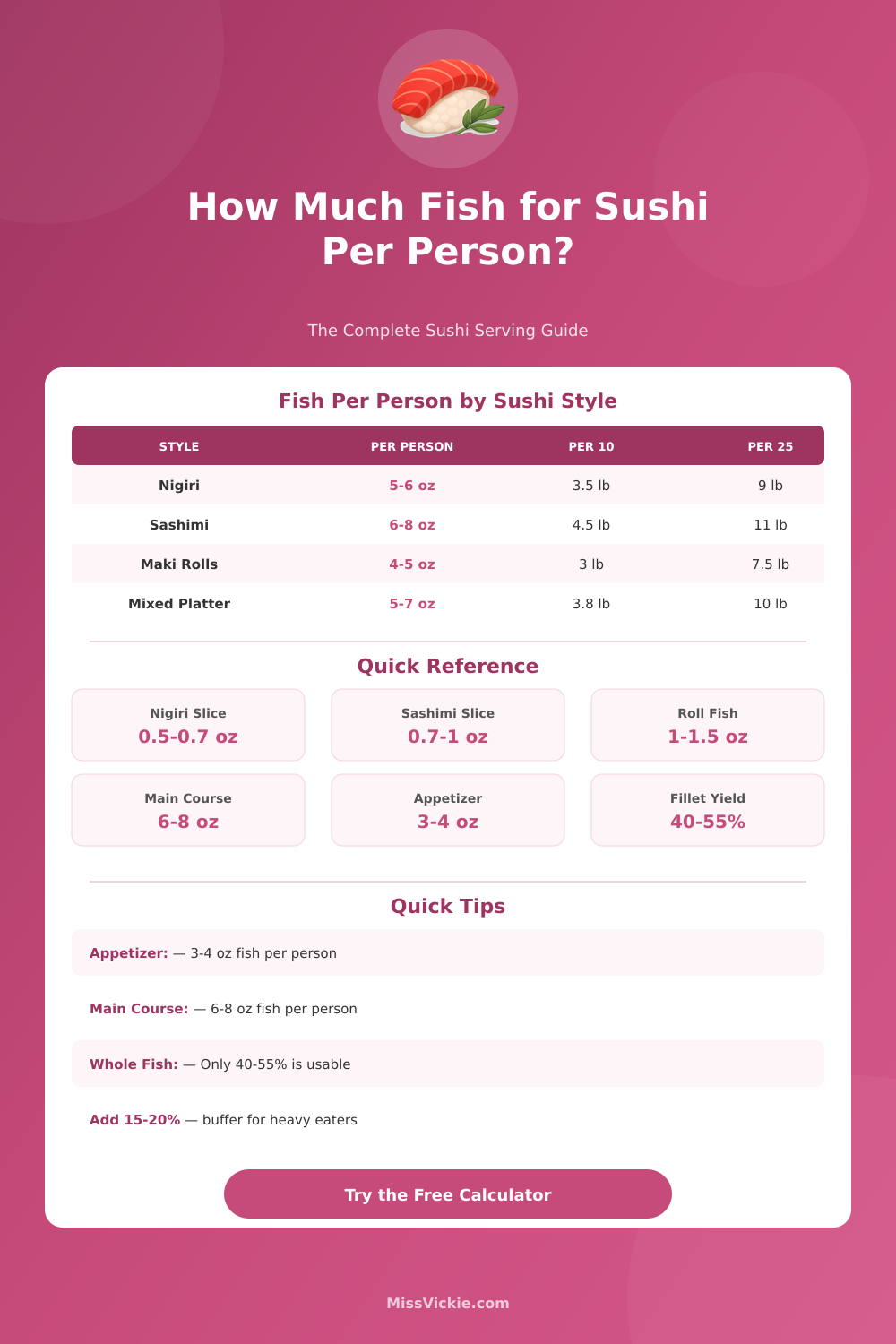
| Sushi Style | Appetizer | Main Course | Buffet |
|---|---|---|---|
| Nigiri | 2–3 oz (55–85g) | 5–6 oz (140–170g) | 3–4 oz (85–115g) |
| Sashimi | 3–4 oz (85–115g) | 6–8 oz (170–225g) | 4–5 oz (115–140g) |
| Maki Rolls | 1.5–2 oz (40–55g) | 4–5 oz (115–140g) | 2.5–3.5 oz (70–100g) |
| Mixed Platter | 2.5–3.5 oz (70–100g) | 5–7 oz (140–200g) | 3.5–4.5 oz (100–130g) |
| Fish Type | Fillet Yield | Saku Block Yield | Common Purchase Size |
|---|---|---|---|
| Salmon | 55–65% | 40–50% | 8–12 lb whole |
| Tuna (Yellowfin) | 55–60% | 45–52% | Loin: 5–15 lb |
| Yellowtail | 50–58% | 38–48% | 10–18 lb whole |
| Shrimp | 85–90% (peeled) | 80–85% (cleaned) | 2 lb bags (21–25 ct) |
| Snapper | 45–52% | 35–42% | 2–5 lb whole |
| Sushi Type | Fish Per Piece | Appetizer (pcs) | Main Course (pcs) |
|---|---|---|---|
| Nigiri | 0.5–0.7 oz (15–20g) | 4–6 pieces | 8–12 pieces |
| Sashimi | 0.7–1 oz (20–28g) | 5–7 slices | 10–15 slices |
| Maki Roll (6 pcs) | 1–1.5 oz (28–42g) per roll | 1 roll | 3–4 rolls |
| Hand Roll (Temaki) | 1–1.5 oz (28–42g) | 1–2 pieces | 3–4 pieces |
| Guests | Nigiri (Main) | Sashimi (Main) | Mixed (Main) |
|---|---|---|---|
| 5 | 1.7 lb (0.8 kg) | 2.2 lb (1.0 kg) | 1.9 lb (0.9 kg) |
| 10 | 3.4 lb (1.5 kg) | 4.4 lb (2.0 kg) | 3.8 lb (1.7 kg) |
| 15 | 5.2 lb (2.4 kg) | 6.6 lb (3.0 kg) | 5.6 lb (2.5 kg) |
| 25 | 8.6 lb (3.9 kg) | 10.9 lb (5.0 kg) | 9.4 lb (4.3 kg) |
| 50 | 17.2 lb (7.8 kg) | 21.9 lb (9.9 kg) | 18.8 lb (8.5 kg) |
In a typical sushi restaurant one served 8 to 12 pieces nigiri for one person as main dish with around 0.5 to 0.7 ounces (15 to 20 g) of fish each piece. Like this the whole amount of fish good for sushi reach 5 to 7 ounces (140 to 200 g) per person during full dinner, without counting the rice, nori sheets or side dishes.
Sashimi requires more fish for every guest, because it lacks the rice that helps fill the volume. For a main plate one cuts a typical sashimi portion from 6 to 8 ounces (170 to 225 g) of fish in 10 to 15 slices, each weighing around 0.7 to 1 ounce (20 to 28 g). As a starter the portions of sashimi drop to 3 to 4 ounces (85 to 115 g), or around 5 to 7 slices.
How Much Fish Do You Need for Sushi?
Between the three main kinds of sushi, maki-rolls require the least fish for person. A standard roll with 6 pieces holds 1 to 1.5 ounces (28 to 42 g) of fish. During a main plate plan 3 to 4 rolls for one guest, what gives 4 to 5 ounces (115 to 140 g) of fish.
As a starter one roll is enough, or around 1.5 to 2 ounces (40 to 55 g).
From whole salmon the output for sushi reaches 40 to 50% of fish from the original wait to well processed blocks for saku. 10 pounds (4.5 kg) of whole salmon give around 4 to 5 pounds (1.8 to 2.3 kg) of fish meat good for sushi. From whole leftover pieces the amount of usable material after removing spine and well sorting reach 78%.
Pre-cut blocks from fish shops deliver 90 to 92% of usable meat with little waste.
Yellowfin tuna bought as loin sections give 45 to 52% of blocks ready for sushi after removing the tendon and the blood line. Whole yellowtail (hamachi) delivers 38 to 48% of flesh good for saku. Shrimp is the most useful with 80 to 85% of usable product after cleaning, removing veins and butterflying.
For bigger groups: 10 guests that eat self-serve sushi as main dish require 3.5 to 4.4 pounds (1.6 to 2.0 kg) of good fish. With 25 guests that goes to 9 to 11 pounds (4 to 5 kg). For 50 guests during buffet with other non-sushi dishes available, the need of fish drops to around 12.5 to 14 pounds (5.7 to 6.4 kg) in total, because portions in buffet are 25 to 35% smaller than full main plate services.
Variety in appetite seriously affects the amounts. Light eaters eat around 75% of usual portions, so a 6-ounce main plate drops to around 4.5 ounces (128 g). Heavy eaters take 125% or more, meaning around 7.5 ounces (213 g) or even more. Children between 4 and 10 years usually eat 40 to 50% of an adult part, so around 2.5 to 3 ounces (70 to 85 g) of fish for a main plate.
One piece nigiri weighs about 0.9 to 1.2 ounces (25 to 35 g), where the fish topping forms 50 to 60% of the mass and the rice base 40 to 50%. Professional sushi cooks measure exactly 18 to 22 g of rice per piece nigiri. One cup (185 g) of raw sushi rice gives around 2.5 cups (420 g) of cooked, vinegar rice, quite a lot for around 18 to 22 pieces nigiri.
Japanese associations of restaurants suggest 150 to 200 g per person during omakase-style meals. Suppliers for buffets that have sushi as one of 4 to 6 protein options usually plan 2.5 to 3.5 ounces (70 to 100 g) of fish per person only for the sushi station.
For nutrition value, 6 ounces (170 g) of regular salmon deliver around 208 calories, 34 g of protein and 9.2 g of fat. Yellowfin tuna in the same amount gives 184 calories with 39 g of protein and only 1.6 g of fat. A 6-ounce serving of yellowtail has 212 calories, 33 g of protein and 8.1 g of fat.
Shrimp is the leanest with 144 calories, 28 g of protein, 2.5 g of fat and 1.5 g of carbohydrates for a 6-ounce part.
While one prepares a mixed platter with 3 different kinds of fish, expert sushi cooks usually share the fish weight as 40% main fish (commonly salmon or tuna), 35% secondary and 25% accent fish. That means around 1.6 pounds from the main fish, 1.4 pounds from the secondary and 1 pound from the third kind.