🌡️ Sous Vide Cooking Time Calculator
Get precise cooking times based on food type, thickness & doneness level
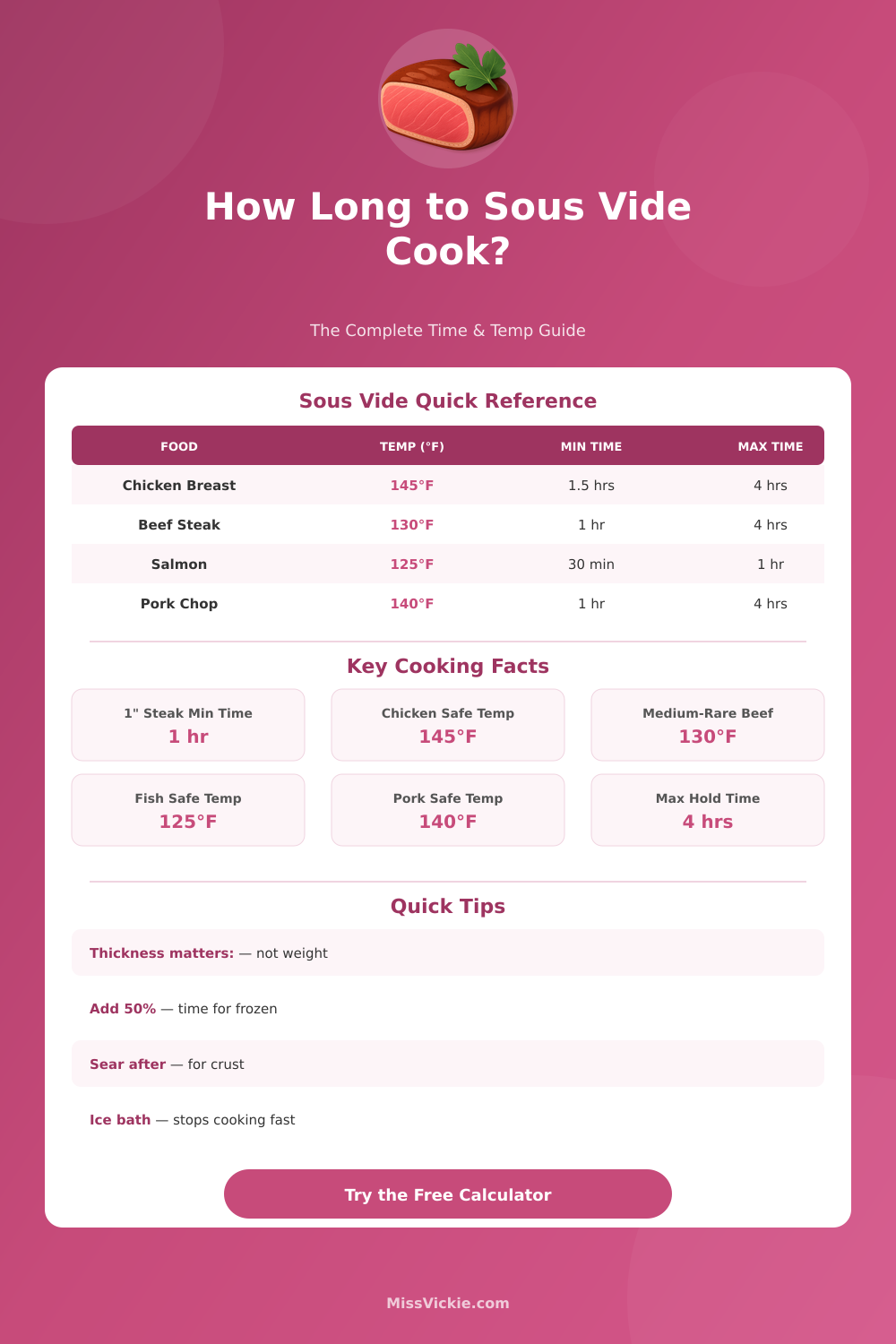
| Food | Doneness | Temp (°F) | Temp (°C) | Min Time | Max Time |
|---|---|---|---|---|---|
| Beef Steak | Rare | 120°F | 49°C | 45 min | 2.5 hrs |
| Beef Steak | Medium-Rare | 130°F | 54°C | 1 hr | 4 hrs |
| Beef Steak | Medium | 140°F | 60°C | 1 hr | 4 hrs |
| Beef Steak | Well Done | 160°F | 71°C | 1 hr | 3 hrs |
| Chicken Breast | Juicy / Safe | 145°F | 63°C | 1.5 hrs | 4 hrs |
| Chicken Thigh | Tender | 165°F | 74°C | 1 hr | 4 hrs |
| Pork Chop | Medium | 140°F | 60°C | 1 hr | 4 hrs |
| Pork Tenderloin | Medium | 140°F | 60°C | 1 hr | 3 hrs |
| Salmon | Silky | 125°F | 52°C | 30 min | 1 hr |
| Salmon | Flaky | 140°F | 60°C | 30 min | 45 min |
| Shrimp | Tender | 135°F | 57°C | 15 min | 30 min |
| Lobster Tail | Tender | 140°F | 60°C | 30 min | 1 hr |
| Lamb Chop | Medium-Rare | 130°F | 54°C | 1 hr | 4 hrs |
| Duck Breast | Medium-Rare | 135°F | 57°C | 1.5 hrs | 4 hrs |
| Beef Short Rib | Tender | 155°F | 68°C | 24 hrs | 72 hrs |
| Egg (Soft) | Runny Yolk | 167°F | 75°C | 13 min | 15 min |
| Egg (Poached) | Custardy | 145°F | 63°C | 45 min | 1 hr |
| Carrot | Tender | 183°F | 84°C | 1 hr | 3 hrs |
| Potato | Tender | 190°F | 88°C | 1 hr | 3 hrs |
| Thickness (in) | Thickness (cm) | Min Cook Time | Notes |
|---|---|---|---|
| 0.5 in | 1.3 cm | 20–30 min | Thin cuts, fish fillets |
| 1 in | 2.5 cm | 1–1.5 hrs | Standard steaks, chops |
| 1.5 in | 3.8 cm | 1.5–2 hrs | Thick steaks |
| 2 in | 5 cm | 2.5–3 hrs | Double-cut chops |
| 2.5 in | 6.4 cm | 3–4 hrs | Roasts, thick cuts |
| 3 in | 7.6 cm | 4–6 hrs | Large roasts |
| 4+ in | 10+ cm | 6–10 hrs | Whole birds, large roasts |
| °Fahrenheit | °Celsius | Common Use | Protein |
|---|---|---|---|
| 120°F | 49°C | Beef Rare | Beef |
| 125°F | 52°C | Beef Medium-Rare / Silky Salmon | Beef, Fish |
| 130°F | 54°C | Beef Medium-Rare / Lamb | Beef, Lamb |
| 135°F | 57°C | Duck, Shrimp | Duck, Shrimp |
| 140°F | 60°C | Beef Medium, Pork, Lobster | Beef, Pork, Fish |
| 145°F | 63°C | Chicken Breast, Egg Poached | Chicken, Egg |
| 150°F | 66°C | Pork Well / Chicken Thigh | Pork, Chicken |
| 155°F | 68°C | Short Rib / Brisket start | Beef (tough) |
| 165°F | 74°C | Chicken Thigh (tender) | Chicken |
| 183°F | 84°C | Vegetables (carrots) | Vegetables |
| 190°F | 88°C | Potatoes | Vegetables |
sous vide started from the French cooking world; the word itself means “under vacuum”. Here is how it works: you close food in a pocket, removing the air, then you put it in a water bath that you keep at a precise and steady temperature. The closed pocket stays away from the heat source and the food cooks slowly until it reaches exactly the doneness that you want.
Compared to usual ways of cooking, sous vide uses lower temperatures and requires more time. But why stretch the cooking time? That is the main advantage.
How Sous Vide Works and Why It Is Good
Frying in a pan or roasting in an oven commonly push the food past the right spot or leave it too raw. With sous vide the food slowly reaches the intended internal heat and simply stays there. No guessing, no crossing of fingers.
The results are always perfect, meal aftre meal.
The method itself is surprisingly easy. You set the wanted heat, the water warms until even, drop your sealed food and go. For instance, steak can cook at the perfect temperature for medium-rare.
What really shows its power, is the absence of need to watch. Put it in the morning, and by evening the main meal is ready, no watching, no reminders, no worry about it.
Many proteins all adapt well to this method. Pork, beef, seafood, birds. Name it, it cooks surprisingly well.
Chicken really is one of the biggest surprises hear. After it finishes in the water bath, fast frying in a warm heavy pan with butter or oil gives that nice crust and caramel flavor. Salmon also stands out, because sous vide escapes entirely the tough, overcooked texture, giving you full control over time and heat.
Big cuts also handle this method well. Rib roast, lamb legs, pork roast, turkey breasts, all of them come out perfect. The only real limit is the size of your container and whether your devices can handle so much space.
A Dutch oven commonly helps for that, and you always can use bigger ones for large parties.
This is not only a past trend in the kitchen. The technique existed almost from before 2000. Back then, starter systems cost too much, which kept them away from home cooks.
Folks who wanted to use it at home, communities formed to build homemade sous vide devices. Today the prices dropped a lot, so starting at home is no longer that financial obstacle thatit was before.
One big bonus is freeing your oven and having the food ready on your time. It shines for preparing big meals and serving many folks. The heat control quite well kills germs through pasteurizing, although that differs from sterilization.
Even so, leaving the meat too long can make it mushy, so count the time carefully. A dipping circulator beats a simple water bath for keeping steady heat and reducing swings of temperature.