🍞 Sourdough Starter Calculator
Calculate exact feeding ratios, hydration levels & flour/water amounts for your starter
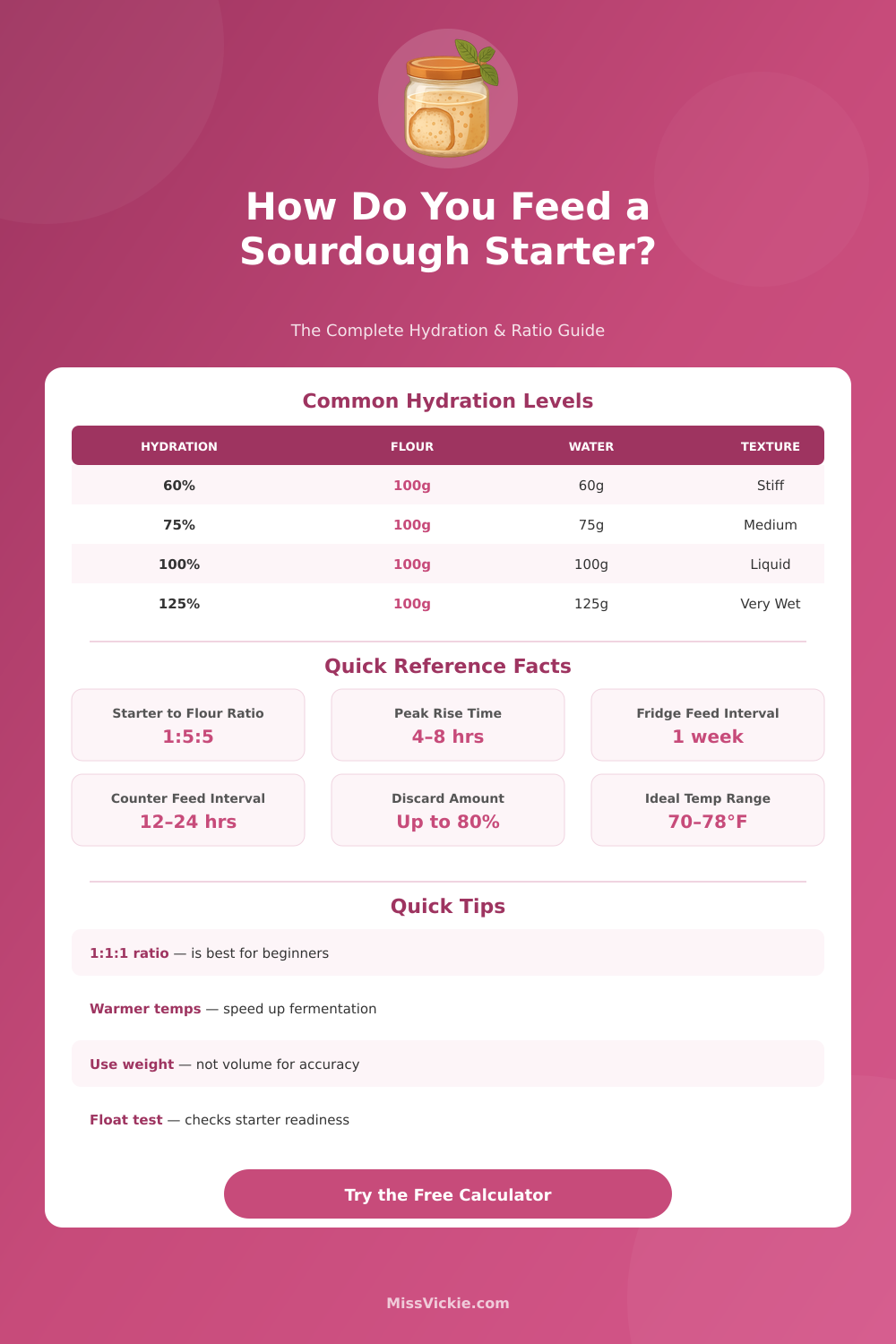
| Hydration % | Flour (g) | Water (g) | Texture | Best For |
|---|---|---|---|---|
| 50–60% | 100g | 50–60g | Very Stiff | Panettone, Bagels |
| 65–70% | 100g | 65–70g | Firm Dough | Pizza, Focaccia |
| 75–80% | 100g | 75–80g | Medium | Country Loaf |
| 100% | 100g | 100g | Pourable | Waffles, Pancakes |
| 125% | 100g | 125g | Very Wet | Crackers, Flatbreads |
| Ratio (S:F:W) | Rise Time (70°F) | Use Case | Activity Level |
|---|---|---|---|
| 1:1:1 | 4–6 hrs | Active daily maintenance | Very Active |
| 1:2:2 | 6–8 hrs | Twice-weekly feeding | Active |
| 1:3:3 | 8–10 hrs | Weekend baking | Moderate |
| 1:5:5 | 10–14 hrs | Overnight rise at room temp | Slow |
| 1:10:10 | 12–18 hrs | Overnight cold rise | Very Slow |
| 1:20:20 | 18–24 hrs | Long cold fermentation | Minimal |
| Discard % | Starter Kept (from 100g) | Starter Kept (from 50g) | Frequency |
|---|---|---|---|
| 50% | 50g kept | 25g kept | Daily / Twice Daily |
| 70% | 30g kept | 15g kept | Daily Maintenance |
| 80% | 20g kept | 10g kept | Standard Maintenance |
| 90% | 10g kept | 5g kept | Minimal Waste |
| 0% (no discard) | 100g kept | 50g kept | Growing Starter |
The sourdough starter for sourdough bread is made up of fermented culture prepared from simple flour and water. It gathers natural yeasts and bacteria that naturally exist in the flour and in the surrounding air. One keeps this mix alive by means of regular feeding and uses it to ferment soft bread without store-bought chemicals.
One can prepare such a sourdough starter buy one, or receive one from other home bakers.
How to Make and Feed a Sourdough Starter
To create one from nothing requires around seven days or even more. The process does not happen quickly. Usually one starts the process with whole wheat flour, to quickly start the fermentation.
Later, one uses everyday all-purpose flour for feeding and to strengthen the natural yeasts together with good bacteria. Some methods offer to start with rice flour and water, then refresh with wheat flour every 24 hours. Even basic white all-purpose flour will work, if one gives time and keeps feeding, although the type of flour affects the speed, the safety and the taste.
On the first day one mixes flour and water in a safe container, for instance in glass, in stainless steel or in a plastic food box. A container that has half to three quarters of space works best. Right after one begins the feeding.
Many guides suggest to do it every 12 hours, but every 24 hours is enough. During each feeindg one dumps around half of the sourdough starter, then adds equal parts of flour and warm water. One mixes until smooth, covers and leaves to rest at room temperature for another 24 hours.
The sourdough starter is only as old as the time passed since the last feeding. The true age of a sourdough starter does not matter a lot, despite what some sellers could say. Simple, homemade sourdough starter, that one keeps healthy, will give just as good bread as any other.
Some signs show that the sourdough starter already works. It should double in volume during four to six hours after feeding. It should have a nice smell, a bit sour, not unpleasant.
Small bubbles on the surface and inside are positive signs. The float test is also useful. One lays a spoon of it in water, and if it floats, probably it is ready.
Waiting only one weak may not be enough. Too young sourdough starter does not manage to give bread the right crust and fluff. After about two weeks of feeding, it should have a lovely smell and be ready.
The temperature affects more than many believe. If the dough or sourdough starter gets too warm or too cold, it can fail the rising and cause bad results. Keeping everything at a stabletemperature helps a lot.
The leftover sourdough starter is useful for many things. It works well for pancakes, crepes, pizza dough, muffins and even for carrot cake. Drying the leftover sourdough starter is another way, and it usually works better than freezing it.
The recipes differ regarding the amount of sourdough starter, from as little as 40 grams to a whole 454 grams, depending on the kind of recipe.