🍕 Sourdough Pizza Dough Calculator
Calculate exact flour, water, starter & salt for perfect sourdough pizza dough
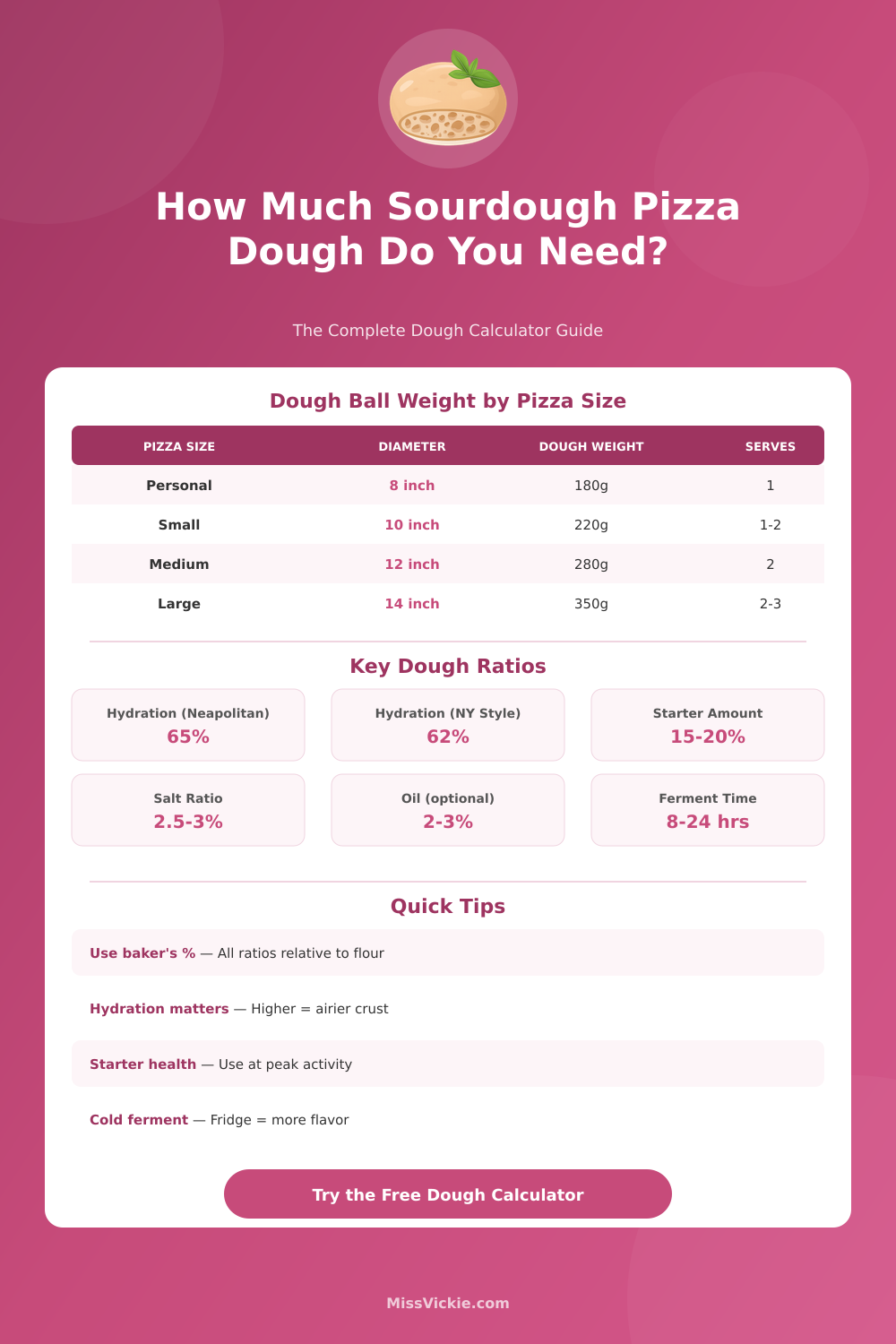
| Pizza Size | Diameter | Dough Weight (g) | Dough Weight (oz) | Typical Style | Slices |
|---|---|---|---|---|---|
| Personal | 8" | 180g | 6.3 oz | Neapolitan-style | 4 |
| Small | 10" | 220g | 7.8 oz | Neapolitan/NY | 6 |
| Medium | 12" | 280g | 9.9 oz | NY / Artisan | 8 |
| Large | 14" | 350g | 12.3 oz | NY Style | 8–10 |
| XL | 16" | 420g | 14.8 oz | Family / Party | 10–12 |
| Sheet Pan | 13"x18" | 700g | 24.7 oz | Roman Al Taglio | 12–16 |
| Hydration % | Dough Feel | Crust Result | Skill Level | Best Style |
|---|---|---|---|---|
| 55–60% | Stiff, firm | Crispy, cracker-thin | Beginner | Thin & Crispy, Roman |
| 60–65% | Smooth, workable | Chewy, balanced | Beginner | NY Style, Neapolitan |
| 65–70% | Slightly tacky | Airy, open crumb | Intermediate | Artisan, Neapolitan |
| 70–75% | Sticky, soft | Very airy, large bubbles | Intermediate | Neapolitan DOC |
| 75–80% | Very sticky | Extremely open crumb | Advanced | Artisan / Focaccia |
| 80%+ | Pourable | Ciabatta-like holes | Expert | Al Taglio / Focaccia |
| Starter % | Room Temp Rise Time | Cold Ferment Time | Flavor Intensity |
|---|---|---|---|
| 5–10% | 18–24 hrs | 48–72 hrs | Very Strong & Complex |
| 10–15% | 12–18 hrs | 36–48 hrs | Strong, Tangy |
| 15–20% | 8–12 hrs | 24–36 hrs | Moderate, Balanced |
| 20–25% | 6–8 hrs | 18–24 hrs | Mild Sour |
| 25–35% | 4–6 hrs | 12–18 hrs | Subtle, Mild |
| Ingredient | Min % | Typical % | Max % | Notes |
|---|---|---|---|---|
| Flour | 100% | 100% | 100% | Always the base (100%) |
| Water (Hydration) | 55% | 65% | 90% | Includes water in starter |
| Sourdough Starter | 5% | 20% | 35% | Includes flour + water |
| Salt | 2% | 2.5% | 3% | Never touch starter directly |
| Olive Oil | 0% | 2% | 5% | Optional, softens crumb |
| Sugar / Honey | 0% | 0% | 2% | Optional, aids browning |
The sourdough pizza dough makes a crust that is crisp and chewy, that comes from the oven with perfectly burned top and base. It carries various toppings for the pizza and cooks well always even without a special pizza pan. One gets a slim base with crust like Italian, and everything one can prepare at home.
To reach excellent structure in a home oven, it matters to use dough with high hydration, around 75 percent, fermentation that lasts long and slow in every stage, and gentle treatment. A good mix of flours is made up of 75% Type 00 flour and 25% something more hearty, for instance whole wheat flour. Almost equal parts of Type 00 flour and bread flour with high protein add extra chewiness and crispness, especially during home cooking.
How to Make Sourdough Pizza Dough at Home
The active sourdough starter forms the main rising agent. One feeds it between 4 and 12 hours before use, when it reaches the peak of its bubbling to give the dough the most rise. The sourdough starter simply replaces the yeast in teh recipe.
No need to add store yeast, because good sourdough pizza dough does require long fermentation, and the sourdough starter takes care of the rising itself.
After blending and buildup, one forms the dough in balls and lays it with sealed side up in a bowl lightly oiled. After 30 minutes, a series of stretches and folds builds more strength. Later the dough rests during main fermentation until almost doubled, for around 4 hours.
Then one can share it in parts and roll them in balls. Dough balls of 200 to 250 grams work well for pizzas of 10 to 12 inches.
Slow cold proofing in the fridge is a good method. The dough can rest hear during 2 to 3 days and actually improve. Before shaping, it must reach room temperature.
The dough works also for freezing. Around 450 to 500 grams is enough for one thick pizza of medium size, placed in a freezer bag or sealed tin. Frozen dough balls stay good at least one month.
Just move them to the fridge the night before cooking.
During cooking, a pizza stone or pizza steel one must have, and the hotter the oven, the better. Cook at 500 degrees for around 7 minutes, then broil for 1 minute to brown the crust nice and caramelize upper toppings like onions and peppers. The dough is really flexible.
For thicker crust, one takes bigger dough balls and does not stretch too thin. For crust like a cracker, stretch it more broadly and cook until it getshard.
sourdough pizza dough delivers a fermented deep taste with golden, crisp base and soft, light moisture. It deserves a try one time, and later hardly one forgets about it.