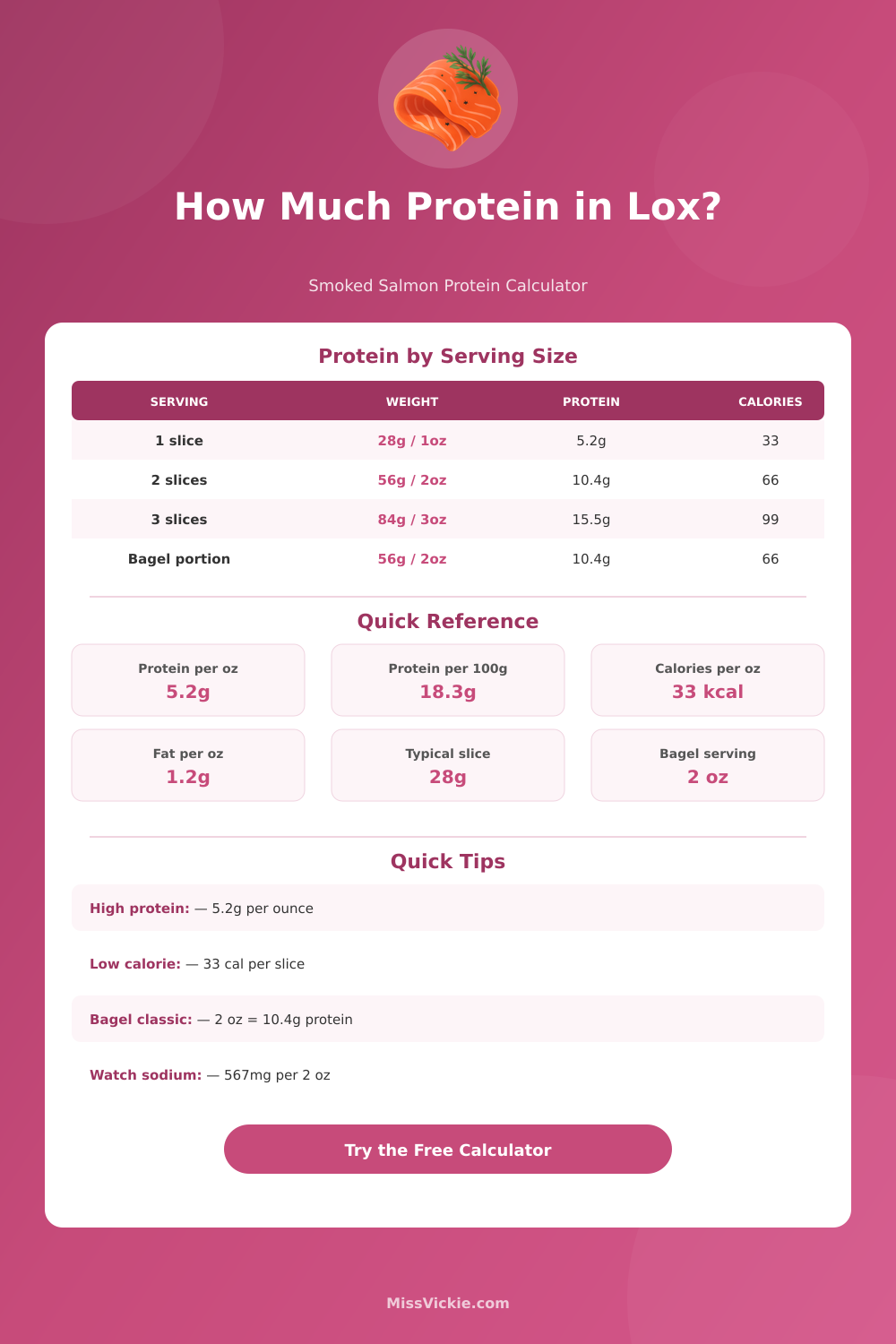
🐟 Protein in Lox Calculator
Calculate protein, calories, and full nutrition for any serving of lox or smoked salmon
| Serving | Weight | Protein | Calories |
|---|---|---|---|
| 1 thin slice | 1 oz / 28g | 5.2g | 33 |
| 2 slices (bagel) | 2 oz / 56g | 10.4g | 66 |
| 3 slices | 3 oz / 84g | 15.5g | 99 |
| 4 oz serving | 4 oz / 113g | 20.7g | 132 |
| 6 oz portion | 6 oz / 170g | 31.1g | 198 |
| 100 grams | 3.5 oz / 100g | 18.3g | 117 |
| Half pound | 8 oz / 227g | 41.4g | 265 |
| 1 pound | 16 oz / 454g | 82.8g | 529 |
| Type | Protein/oz | Calories/oz | Fat/oz |
|---|---|---|---|
| Lox (traditional) | 5.2g | 33 | 1.2g |
| Cold-Smoked Salmon | 5.2g | 33 | 1.2g |
| Nova Lox | 5.0g | 33 | 1.1g |
| Hot-Smoked Salmon | 6.3g | 44 | 2.1g |
| Gravlax | 5.1g | 36 | 1.4g |
| Nutrient | Lox | Hot-Smoked | Gravlax |
|---|---|---|---|
| Calories | 66 | 88 | 72 |
| Protein | 10.4g | 12.6g | 10.2g |
| Total Fat | 2.3g | 4.2g | 2.8g |
| Saturated Fat | 0.5g | 0.9g | 0.6g |
| Cholesterol | 13mg | 18mg | 14mg |
| Sodium | 567mg | 389mg | 480mg |
| Omega-3 | 0.6g | 0.8g | 0.7g |
| Carbohydrates | 0g | 0g | 0g |
| Amount | Ounces | Grams | Slices (≈) |
|---|---|---|---|
| 1 slice | 1 oz | 28g | 1 |
| 1/4 pound | 4 oz | 113g | 4 |
| 1/2 pound | 8 oz | 227g | 8 |
| 1 pound | 16 oz | 454g | 16 |
| 100 grams | 3.5 oz | 100g | 3–4 |
| 250 grams | 8.8 oz | 250g | 9 |
| 500 grams | 17.6 oz | 500g | 18 |
| 1 kilogram | 35.3 oz | 1000g | 36 |
One ounce of lox gives really good nutritional value, almost 5 grams of protein for only 33 calories, with not even one gram of fat and entirely without carbs. When you prepare a typical bagel with two ounces, the lox alone deliver more than 10 grams of protein. If you expand that to three ounces you reach 15.5 grams, which is worth the attention.
Warm smoked salmon beats everything there, around 6.3 grams of protein for one ounce, although with a bit more fat, namely 2 grams. In 100 grams, lox are made up of 18.3 grams of protein. So a whole pound delivers around 83 grams.
Lox: Nutrition, History and How to Eat It
Naturally, the main disadvantage is the sodium, a two-ounce serving has about 567 milligrams, which matches a quarter of the daily limit. For a gruop of 10 folks during a nice brunch, I plan half a pound of lox to well cover everything.
The history of lox is quite interesting. It is brined salmon, and the name comes from the word “laks”, that comes from middle German. Before, lox were much more cheap than pastrami, and folks bought it at small stores, that were common then.
Real lox pass through only a simple brine, using only the fat belly part of the salmon. Smoked salmon gets salted and later smoked, whether warm or cold, which gives it an entirely different texture and smoky taste. Belly lox sits in salt or a mix from salt and sugar, later lightly cold smoked, making it very salty.
Nova Scotia lox gets brined and cold smoked, so it is knot as salty.
Homemade lox is simpler than one thinks. One way is to salt the salmon in sugar and kosher salt for around 48 hours, later rinse it in cool water. Another method needs only 36 hours with only salt and sugar.
One can simplify or add creativity with juniper, cumin, lemon zest and dill. And the best part? Homemade lox cost much less than that from the store.
The traditional way to use lox is on a bagel with cream cheese. Commonly one adds tomatoes, onions, cucumbers, capers and dill, I like big, salty capers, that one rinses and soaks. A bit of lemon juice well ends it.
But lox do not limit to bagels. It well goes with scrambled eggs and caramelized onions with crème fraîche. Also in pasta with dill, sour cream, spring onions and black pepper it stands alone.
Some even make from it a delicious spread.
About servings, two ounces each person is a good guide. Four ounces would be very rich, similar to a standard deck of cards. A three-ounce serving reaches around 74% of the daily sodium limit, so one must remember that.
A one-ounce serving of smoked chinook salmon has around 33 calories, with 33% fat, 0% carbs and 62% protein. A two-ounce serving of lox stores about 35 milligrams of cholesterol.
A big advantage of lox is that it freezes well, so one can keep it if you do not finish the whole package right away. For best taste and freshness, even so, I advise to eat it within 5 days. Ah, and yet one funny detail; in bagelstores, adding lox to the order almost triples the price.
Mad, right?