🍖 Smoked Meat Calculator
Calculate exactly how much raw meat to buy for your guests — with yield & serving breakdowns
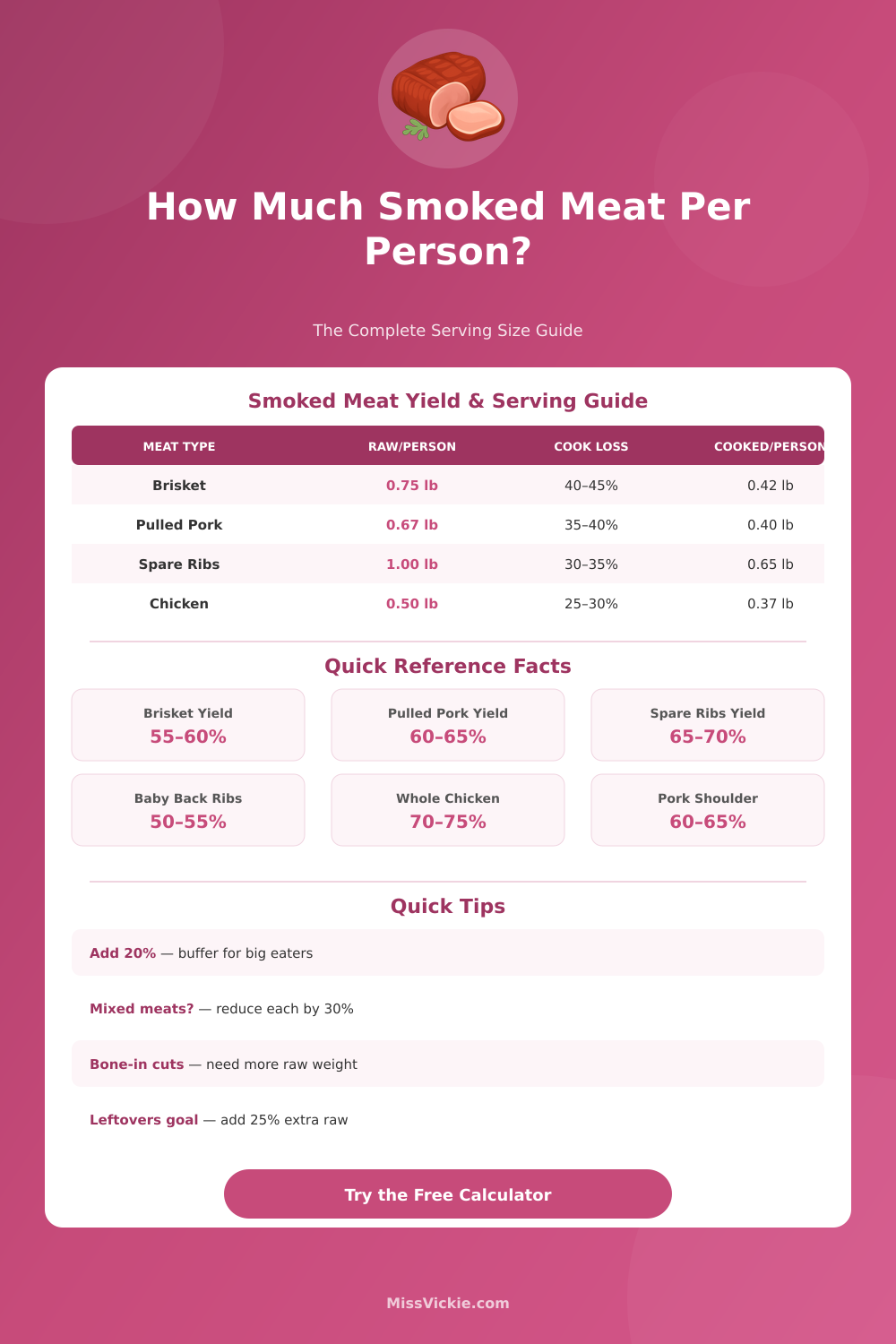
| Meat Cut | Cooked Yield % | Raw Weight / Person (lb) | Cooked Serving (oz) | Bone-In? |
|---|---|---|---|---|
| Beef Brisket (flat) | 55–60% | 0.75 | 6–7 oz | No |
| Pulled Pork Shoulder | 60–65% | 0.67 | 6 oz | Sometimes |
| Pork Spare Ribs | 65–70% | 1.00 | 3–4 bones | Yes |
| Baby Back Ribs | 50–55% | 0.75 | 3–4 bones | Yes |
| Whole Chicken (halves) | 70–75% | 0.50 | 5–6 oz | Yes |
| Chicken Thighs | 72–78% | 0.45 | 4–5 oz | Yes |
| Beef Short Ribs | 60–65% | 1.00 | 7–8 oz | Yes |
| Lamb Shoulder | 58–63% | 0.75 | 6–7 oz | Sometimes |
| Turkey Breast | 68–72% | 0.60 | 5–6 oz | No |
| Pork Belly | 65–70% | 0.55 | 5 oz | No |
| Guests | Brisket (lb) | Pulled Pork (lb) | Spare Ribs (lb) | Baby Backs (lb) |
|---|---|---|---|---|
| 5 guests | 3.75 | 3.35 | 5.0 | 3.75 |
| 10 guests | 7.5 | 6.7 | 10.0 | 7.5 |
| 20 guests | 15.0 | 13.4 | 20.0 | 15.0 |
| 30 guests | 22.5 | 20.1 | 30.0 | 22.5 |
| 50 guests | 37.5 | 33.5 | 50.0 | 37.5 |
| 75 guests | 56.3 | 50.3 | 75.0 | 56.3 |
| 100 guests | 75.0 | 67.0 | 100.0 | 75.0 |
Smoked meat comes from an old way of preparing red meat, white meat and seafood, that started during the paleolithic era. The smoking gives extra flavor, improves the look of the meat by means of what one calls the Maillard-reaction, and when one combines it with salting it helps to preserve the food. Before, smokers were made up of simple rooms from stones, where one hanged the meat from the ceiling.
The fire made smoke, that dried the meat and preserved it. Now one does smoking by means of special smokers, that can be little or big according to size.
How to Smoke Meat
Two main kinds of smoking exist. Warm smoking really cooks the meat thanks to the heat. Cold smoking uses smoke that comes from fuels some feet away, so that the smoke stays cold and the meat does not cook.
It works for beef, chicken, pork and salted fish like lox. Dry meat and smoked meat is not the same thing. One salts dry meat and hangs it until dry.
For smoked meat one salts it, later lays it in a smoker for several hours, and it can become something similar to jerky.
Smoke brings a new level of flavor and richness to the meat. It fits ideally. Even so too much smoking of meats can cause bitter final taste, so matter to mind that.
When wooden bits like hickory burn in the smoker, nitrogen dioxide releases. That gas bonds with the myohemoglobin in the meet instead of oxygen, what alters its colour and taste.
Well choosing the right slice is key. Equal thickness ensures uniform taste. Meats with good fat-marbling stay wet during the smoking process.
Well mixed rub from salt, sugar and spices form the bark, that is the crust that marks good smoked meat. Smoked steak results tender and juicy with good smoky smell. Pork chops are a bit thin for smoking, but soaking them in brine is good.
Short beef ribs are easy to prepare and great for smoking. Pork loin is soft and always comes out tasty.
Long cooking in steady heat, followed by long rest, makes the meat surprisingly tender. Keeping stable temperature during twelve hours is not simple the first time. The wise way is to cook according to internal temperature, not according to time.
That means reaching sure heat inside instead of cooking a fixed number of hours. Big brisket can require around eighteen hours. Boston butt requires about twelve hours.
Wrapping the meat in foil at around 155 degrees helps everything go more quickly and simply. After that the meat will not absorb more smoke anyway.
When one serves, half a pound of cooked brisket per folk works well as main food. One pound of finished product feeds two to three people. If the budget is tight, two-ounce portions of brisketwith side dishes and other meats work for folks well.