🍣 Sashimi Per Person Calculator
Calculate the perfect amount of sashimi for any gathering
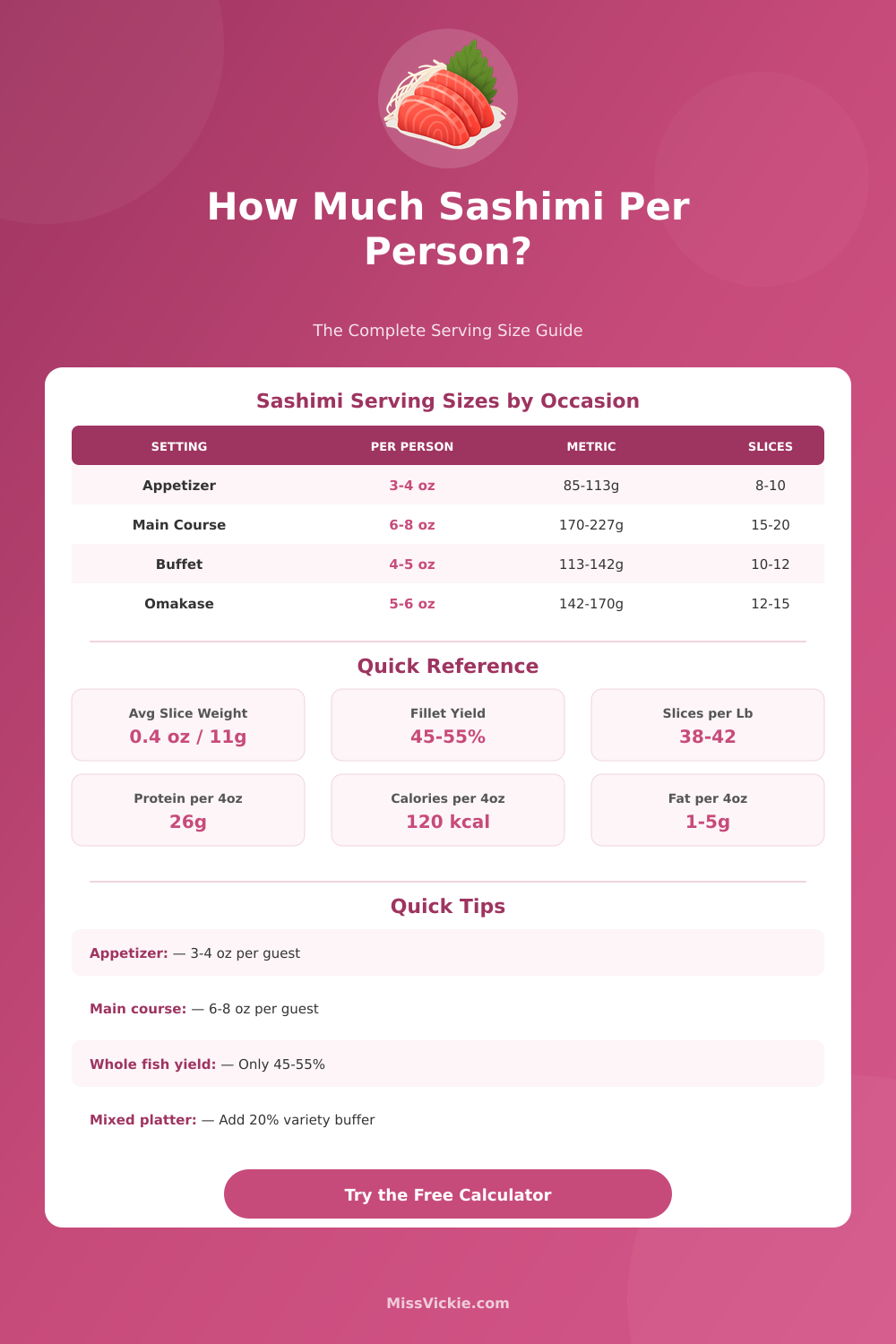
| Setting | Per Person (oz) | Per Person (g) | Approx Slices |
|---|---|---|---|
| Appetizer / Starter | 3 – 4 oz | 85 – 113 g | 8 – 10 |
| Main Course | 6 – 8 oz | 170 – 227 g | 15 – 20 |
| Buffet Spread | 4 – 5 oz | 113 – 142 g | 10 – 12 |
| Omakase Style | 5 – 6 oz | 142 – 170 g | 12 – 15 |
| Kids (under 12) | 2 – 3 oz | 57 – 85 g | 5 – 7 |
| Fish Type | Whole Fish Yield | Fillet Yield | Avg Slice (g) |
|---|---|---|---|
| Salmon (Sake) | 50 – 55% | 92% | 10 – 12 |
| Tuna (Maguro) | 48 – 52% | 90% | 12 – 15 |
| Yellowtail (Hamachi) | 50 – 55% | 93% | 10 – 12 |
| Sea Bream (Tai) | 40 – 45% | 90% | 8 – 10 |
| Mixed Platter (avg) | 47 – 52% | 91% | 10 – 12 |
| Guests | Fillet Needed (lb) | Fillet Needed (kg) | Whole Fish (lb) |
|---|---|---|---|
| 5 | 2.2 lb | 1.0 kg | 4.4 lb |
| 10 | 4.4 lb | 2.0 kg | 8.8 lb |
| 15 | 6.6 lb | 3.0 kg | 13.1 lb |
| 20 | 8.8 lb | 4.0 kg | 17.5 lb |
| 25 | 10.9 lb | 5.0 kg | 21.9 lb |
| 50 | 21.9 lb | 9.9 kg | 43.8 lb |
| 100 | 43.8 lb | 19.8 kg | 87.5 lb |
| Imperial | Metric | Notes |
|---|---|---|
| 1 oz | 28.35 g | Single small portion |
| 4 oz | 113 g | Light appetizer serving |
| 7 oz | 198 g | Average main course serving |
| 1 lb (16 oz) | 454 g | Serves 2–3 as main |
| 2.2 lb | 1 kg | Serves 5 as main |
| 5 lb | 2.27 kg | Serves 10–12 as main |
A normal serving of sashimi in various lands is around 7 ounces for one guest, around 200 grams. That matches 15 to 20 slices depending on the kind of fish. For appetizers one uses 3.5 ounces so maybe 8 to 10 pieces each serving.
In buffets the amount for every person falls between 4.5 ounces.
How much sashimi to serve and how to prepare it
Here where things become tricky, the amount of usable meat from whole fish is really low. Salmon delivers around 52 percent, while sea bass only 42 percent. Blocks from fillets are much more efficient, with 90 to 93 percent of usable flesh.
That makes a big diffrence during planning.
For ten folks, that eat normal servings, I counted around 4.4 pounds of fish. For twenty guests that grows to 22 pounds, really impressive, when one sees it arranged. If eaters are greedy, they consume up to 30 percent more, so a group of 20 hungry adults require about 11.5 pounds of ready fish.
Nutritionally every 4-ounce serving has around 120 calories, 26 grams of protein and almost no carbs, which surprised me.
The details below do not come from a calculator… They are combined from actual home cooks, professional cooks and discussions in food communities across the net.
Sashimi is a Japanese food prepared with fresh raw fish or meat, cut in thin strips. The term sashimi wants too say “piercing body”, from the Japanese words for “pierce” and “body”. It ranks among the most known Japanese dishes.
The heart of sashimi lies in the enjoyment of prime raw fish in its purest state, without strong seasonings or complex cooking methods.
Fish forms the main type for sashimi, even though meats like beef, horse or deer also work. Even stuff like yuba or konnyaku happen as sashimi. When you order sashimi in a restaurant, expect fresh, well cut raw fish without extras.
Like this the real flavor of the fish one truly feels.
One serves sashimi usually with soy sauce and wasabi. Commonly alongside freshly grated ginger, shredded daikon root and leaves of shiso. Ponzu sauce is another good choice.
The look matters equally, it must seem attractive on the plate.
The flavor of sashimi changes depending on the cutting style. One cuts the fish by means of smooth move of the knife in one direction. Swinging the blade forward and backward makes the slices rough and destroys the texture.
Good sashimi must feel a bit buttery, not fishy or slimy. It almost melts in the mouth, if it is well done. Salmon and tuna work for newcomers, because they have soft texture and not too strong taste.
The belly of tuna costs much more than regular red tuna, but the thickness and oil makes it truly delicious. Fish of low quality with many fibers gives sashimi a bad name. More oily species like bonito go well with special sauces, for instance tosazu, that mixes soy sauce, vinegar, mirin, dashi and kombu.
Cleaning the fish is an almost required stage in the preparation of sashimi. It strengthens the texture and adds taste, so that the fish tastes better. The cleaning can use mirin or sake.
Before cutting one checks the fish for parasites. Larvae of anisakis form visible worms around five millimeters long, commonly with blood spots in the meat.
A normal piece of sashimi weighs around half an ounce. Usual serving is five to six slices each person. Around sixteen pieces match eight ounces, which is a rich amount.
Fish for sashimi needs to come from a reliable source, and freshness decides about safety andflavor. In sushi chefs learn for years, before they can cut fish properly.