🍖 Roast Beef Cooking Time Calculator
Calculate exact cooking times by weight, cut, and desired doneness level
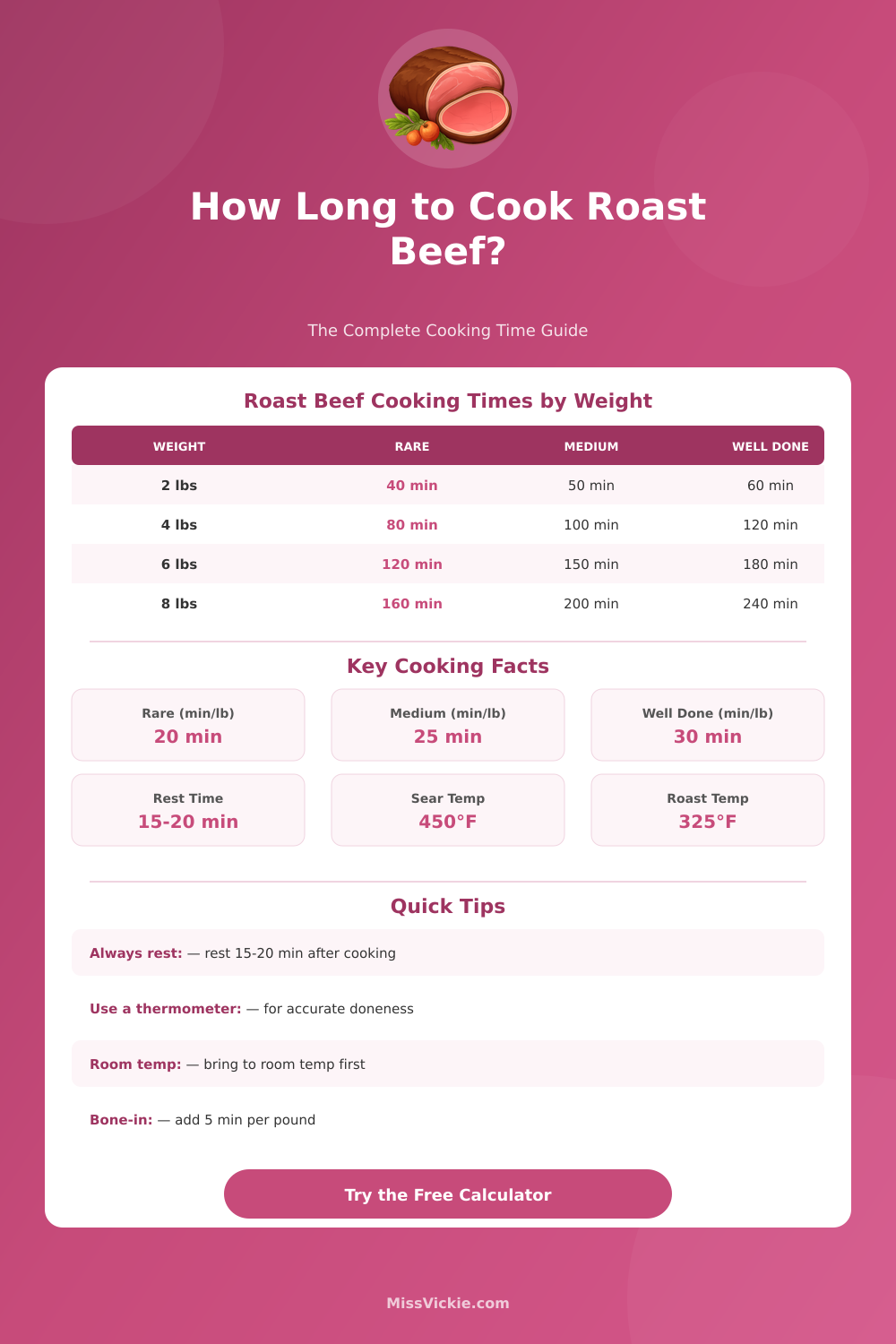
| Cut | Rare | Medium-Rare | Medium | Well Done |
|---|---|---|---|---|
| Ribeye / Prime Rib | 18 min/lb | 20 min/lb | 25 min/lb | 30 min/lb |
| Sirloin Roast | 20 min/lb | 22 min/lb | 26 min/lb | 32 min/lb |
| Top Round / Eye of Round | 20 min/lb | 22 min/lb | 28 min/lb | 33 min/lb |
| Chuck Roast | — | — | 30 min/lb | 35 min/lb |
| Tenderloin | 15 min/lb | 18 min/lb | 22 min/lb | 27 min/lb |
| Bone-In Rib Roast | 22 min/lb | 25 min/lb | 30 min/lb | 35 min/lb |
| Doneness Level | Target Temp (°F) | Target Temp (°C) | Appearance |
|---|---|---|---|
| Rare | 120–125°F | 49–52°C | Bright red center |
| Medium-Rare | 130–135°F | 54–57°C | Warm red center |
| Medium | 140–145°F | 60–63°C | Pink center |
| Medium-Well | 150–155°F | 65–68°C | Slightly pink |
| Well Done | 160–165°F | 71–74°C | No pink |
| Pounds (lb) | Kilograms (kg) | Ounces (oz) | Grams (g) |
|---|---|---|---|
| 1 lb | 0.45 kg | 16 oz | 454 g |
| 2 lb | 0.91 kg | 32 oz | 907 g |
| 3 lb | 1.36 kg | 48 oz | 1,361 g |
| 4 lb | 1.81 kg | 64 oz | 1,814 g |
| 5 lb | 2.27 kg | 80 oz | 2,268 g |
| 6 lb | 2.72 kg | 96 oz | 2,722 g |
| 8 lb | 3.63 kg | 128 oz | 3,629 g |
| 10 lb | 4.54 kg | 160 oz | 4,536 g |
Roast Beef is made from a big bit of beef that one roasts in the oven until it gets brown crust and the wanted internal heat. In the English speaking world it ranks among the meats that one commonly prepares for Sunday dinner or mainstream meal. Roasting itself is a cook method using dry heat, usually in an oven.
Before, one usually bound the bit with string in the form of a package and hanged it before the fire of the kitchen.
How to Choose, Cook and Serve Roast Beef
Very important is choosing the right bit of meat. Among the favorites is the top round. This is the most tender from all parts of the beef round, that comes from the back leg of the animal.
Cheap bits, for example the top round, answer best for making sandwiches. Another excellent choice is the upper back roast, because all fat sits on the skin and easily comes off after the cook. If you want something more fancy, rib roast answers surprisingly, although it costs a bit more.
Boneless rib roast one cooks more evenly. And the tri-tip bit and the strip of buttock both have rich taste and stay soft while roasting.
Slow roasting at low temperatures does miracles with tougher bits and gives the most tender result. For instance, one can start at 500 degrees for five minutes each pound, later turn the oven off and leave the meat to reach 135 degrees. Later, give it ten minutes to rest before you cut.
A thermometer for meat is key, because without such tool cooking a big block of flesh is like gambling. The opposite method (start cold and end hot), results in juicy and tender roast without too cooked edge around teh surface.
Spices must not be complicated. Salt, black pepper and garlic powder works well. Olive oil can mix with crushed garlic and herbs in a paste that one spreads over the bit.
Fresh herbs like rosemary or thyme give extra smell, and rubs or marinades help also.
Roast Beef and pot roast is not the same thing. Pot roast cooks slowly for a long time and ends fully done, usually together with potatoes, carrots and onions. Roast Beef one cuts in solid bits with texture that ranges from soft and juicy in medium-rare to a bit more firm in medium-well.
The mainstream rib cuts are much more fatty and one usually prepares them only rare with a grassy crust, and it costs three to four times more each pound.
In portions for serving, three to four pieces each person answer well, around the size of a deck of playing cards. For Roast Beef sandwiches or a lighter meal, four to six pieces each person work great. The north shore Roast Beef sandwich from Essex County in Massachusetts comes with mayo, grilled sauce and cheese, commonly on an onion roll.
Kaiser rolls are great for such sandwiches, and rye bread with seeded crustanswers surprisingly also.