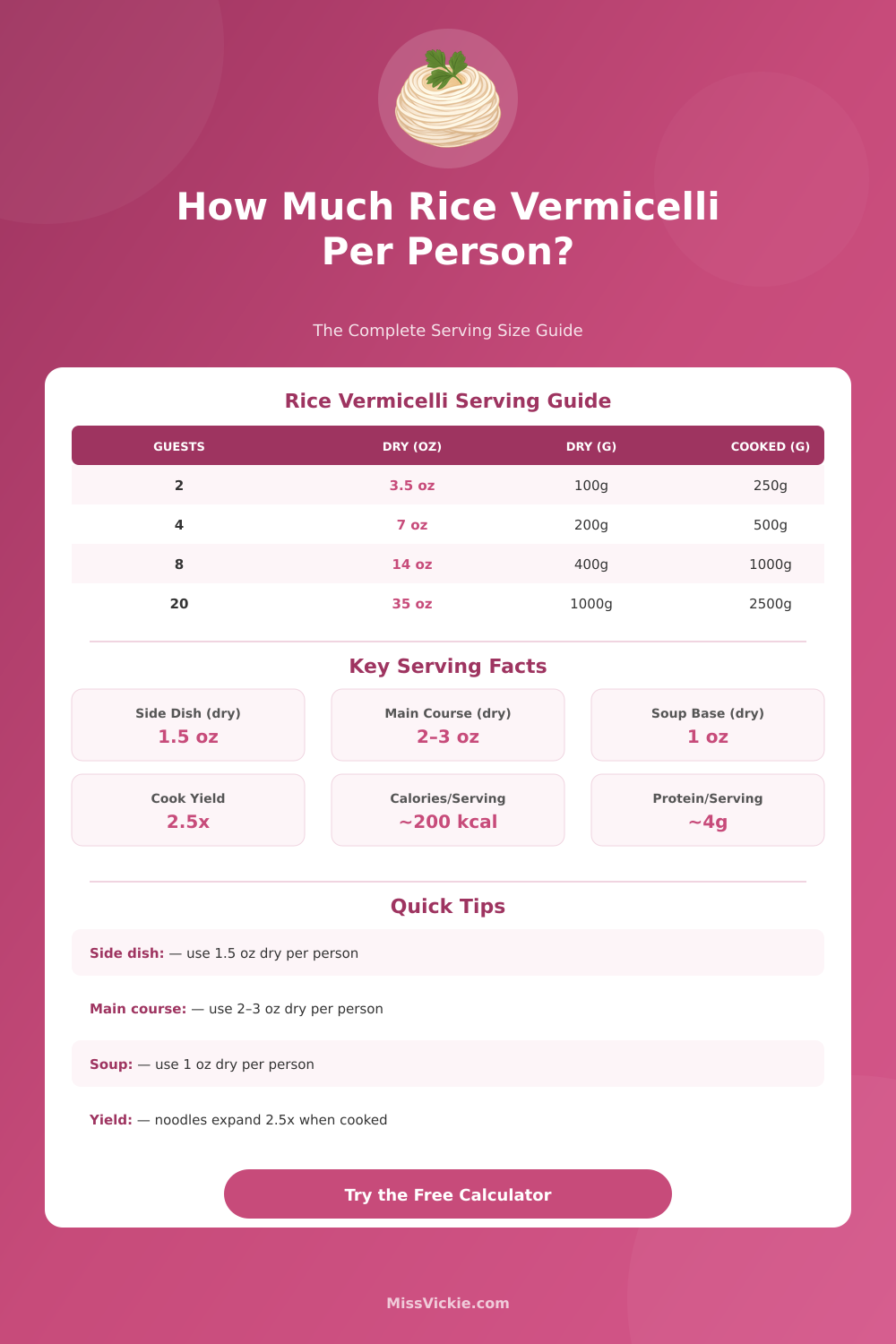
🍜 Rice Vermicelli Per Person Calculator
Get exact dry & cooked quantities for any group size — metric & imperial
| Meal Use | Dry per Person (g) | Dry per Person (oz) | Cooked Yield (g) |
|---|---|---|---|
| Soup Base / Light | 28–42g | 1–1.5 oz | 70–105g |
| Side Dish | 42–56g | 1.5–2 oz | 105–140g |
| Main Course | 56–85g | 2–3 oz | 140–213g |
| Heavy / Very Hungry | 85–113g | 3–4 oz | 213–283g |
| Guests | Dry (g) | Dry (oz) | Cooked (g) |
|---|---|---|---|
| 1 | 70g | 2.5 oz | 175g |
| 2 | 140g | 5 oz | 350g |
| 4 | 280g | 10 oz | 700g |
| 6 | 420g | 15 oz | 1,050g |
| 8 | 560g | 20 oz | 1,400g |
| 10 | 700g | 25 oz | 1,750g |
| 15 | 1,050g | 37 oz | 2,625g |
| 20 | 1,400g | 49 oz | 3,500g |
| 30 | 2,100g | 74 oz | 5,250g |
| 50 | 3,500g | 123 oz | 8,750g |
| Dry Amount | Dry (oz) | Cooked Weight (g) | Cooked Weight (oz) |
|---|---|---|---|
| 50g | 1.8 oz | 125g | 4.4 oz |
| 100g | 3.5 oz | 250g | 8.8 oz |
| 200g | 7.1 oz | 500g | 17.6 oz |
| 300g | 10.6 oz | 750g | 26.5 oz |
| 500g | 17.6 oz | 1,250g | 44.1 oz |
| 1 kg | 35.3 oz | 2,500g | 88.2 oz |
rice vermicelli is a kind of noodles from rice. One sometimes calls it “rice sticks” or “rice strips” even so one must not mix it with cellophane noodles. Those cellophane noodles form other Asian kind of vermicelli, prepared from starch of mung beans.
The rice noodles are made up of rice flour, what gives them the name. The word vermicelli relates to the form and preparation of those noodles. Those slim rice strips one sometimes calls “rice vermicelli noodles”, so that the unknown name sounds to westerners.
What Is Rice Vermicelli and How to Cook It
One can prepare rice vermicelli, soaking it in water at room temperature for around 20 minutes, before using it as desired. Other way is pour hot water on the dry vermicelli in a cup and leave it for some minutes. Later one lowers the heat, covers and leaves it simply until the noodles are wet.
Then one drains them and rinses with cold water. Rice vermicelli works well for salads, broths or fried foods with tender flavors and fresh vegetables. Around 50 to 75 grmas of dry rice vermicelli for one person gives enough serving without leftovers.
Brown rice vermicelli widely beats the average for everyday use. It stores more fibers and nutrients, that helps to manage the blood sugar, help the digestion and control the wait. Even small servings can give about 2 grams of fibers, and the brown versions cause lower reaction of the blood to sugar.
There is also an entirely other dish, called vermicelli rice. It is rice pilaf, popular in the Middle East. The Lebanese vermicelli rice pilaf carries only rice, vermicelli from pasta and olive oil.
It forms basic food in Lebanon and many Middle Eastern homes. One toasts the vermicelli in olive oil until the color becomes golden, what adds nutty flavor. The dish seasons only with salt.
Long grain rice, like basmati or jasmine, works best. The used vermicelli are very short and slim pasta pieces from wheat, do not mix with Asian rice noodles. They are even thinner than spaghetti, broken in small bits and toasted.
Egyptian rice presents other variant. One cooks the rice with vermicelli fried in ghee for comfort in the result. That famous dish matches surprisingly with many recipes, but usually goes with meat.
The Turkish version uses long grain white rice, cooked in chicken broth with toasted vermicelli pasta. The Lebanese rice pilaf can use clarified butter instead of olive oil. Toasted pine nuts add nice touch.
In Vietnamese cuisine rice vermicelli works as a neutral base for contrast with tasty elements. It gives balance, what is a natural trait of Vietnamese foods. In bun thit nuong, for instance, tasty lemongrass pork goes with fresh vegetables and rice vermicelli.
Rice vermicelli also goes wellwith Vietnamese spring rolls from rice paper.