🍜 Rice Noodles Per Person Calculator
Get exact dry & cooked rice noodle quantities for any group size
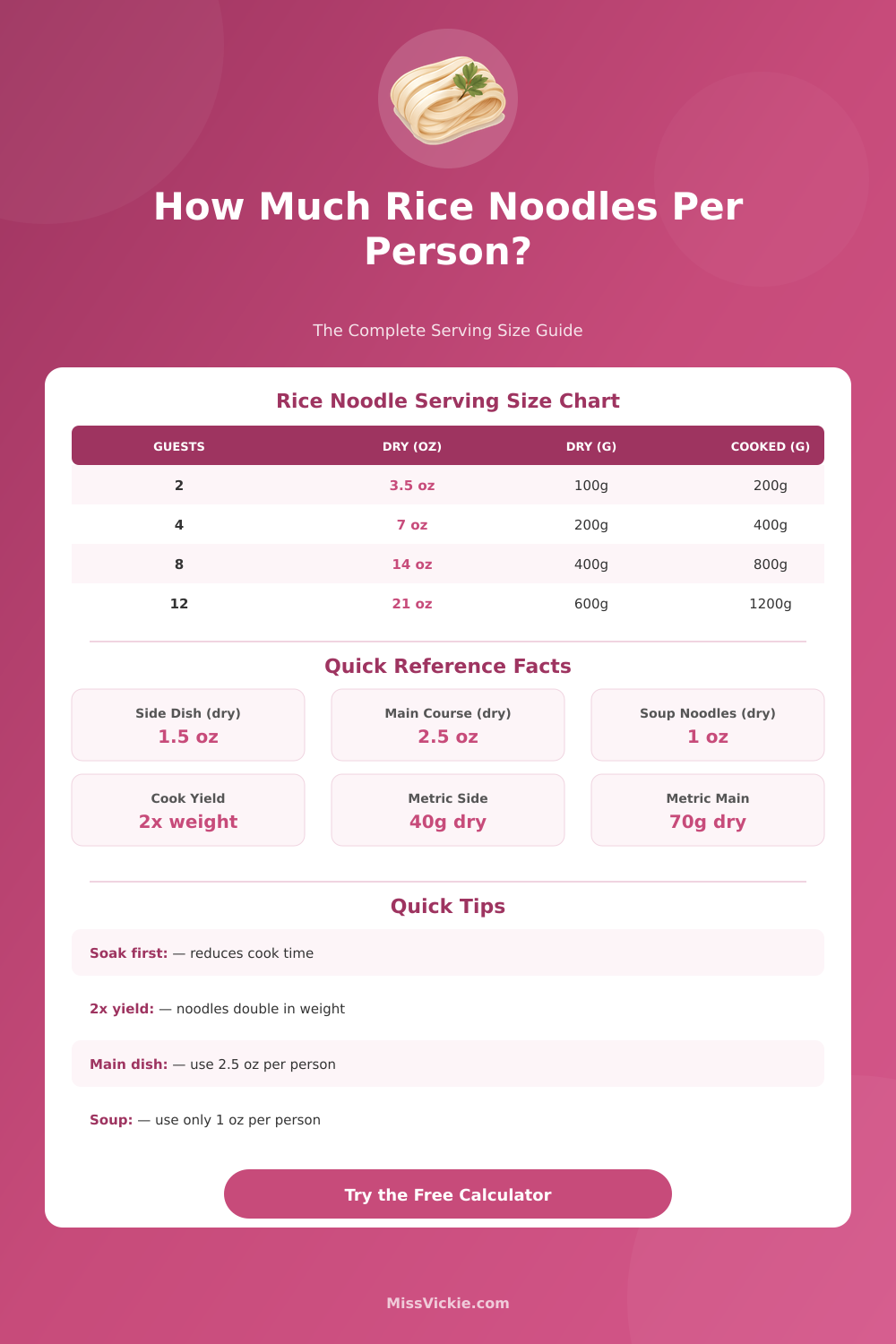
| Guests | Side (dry g) | Main (dry g) | Soup (dry g) | Cooked Main (g) | 200g Packets |
|---|---|---|---|---|---|
| 1 | 40g | 70g | 30g | 140g | 1 |
| 2 | 80g | 140g | 60g | 280g | 1 |
| 4 | 160g | 280g | 120g | 560g | 2 |
| 6 | 240g | 420g | 180g | 840g | 3 |
| 8 | 320g | 560g | 240g | 1120g | 3 |
| 10 | 400g | 700g | 300g | 1400g | 4 |
| 15 | 600g | 1050g | 450g | 2100g | 6 |
| 20 | 800g | 1400g | 600g | 2800g | 7 |
| 30 | 1200g | 2100g | 900g | 4200g | 11 |
| 50 | 2000g | 3500g | 1500g | 7000g | 18 |
| Noodle Type | Dry Weight | Cooked Weight | Yield Factor |
|---|---|---|---|
| Thin rice vermicelli | 100g | 185g | 1.85x |
| Flat rice noodles (5mm) | 100g | 200g | 2.0x |
| Wide rice noodles (10mm) | 100g | 220g | 2.2x |
| Rice stick noodles | 100g | 195g | 1.95x |
| Rice sheet noodles (fresh) | 100g | 110g | 1.1x |
| Pad Thai rice noodles | 100g | 200g | 2.0x |
| Guests | Side (oz dry) | Main (oz dry) | Soup (oz dry) | Total lbs (main) |
|---|---|---|---|---|
| 1 | 1.4 oz | 2.5 oz | 1.1 oz | 0.15 lbs |
| 2 | 2.8 oz | 5 oz | 2.1 oz | 0.31 lbs |
| 4 | 5.6 oz | 10 oz | 4.2 oz | 0.62 lbs |
| 6 | 8.5 oz | 14.8 oz | 6.3 oz | 0.93 lbs |
| 8 | 11.3 oz | 19.8 oz | 8.5 oz | 1.23 lbs |
| 10 | 14.1 oz | 24.7 oz | 10.6 oz | 1.54 lbs |
| 20 | 28.2 oz | 49.4 oz | 21.2 oz | 3.09 lbs |
| 50 | 70.5 oz | 123.5 oz | 52.9 oz | 7.72 lbs |
rice noodles are made from rice flour and water as basic ingredients. Sometimes one adds tapioca or cornstarch to make them more clear or to give more chewy structure. They look similar to regular wheat noodles however rice variants have white color rather than the brown tone of usual noodles.
Big difference between rice noodles and those from wheat come from the gluten. This stretchy protein from wheat give to regular flour doughs their strength. Noodles with gluten result more flexible and strong than those from rice.
All About Rice Noodles
One makes rice noodles from rice flour, what makes them good for people sensitive to gluten.
rice noodles come in various forms. Vermicelli from rice are very slim, almost like thread. They work well for soups, spring rolls, stir fries or even for deep frying for crisp topping.
Broad rice noodles have width of two to four inches. Biggest variants suit for stir fries, where one wants chewy noodles that does not break, for instance in pad thai or beef chow fun. Fresh broad noodles usually last in the fridge at Asian stores.
They are flexible, soft and commonly already cooked.
Cooking of rice noodles can confuse. Every packet shows different directions. Some require boiling, other dip in warm or room temperature water.
Rice vermicelli one always soaks before than boil. After cooking, one rinses the noodles with cold water to remove extra starch. Tossing them in a bit of neutral cooking oil helps, if one does not use them right away.
They cook quickly after the water boils. If rice noodles stick, that happens because of too much absorbed water.
One can boil them and serve in soups, stir fry with vegetables and proteins or use in cold salads. Rice noodles commonly appear in spring rolls or as base for many Asian foods. Pho is a famous Vietnamese noodle soup that includes them.
Mix rice noodles with chili oil, soy sauce and sesame oil gives fast meal. Peanut sauce stir fry with carrots, onions, peppers, broccoli and garlic is filling and satisfying, even sew stay light.
Home making them requires rice flour and tapioca starch. One mixes the flour and the starch, later add water slowly until form soft dough. Heat does not help for well forming rice noodles.
If the dough is too soft, the noodles will not keep form and could fail in noodle press. Frying leftover rice noodles does not work. Reheating them best in wok over medium heat, add a bit ofbutter or soy sauce if they seem dry.