🥄 Whisk Recipe Converter
Scale any recipe up or down instantly — imperial & metric conversions included
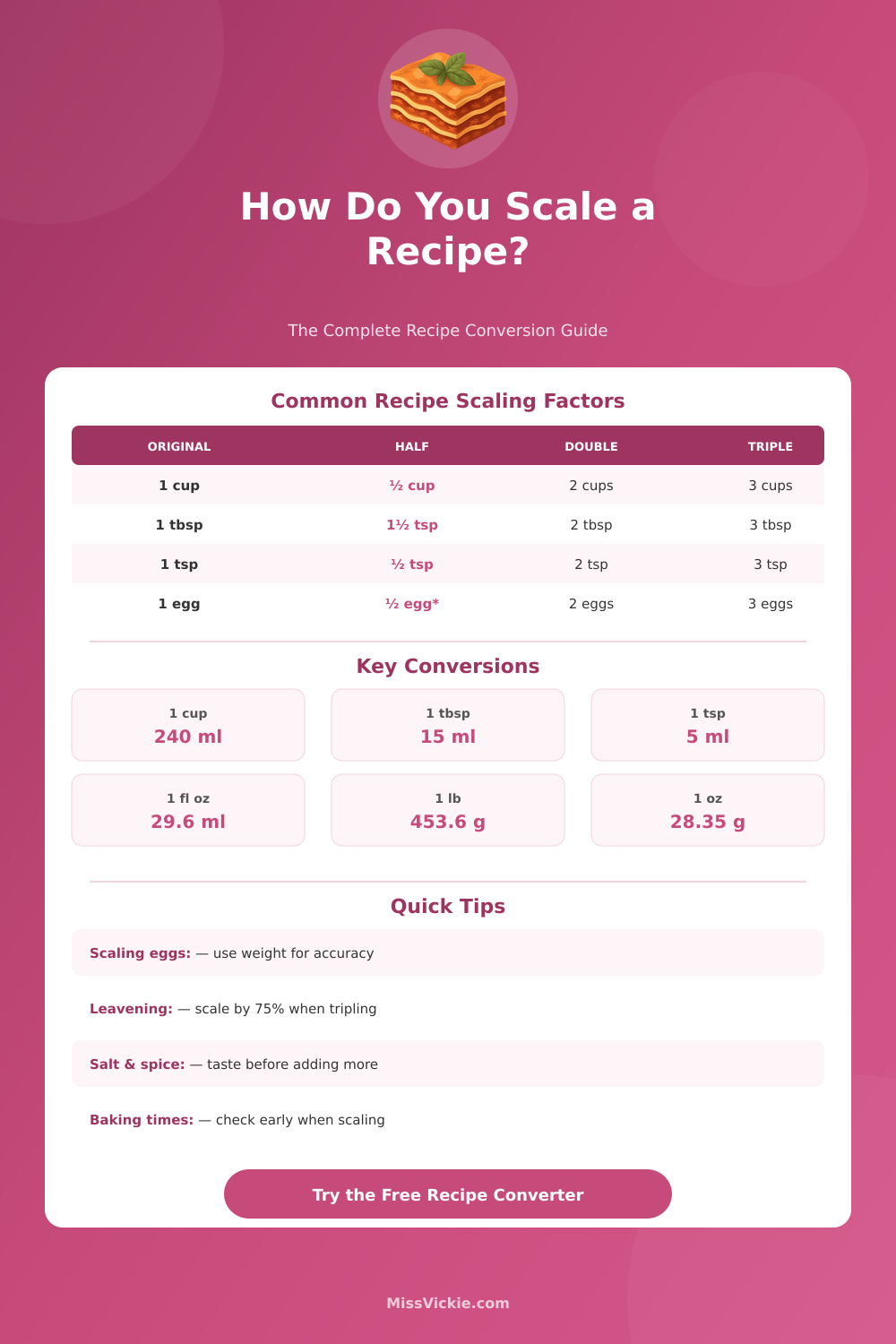
| Imperial Unit | Metric Equiv. | Also Equals |
|---|---|---|
| 1 cup | 240 ml | 16 tbsp |
| ¾ cup | 180 ml | 12 tbsp |
| ⅔ cup | 160 ml | 10½ tbsp |
| ½ cup | 120 ml | 8 tbsp |
| ⅓ cup | 80 ml | 5⅓ tbsp |
| ¼ cup | 60 ml | 4 tbsp |
| 1 fl oz | 29.6 ml | 2 tbsp |
| 1 tablespoon | 15 ml | 3 tsp |
| 1 teaspoon | 5 ml | ⅓ tbsp |
| ½ teaspoon | 2.5 ml | — |
| ¼ teaspoon | 1.25 ml | — |
| Weight Unit | Grams | Notes |
|---|---|---|
| 1 pound (lb) | 453.6 g | 16 oz |
| ¾ lb | 340 g | 12 oz |
| ½ lb | 226.8 g | 8 oz |
| ¼ lb | 113.4 g | 4 oz |
| 1 oz | 28.35 g | — |
| ½ oz | 14.2 g | — |
| 1 kg | 1000 g | 2.205 lb |
| 500 g | 500 g | 1.1 lb |
| 250 g | 250 g | 8.8 oz |
| 100 g | 100 g | 3.5 oz |
| 1 stick butter | 113.4 g | ½ cup / 8 tbsp |
| Ingredient | 1 Cup (imperial) | Weight (grams) | Weight (oz) |
|---|---|---|---|
| All-purpose flour | 1 cup | 125 g | 4.4 oz |
| Bread flour | 1 cup | 130 g | 4.6 oz |
| Cake flour | 1 cup | 114 g | 4 oz |
| White granulated sugar | 1 cup | 200 g | 7.1 oz |
| Brown sugar (packed) | 1 cup | 220 g | 7.8 oz |
| Powdered sugar (sifted) | 1 cup | 120 g | 4.2 oz |
| Butter (softened) | 1 cup | 227 g | 8 oz |
| Honey | 1 cup | 340 g | 12 oz |
| Milk | 1 cup | 244 g | 8.6 oz |
| Heavy cream | 1 cup | 238 g | 8.4 oz |
| Vegetable oil | 1 cup | 218 g | 7.7 oz |
| Cocoa powder | 1 cup | 100 g | 3.5 oz |
| Salt (table) | 1 tbsp | 18 g | 0.63 oz |
| Baking powder | 1 tsp | 4.6 g | 0.16 oz |
| Baking soda | 1 tsp | 6 g | 0.21 oz |
| Rolled oats | 1 cup | 90 g | 3.2 oz |
| Measurement | × 0.5 (Half) | × 1.5 (1.5x) | × 2 (Double) | × 3 (Triple) |
|---|---|---|---|---|
| 1 cup | ½ cup | 1½ cups | 2 cups | 3 cups |
| ½ cup | ¼ cup | ¾ cup | 1 cup | 1½ cups |
| 1 tablespoon | 1½ tsp | 4½ tsp | 2 tbsp | 3 tbsp |
| 1 teaspoon | ½ tsp | 1½ tsp | 2 tsp | 1 tbsp |
| ½ teaspoon | ¼ tsp | ¾ tsp | 1 tsp | 1½ tsp |
| ¼ teaspoon | ⅛ tsp | ⅜ tsp | ½ tsp | ¾ tsp |
| 1 egg | 27g beaten | — | 2 eggs | 3 eggs |
| 1 pound | 8 oz | 24 oz | 2 lb | 3 lb |
Whisks are in short wire mesh nets that one uses in the kitchen for smooth mixes or trapping air in them. That process… Blending together with air, we call whisking or beating.
Most whisks have long handles with several wire nets that branch below and are tied. One could say that it is a wire device fixed to a handle, meant for beating ingredients one with the other.
How to Choose and Use a Whisk
Away from the kitchen, the word “whisking” commonly shows haste and speed. The image of a servant that clears your empty plate before you even notice can annoy. In the kitchen on the other hand, whisking usually implies some fast and strong moves.
Often one works with eggs, egg whites or cream that requires that special treatment.
Currently there is a big range of whisks to choose from. A French whisk commonly is the first choice if one buys only one. Flat whisks are also available, and they really help in narrow places, where a balloon whisk seems too massive.
Mini-whisks form an option, although they are a bit too short for deep pots. Moreover, the Vollrath Piano whisk got a strong name.
Choosing between metal and silicone depends on what matters more for you. Metal whisks work well, but cleaning them later can be difficult. Silicone whisks lack the wait of metal, but they certainly are simpler to take care of.
Here the downside of silicone covered: the soft surface sometimes lets dirt stay on your checks. Hence it matters to choose the right whisk, especially if you have stainless steel or ceramic cookware.
Good silicone whisks that truly stay sealed, without gaps or holes, where grime stays, deserve to search for. Well built products from good materials simply last more long. If you choose metal, then hand wash beats the dishwasher always, when dealing with stopping rust.
Whisks with metal clip joints or connections will rust soon, and that shows cheap quality.
If no whisk is beside you, a fork can work for fast mixing tasks quite well. It shines with liquids. But nothing reaches the volume and airy weight that a whisk gives.
Pressing batter through a good mesh screen by means of a spoon helps a lot when one wants only smoothness, no air. A silicone spatula also can serve in a moment.
For truly thick and stiff batter, a standing blender or device removes the physical effort. On the other hand, for something as fast as a quick recipe or foamy eggs, a whisk works perfectly. Folks trusted in whisks during centuries, before electric blenders appeared.
Said, if you suffer hand pain or havestiff objects, whisking can be this tiring and unpleasant, hence a standing blender with a paddle add-on maybe is the wiser answer.