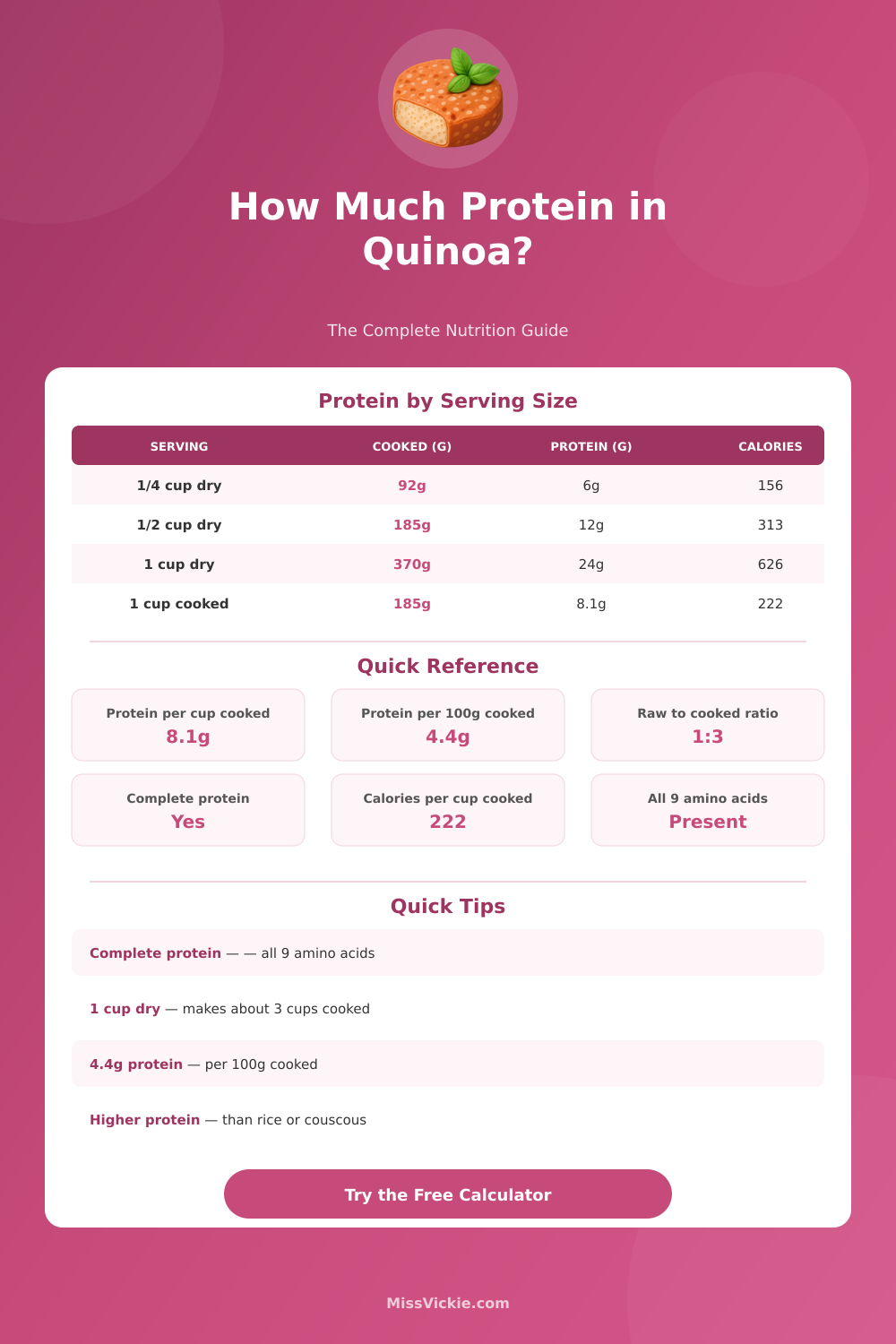
🌾 Quinoa Protein Calculator
Calculate protein content for any serving size of quinoa
| Serving Size | Weight | Protein | Calories |
|---|---|---|---|
| 1 Tbsp dry | 11g | 1.5g | 40 |
| 1/4 cup dry | 43g | 6.0g | 156 |
| 1/2 cup dry | 85g | 12.0g | 313 |
| 1 cup dry | 170g | 24.0g | 626 |
| 1/2 cup cooked | 93g | 4.1g | 111 |
| 1 cup cooked | 185g | 8.1g | 222 |
| 100g cooked | 100g | 4.4g | 120 |
| 100g dry | 100g | 14.1g | 368 |
| 6 oz cooked | 170g | 7.5g | 204 |
| 1 lb dry | 454g | 64.0g | 1670 |
| Grain | Protein | Calories | Complete Protein? |
|---|---|---|---|
| Quinoa | 8.1g | 222 | Yes |
| Brown Rice | 5.5g | 248 | No |
| White Rice | 4.4g | 242 | No |
| Couscous | 6.0g | 176 | No |
| Bulgur Wheat | 5.6g | 151 | No |
| Millet | 6.1g | 207 | No |
| Farro | 7.0g | 220 | No |
| Oats (cooked) | 5.9g | 166 | No |
| Variety | Protein | Calories | Notes |
|---|---|---|---|
| White Quinoa | 4.4g | 120 | Mildest flavor, fluffiest texture |
| Red Quinoa | 4.7g | 122 | Slightly nuttier, holds shape better |
| Black Quinoa | 4.8g | 124 | Earthier flavor, crunchier |
| Tricolor Quinoa | 4.5g | 121 | Blend of all three varieties |
| Dry Amount | Cooked Yield | Weight (cooked) | Water Needed |
|---|---|---|---|
| 1/4 cup (43g) | 3/4 cup | 139g | 1/2 cup |
| 1/3 cup (57g) | 1 cup | 185g | 2/3 cup |
| 1/2 cup (85g) | 1.5 cups | 278g | 1 cup |
| 1 cup (170g) | 3 cups | 555g | 2 cups |
| 2 cups (340g) | 6 cups | 1110g | 4 cups |
| Amino Acid | Amount (mg) | % Daily Value | Essential? |
|---|---|---|---|
| Leucine | 530 | 19% | Yes |
| Lysine | 487 | 23% | Yes |
| Isoleucine | 350 | 25% | Yes |
| Valine | 390 | 21% | Yes |
| Histidine | 258 | 37% | Yes |
| Threonine | 280 | 27% | Yes |
| Methionine | 178 | 24% | Yes |
| Phenylalanine | 370 | 42% | Yes |
| Tryptophan | 95 | 34% | Yes |
One cup cooked quinoa gives around 8.1 grams of protein for 222 calories; that is about 15 percent of the calories from protein, what really is not bad for a grain. Here strictly said it is a fake grain. Raw quinoa has more protein per gram, around 14.1 g for 100 grams, but folks do not eat it raw, so the values for the cooked version are the ones that matter.
The ratio between raw and cooked quinoa surprisingly shocked me at first. One cup raw (170 g) turns into around three cups cooked, or so. About 555 grams.
How Much Protein Is in Quinoa?
That is 3.3 times growth because of soaking up water. Black quinoa a bit beats the white, with 4.8 g protein for 100 g cooked rather than 4.4 g. No big difference, but it adds up over a whole serving.
Compared to brown rice with 5.5 g per cup cooked, quinoa wins by around 47 percent. That is a big advantage. And it is among the few plant sources with all nine essential amino acids; 530 mg leucine per cup cooked, 487 mg lysine.
I did not expect that those numbers wood be this strong for something grain-like.
The info below does not come from a calculator or some converter. It is based on actual use, forum talks and experiences from cooking groups across the net.
Quinoa is said “keen-wah” and it is technically a seed, not a grain. It belongs to the same family as beetroots, chard and spinach. Although it is a seed, quinoa is commonly grouped with fake grains like amaranth and buckwheat.
During cooking, it fills the role of starchy grains, so folks treat it as if one of them.
The main benefit of protein in quinoa is that it forms complete proteins. That means it has all nine essential amino acids that the body itself can not make. That is serious for vegetarians and vegans, because getting complete proteins from plant foods can be hard.
Animal products commonly have complete proteins, but finding the same in plants is harder. Quinoa really helps with that challenge well.
Quinoa however is not packed with protein. A serving of one cup cooked quinoa carries around 222 calories, 39 grams of carbs and 8 grams of protein. English muffins have 7 grams of protein in a 172-calorie serving, what is quite alike.
Around a quarter of a cup raw quinoa gives about 6 grams of protein and 160 calories. After cooking, that small amount turns into a big portion. So the ratio of protein to calorie is not surprising.
Carbs are plenty, so quinoa alone is not a strong protein source.
Quinoa naturally does not carry gluten. It also gives good fiber. In it are healthy fats, vitamins, minerals and antioxidants.
It has a low glycemic index, although not a low glycemic load. One can easily digest it.
Native people in South America grew quinoa for more than 5,000 years. The Inca folks considered it holy. Only recently it became popular in the United States.
Even NASA used quinoa for feeding astronauts during long space trips, because of its rich nutrition. It beats in protein many likes such as rice, corn and whole wheat, what also helps during weight loss.
Quinoa cooks quickly, what gives fast joy. Its taste is very mild and it blends into many foods without strongly changing the flavor. It works well for taco bowls, salads with chickpeas and grain bowls.
Cooking quinoa in veggie broth adds extra flavor. One Mexican style grain bowl with quinoa and ground meat has 34 grams of protein per serving. Adding chickpeas to quinoa salads boosts the proteins and gives nice texture.
It also works well as food after a workout, because it fills you up and is fairly rich inplant proteins.
One thing to recall is that cooked quinoa carries fewer grains per cup than raw quinoa. The protein in every grain stays the same during cooking, but the volume grows. Also anyone that suffers stomach pain, cramps or throwing up after eating quinoa should avoid it.