🍳 Pressure Cooker Recipe Converter
Convert any stovetop or oven recipe to pressure cooker timing & liquid amounts
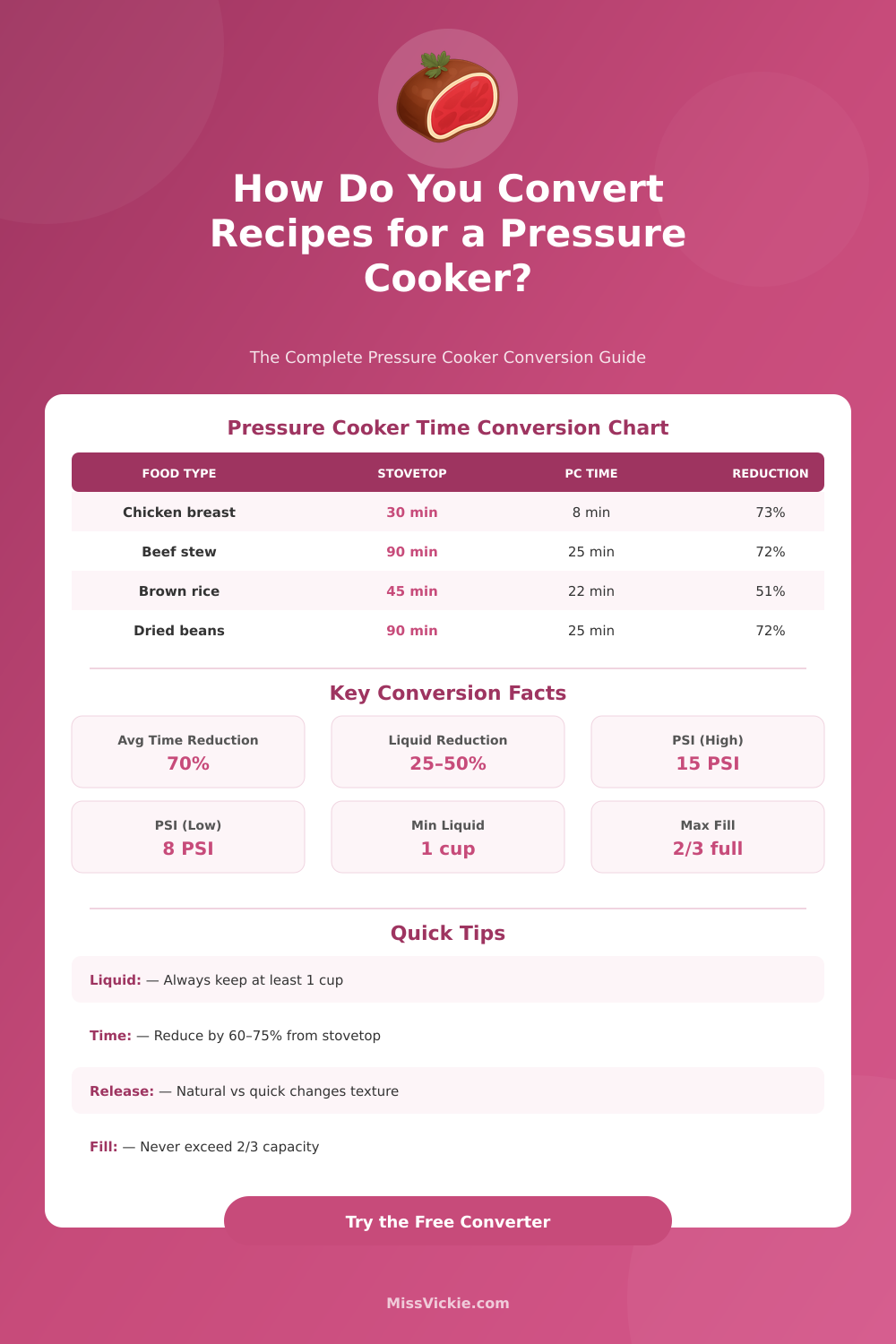
| Food | Original Time | PC Time (High) | PC Time (Low) | Liquid Needed | Release |
|---|---|---|---|---|---|
| Chicken breast (boneless) | 30 min | 8 min | 12 min | 1 cup | Quick |
| Chicken thighs (bone-in) | 45 min | 12 min | 18 min | 1 cup | Natural 5 min |
| Beef stew chunks | 90 min | 25 min | 35 min | 1.5 cups | Natural |
| Beef roast (pot roast) | 3 hrs | 60 min | 90 min | 2 cups | Natural |
| Pork shoulder (pulled) | 4 hrs | 75 min | — | 1.5 cups | Natural |
| Pork ribs (spare) | 2 hrs | 25 min | 35 min | 1 cup | Natural 10 min |
| White rice | 20 min | 3 min | 6 min | 1:1 ratio | Natural 10 min |
| Brown rice | 45 min | 22 min | 30 min | 1:1.25 ratio | Natural 10 min |
| Dried black beans | 90 min | 25 min | 35 min | 3x beans vol | Natural |
| Lentils (red/green) | 30 min | 10 min | 15 min | 2x lentil vol | Quick |
| Vegetable soup | 40 min | 10 min | 15 min | Recipe liquid | Quick |
| Steel-cut oats | 30 min | 10 min | 15 min | 1:3 ratio | Natural 10 min |
| Potatoes (cubed) | 20 min | 6 min | 9 min | 1 cup | Quick |
| Salmon fillet | 12 min | 3 min | 5 min | 1 cup | Quick |
| Imperial | Metric | Notes |
|---|---|---|
| 1/4 cup | 60 ml | Minimum add-in |
| 1/2 cup | 120 ml | Small adjustment |
| 1 cup | 240 ml | Min for PC use |
| 1.5 cups | 355 ml | Standard recipes |
| 2 cups | 475 ml | Larger cuts |
| 3 cups | 710 ml | Soups/stews |
| 4 cups (1 qt) | 950 ml | Large batch |
| From Method | PC Factor | Liquid Adj. |
|---|---|---|
| Stovetop simmer | ×0.25–0.33 | Reduce 25% |
| Oven braising | ×0.25–0.30 | Reduce 25% |
| Slow cooker (high) | ×0.25 | Reduce 50% |
| Slow cooker (low) | ×0.125 | Reduce 50% |
| Boiling | ×0.33 | Keep same |
| Regular PC (low) | ×1.4 | Same liquid |
A pressure cooker is a sealed jar that uses steam and warm water to cook foods much more quickly than usual ways. The secret lies in that high pressure raises the boiling point, rather than water that boils at 212°F on your stovetop in the pressure cooker you reach temperatures near 250°F. That extra heat is the reason that everything cooks in only part of the usual time.
Here is how it works. When you close the cover tight, the seal forms an airtight lock. Steam builds, pressure grows, and that pushes the boiling point more and more upward.
How a Pressure Cooker Works and Why to Use It
The cover locks itself down with inner safety parts that control everything. Pressure measures in psi, and the most pressure cookers work at around 11 to 15 psi. Really, cooking at 12 psi compared to 15 psi does not make a big difference in the final food.
The heat is so even that it barely deserves to care about that.
What really sets this tool apart is its big flexibility. Soups, stews, risottos, sweets, everything goes well in a pressure cooker. Chicken goes from raw to edible in about 20 minutes.
Those dried beans in your cabinet? They do not need a long soak any more. You can first brown the meat, then finish everything in one hour.
Potatoes cook in 15 to 20 minutes. Vegetables finish in less then 10. Brown rice also cooks surprisingly fast.
When you are tired in the evening, one-pot meals, dal or simple soups become actually possible.
Two main kinds are: stovetop and electric. The stovetop models are reliable workhorses, built to serve years, with good heat output for nice browning. Electric ones offer big comfort (you lay ingredients), press buttons, and simply go.
On the other hand, they sometimes have troubles with good sealing, when pressure should build.
Size is something that you must think about well. The most common pressure cookers come in five to seven quarts. A six-quart is the ideal for many, good for a small family of three or four folks.
Choose an eight-quart for six to eight people, or a ten-quart if you feed almost 15. But never fill past two-thirds capacity.
One thing that commonly surprises folks: a recipe for pressure cooker cooking needs to adapt, because almost no liquid dries up as in a normal pot. Some minutes more under pressure can fully change the result. Stainless steel is the best material for good quality pressure cookers, and you will find reliable brands.
Search for adjustable pressure valves, safe valves and good steam seals. Themost producers clearly warn against using only oil in the pressure cooker because of safety.