🍖 Pork Loin Cooking Time Calculator
Enter your roast weight & oven temperature to get precise cooking times
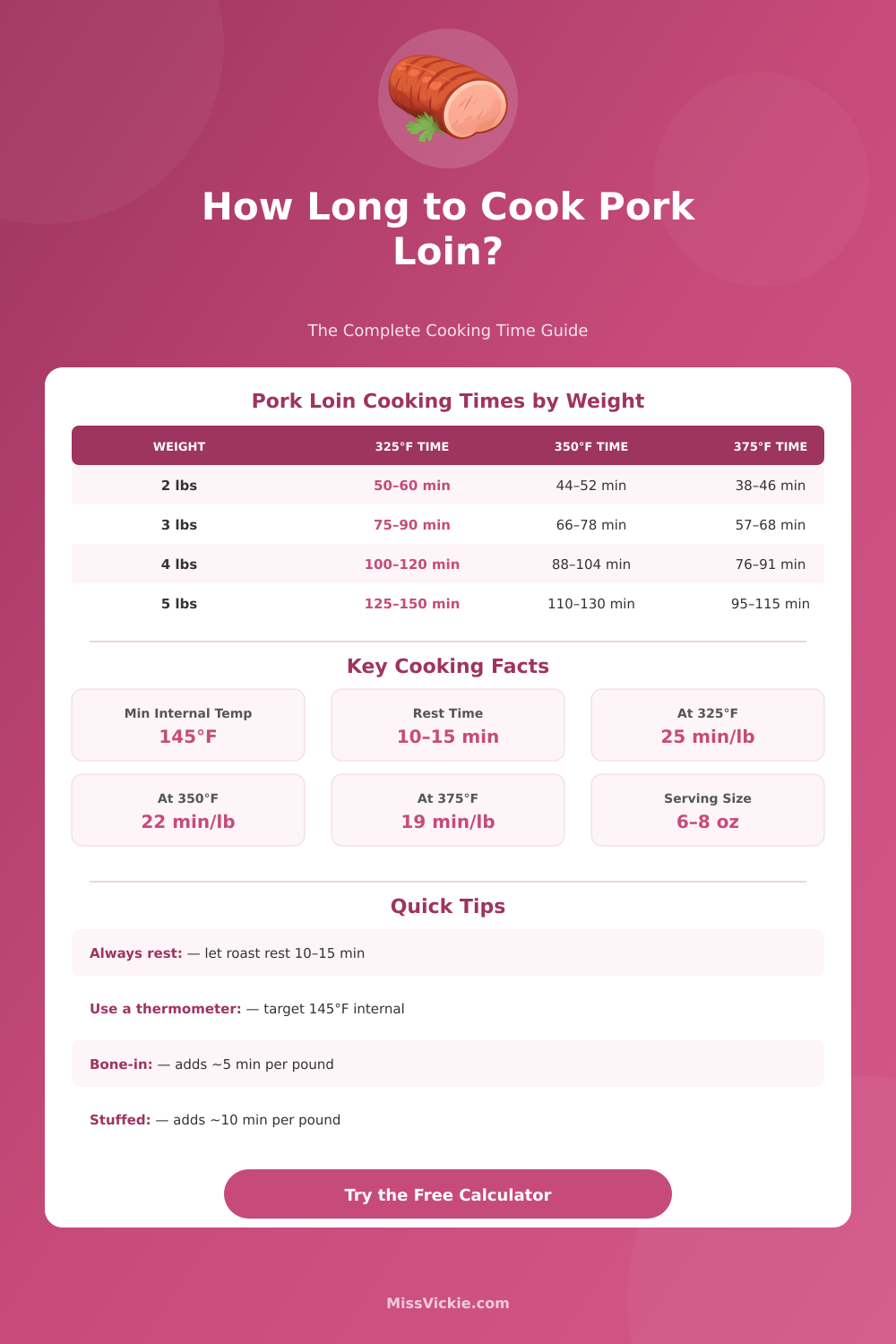
| Weight (lb) | Weight (kg) | 325°F / 163°C | 350°F / 177°C | 375°F / 191°C |
|---|---|---|---|---|
| 1 lb | 0.45 kg | 25–30 min | 22–26 min | 19–23 min |
| 1.5 lb | 0.68 kg | 38–45 min | 33–39 min | 28–34 min |
| 2 lb | 0.91 kg | 50–60 min | 44–52 min | 38–46 min |
| 2.5 lb | 1.13 kg | 63–75 min | 55–65 min | 48–57 min |
| 3 lb | 1.36 kg | 75–90 min | 66–78 min | 57–68 min |
| 4 lb | 1.81 kg | 100–120 min | 88–104 min | 76–91 min |
| 5 lb | 2.27 kg | 125–150 min | 110–130 min | 95–115 min |
| 6 lb | 2.72 kg | 150–180 min | 132–156 min | 114–137 min |
| Cut Type | Time Adjustment | Min/lb at 350°F | Notes |
|---|---|---|---|
| Boneless (unstuffed) | Baseline | ~22 min/lb | Standard calculation |
| Bone-In (unstuffed) | +5 min/lb | ~27 min/lb | Bone slows heat transfer |
| Boneless (stuffed) | +10 min/lb | ~32 min/lb | Filling adds mass & density |
| Bone-In (stuffed) | +15 min/lb | ~37 min/lb | Maximum adjustment needed |
| Roast Weight | Cooked Yield (~75%) | Servings (6 oz) | Servings (8 oz) |
|---|---|---|---|
| 2 lb (0.91 kg) | 1.5 lb (0.68 kg) | 4 servings | 3 servings |
| 3 lb (1.36 kg) | 2.25 lb (1.02 kg) | 6 servings | 4–5 servings |
| 4 lb (1.81 kg) | 3 lb (1.36 kg) | 8 servings | 6 servings |
| 5 lb (2.27 kg) | 3.75 lb (1.70 kg) | 10 servings | 7–8 servings |
| 6 lb (2.72 kg) | 4.5 lb (2.04 kg) | 12 servings | 9 servings |
The pork loin comes from the part under the shoulder and usually are quite lean, with fat cover that one can remove to any level of liking after one is done. The most common of those roasts weigh between two and five pounds and have height of around two to three inches. It is especially flexible.
Some even arrive pre-spiced at the butcher, which wants to say that you simply unwrap and roast it.
Pork Loin: What It Is and How to Cook It
Here where folks commonly err: pork loin and pork tenderloin sound so alike that one thinks them be same cut, but they really are quite different. The tenderloin is more little, slimmer and much more narrow than its partner. It also cooks more quickly and handles higher heat without drying.
The tenderloin is that muscle that rests along the spine and is removed from the loin itself. The pork loin, on the other hand is broader and flatter. Think about T-bone steak if you want a picture in the mind, the streaky part from New York is like the loin, while that little round bit is your tenderloin.
Pork chops are simply individual stekas cut from the loin, and how soft and fat they are depends on where along the loin the bit came from.
You have some good options with pork loin. Roast it whole works well, or one can cut it in thick chops of around one and half inch and cook like this. Cut it thin and you get material for fry or bake quickly.
A whole loin can be split into roasts, chops, slim slices, even the cover one can use for stuffing if one wants. Medallions cooked in sauce are also delicious. Grill the whole bit and cut it paper-thin gives wonderful sandwiches.
A meat thermometer is not optional hear, it is truly needed. Overdoing is the main problem with pork loin. You want internal temperature of 145 degrees Fahrenheit, and going more high makes it dry out quickly.
Because the pork loin is lean, there is not much fat or tissue around for keeping the juice. Once the juice is gone, there is not real way to recover it. Cook low and slowly or brine helps it stay soft and juicy.
Simple brine is just, salt, water, peppers, bay leaves and cracked pepper if one wants.
Keep it simple when dealing about spices. Pepper, onion powder, salt, pepper and olive oil works well for food that all at the table will like. Herb mustard glaze with slow roasting gives soft results also.
Or stuff the loin with garlic and sausage for deeper taste. One thing that matters: leave the fat cover facing up during cook. Tying it helps themeat stay moist during the roasting.
Good ratio is around eight units of raw pork, that cooks to about three units. If you start with four units of boneless raw pork, you get rough three units after cook. Pork loin naturally has little sodium and is rich in protein.