🍍 Sugar in Pineapple Calculator
Calculate exact sugar content by form, serving size & unit — fresh, canned, or juice
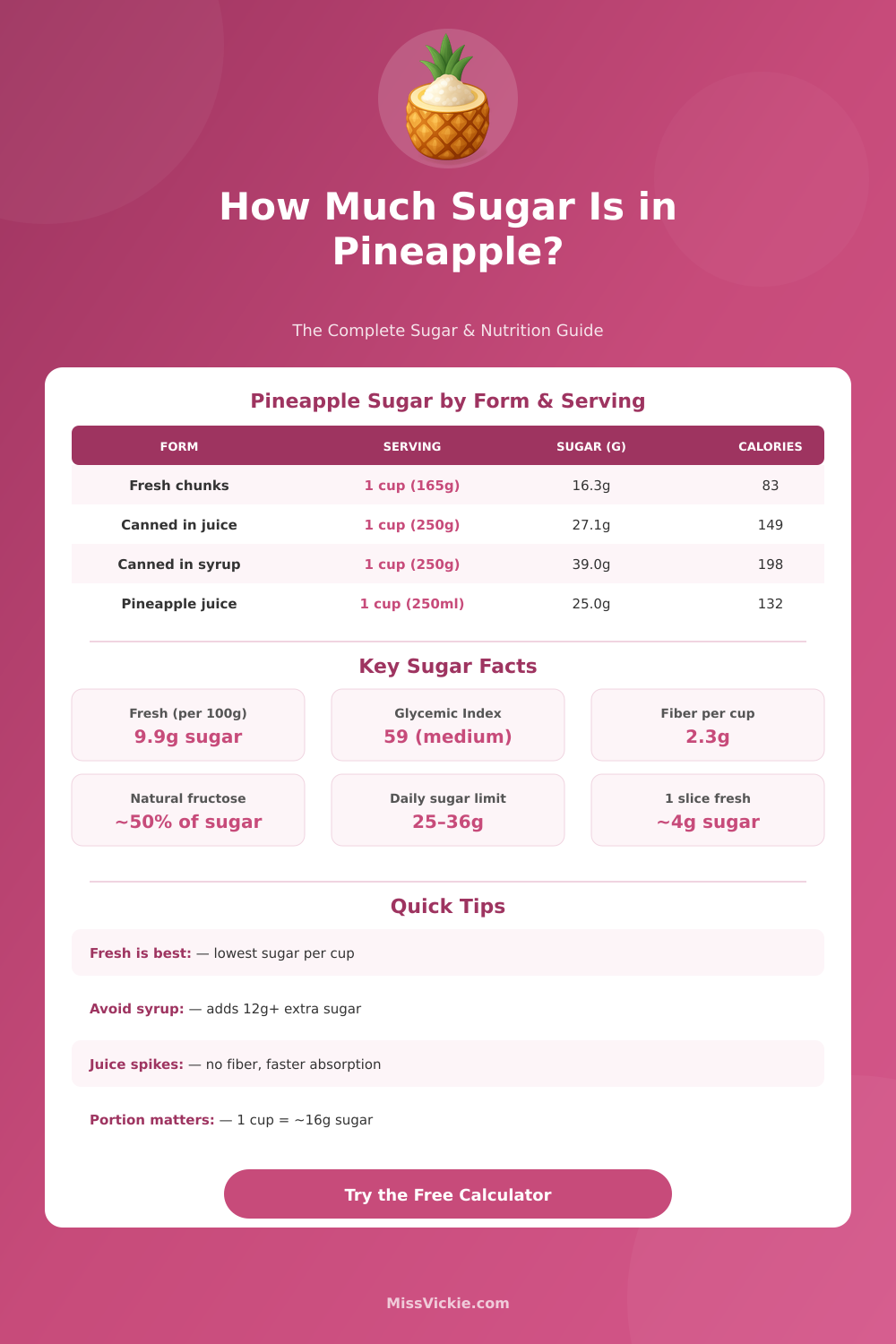
| Pineapple Form | Sugar per 100g | Calories per 100g | Fiber per 100g | GI (approx) |
|---|---|---|---|---|
| Fresh Pineapple | 9.9g | 50 kcal | 1.4g | 59 (medium) |
| Canned in Juice | 10.8g | 60 kcal | 1.0g | 65 (medium) |
| Canned in Syrup | 15.6g | 79 kcal | 1.0g | 70 (high) |
| Pineapple Juice (100%) | 10.0g | 53 kcal | 0.2g | 46–66 |
| Dried Pineapple | 57.8g | 245 kcal | 2.3g | ~65 |
| Frozen Pineapple | 9.5g | 48 kcal | 1.3g | ~55 |
| Serving | Weight | Total Sugar | Calories | % Daily Sugar* |
|---|---|---|---|---|
| 1 Slice fresh (3/4" thick) | 84g | 8.3g | 42 kcal | 23% |
| 1 Cup fresh chunks | 165g | 16.3g | 83 kcal | 45% |
| 1 Cup canned in juice | 250g | 27.1g | 150 kcal | 75% |
| 1 Cup canned in syrup | 250g | 39.0g | 198 kcal | 108% |
| 1 Cup pineapple juice | 250ml | 25.0g | 132 kcal | 69% |
| 1 oz dried pineapple | 28g | 16.2g | 69 kcal | 45% |
| Half a medium pineapple | ~450g | 44.6g | 225 kcal | 124% |
| Whole medium pineapple (flesh) | ~900g | 89.1g | 450 kcal | 248% |
| Imperial Measure | Approx. Weight | Sugar (fresh) | Sugar (canned/juice) |
|---|---|---|---|
| 1 teaspoon (chunks) | ~5g | 0.5g | 0.5g |
| 1 tablespoon (chunks) | ~15g | 1.5g | 1.6g |
| 1/4 cup | ~41g | 4.1g | 4.4g |
| 1/2 cup | ~83g | 8.2g | 9.0g |
| 1 cup | ~165g | 16.3g | 17.8g |
| 1 oz | 28.3g | 2.8g | 3.1g |
| 8 fl oz juice | ~237ml | — | 23.7g |
Pineapple is a tropical fruit that comes from a plant called Ananas comosus. It belongs to the family Bromeliaceae, so it is a relative of tillandsia and Spanish moss. Unlike most bromeliads pineapple plants grow in soil at ground level, which keeps them grounded.
The plant originally came from South America, where people grew it for centuries.
How Pineapples Grow and How to Use Them
The pineapple plant is a slow-growing herb that forms rosettes. It owns long leaves shaped like swords, that arrange themselves in a spiral around the central stalk. Some types have spines at the edges of the leaves, while others do not.
Most pineapples have between 30 and 40 thick, pointed green leaves, that exit from the stalk of teh fruit.
All pineapples start as a bunch of up to 200 small flowers, that grow from the centre of the plant. After pollination, those flowers slowly merge to form the fruit of the pineapple. This quite a lot surprises, if one would think about it.
The fruit itself has strong, rough skin and sweet smell, when it matures. After bananas and citrus fruits, pineapples rank among the three most grown tropical fruits.
Pineapple commonly links with Hawaii, but indeed it is not native there. Even so now it is one of the main crops of those islands.
The fruit stores nutrients, antioxidants and enzymes, that can guard against inflammation and diseases. It is rich in vitamin C, manganese and antioxidants, that help to support the immune system. It also has bromelain, an enzyme with anti-swelling traits, that can help with digestion.
Pineapple is low in fat, with less than half a gram per one-cup serving. It consists mainly of water and carbohydrates, and the standard serving size is one cup of chunks.
A good way to check the ripeness is to pull one of the leaves. If it comes out easily, the fruit is ripe and sweet. Ripe pineapple should smell fruity and sweet.
If it feels soft in parts, it starts two rot and then will be fine when one cuts away the bad bits.
Cut pineapple can seem a bit hard. One way is to remove the core and cut the fruit on one side right beside it, then repeat on the other side and the other two. From there, one can chop the bits to any size that best works.
Fresh pineapple should be cut and placed in the fridge within one to two days after purchase.
Cut pineapple goes well in sauces, smoothies, salads and yoghurt. It is also a common flavor in drinks, that adds tropical feel to them. Pineapple is safe for people with diabetes, if one eats itmoderate.