🍊 Sugar in Orange Juice Calculator
Find out exactly how much sugar, calories & carbs are in your orange juice serving
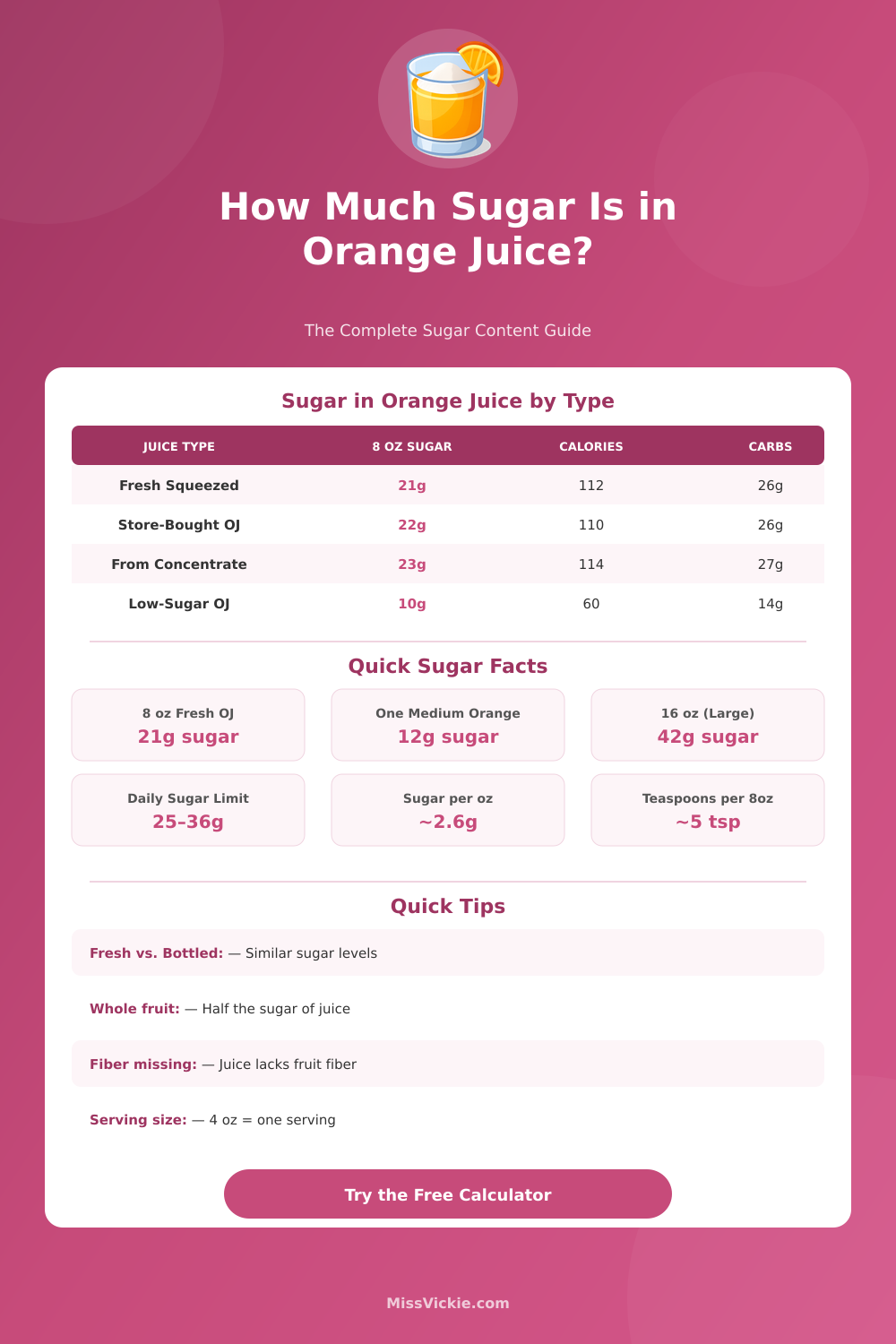
| Juice Type | Sugar (g) | Calories | Carbs (g) | Protein (g) | Glycemic Index |
|---|---|---|---|---|---|
| Fresh Squeezed | 20.8g | 112 | 25.8g | 1.7g | ~50 |
| Store-Bought / Pasteurized | 21.9g | 110 | 25.5g | 1.7g | ~50 |
| Not From Concentrate (NFC) | 21.5g | 111 | 25.6g | 1.7g | ~50 |
| From Concentrate | 22.7g | 114 | 26.8g | 1.7g | ~52 |
| Low-Sugar / Reduced Sugar | 10.0g | 60 | 14.0g | 0.8g | ~38 |
| OJ Blend (with other fruits) | 23.5g | 120 | 28.0g | 1.0g | ~53 |
| Serving Size | fl oz | ml | Sugar (g) | Calories | Teaspoons of Sugar |
|---|---|---|---|---|---|
| Small / Kids | 4 oz | 120 ml | 10.4g | 56 | ~2.5 tsp |
| Standard Serving | 6 oz | 177 ml | 15.6g | 84 | ~3.7 tsp |
| Standard Glass | 8 oz | 240 ml | 20.8g | 112 | ~5.0 tsp |
| Large Glass | 12 oz | 355 ml | 31.2g | 168 | ~7.4 tsp |
| Bottle / Tumbler | 16 oz | 473 ml | 41.6g | 224 | ~9.9 tsp |
| Quart | 32 oz | 946 ml | 83.2g | 448 | ~19.8 tsp |
| Item | Serving | Sugar (g) | Calories | Fiber (g) | Notes |
|---|---|---|---|---|---|
| Whole Orange (medium) | 131g | 12.2g | 62 | 3.1g | High fiber slows sugar absorption |
| Fresh OJ (8 oz) | 240 ml | 20.8g | 112 | 0.5g | ~2 oranges squeezed, no fiber benefit |
| Store-Bought OJ (8 oz) | 240 ml | 21.9g | 110 | 0.5g | Pasteurized, flavor packs added |
| Low-Sugar OJ (8 oz) | 240 ml | 10.0g | 60 | 0.0g | Diluted or enzyme-treated |
| Unit | Equals (ml) | Equals (fl oz) | Sugar in Fresh OJ (g) |
|---|---|---|---|
| 1 fl oz | 29.6 ml | 1 fl oz | 2.6g |
| 1 cup | 240 ml | 8 fl oz | 20.8g |
| 100 ml | 100 ml | 3.38 fl oz | 8.7g |
| 250 ml | 250 ml | 8.45 fl oz | 21.7g |
| 500 ml | 500 ml | 16.9 fl oz | 43.5g |
| 1 liter | 1000 ml | 33.8 fl oz | 87.0g |
orange juice is made up of liquid that one makes from oranges. One gets it by means of pressing or squeezing of the fruits. Various types exist, for instance blood-oranges, navel oranges, Valencia oranges, clementines and mandarins.
For great juice, one should choose especially Valencia oranges.
Orange Juice Basics
orange juice has a tart and fresh taste together with nice smell. Juice freshly pressed ranks among classic fridge favorites and is a lasting choice for thirst quenching drink. It is rich in vitamins and minerals, including vitamin C, folate and potassium.
One glass of 100-percent juice counts as one serving of fruit. The advised amount is 8 units for adults and 4 to 6 units for children.
When oranges are cut or pressed, the vitamin C starts to break down. Only after 8 hours, fresh juice may lose up to 20 percent of its vitamin C. Closed cartons last at least until the date on teh package. After opening, the 9-day countdown starts.
Juices from stores come in different forms. There are those “not from concentrate” and juices from concentrate, plus frozen concentrates, that one mixes at home. Drink companies work with taste and scent experts to create flavor blends, that restore to the juice the taste of oranges.
The additions supposedly come from the fruit, so that companies can market “100% oranges” on the label. Frozen juice from concentrate holds fewer nutrients than that not from concentrate, and sales dropped partly because of that.
Pulp free juice dumps all the fiber from the orange. Eating whole oranges helps more for the belly, because the fiber enters the body. During eating of whole fruit, the sugar and nutrients release slowly because of there tie to the fiber.
With juice, the body absorbs everything much more quickly. Oranges have quite a lot of sugar among citrus fruits. Actually, three types of sugar are present in orange juice: glucose, fructose and sucrose.
The brand Good and Gather for orange juice is smooth, thicker than that of Great Value and full in orange taste without bitter notes. The cheaper juice has a pale orange shade, but its smell is a bit bitter and weak. Prices of orange juice went up a lot because of the year start.
More than for drinking, orange juice works well in the kitchen. It can deglaze pans after meat cooking, acting as sweet-bitter base for sauce. Add it to leafy vegetables to help reduce their bitterness.
Orange crepes get bright taste from juice and fresh zest. Also in soups, orange juice adds sweetness, giving to them a gentle tartness. It even goeswell with ginger in mixes, especially when with a bit of cinnamon.