🧀 Nutritional Yeast Protein Calculator
Calculate the exact protein, calories, and nutrients in any amount of nutritional yeast
| Amount | Weight (g) | Protein (g) | Calories |
|---|---|---|---|
| 1 teaspoon | 2.7g | 1.3g | 10 |
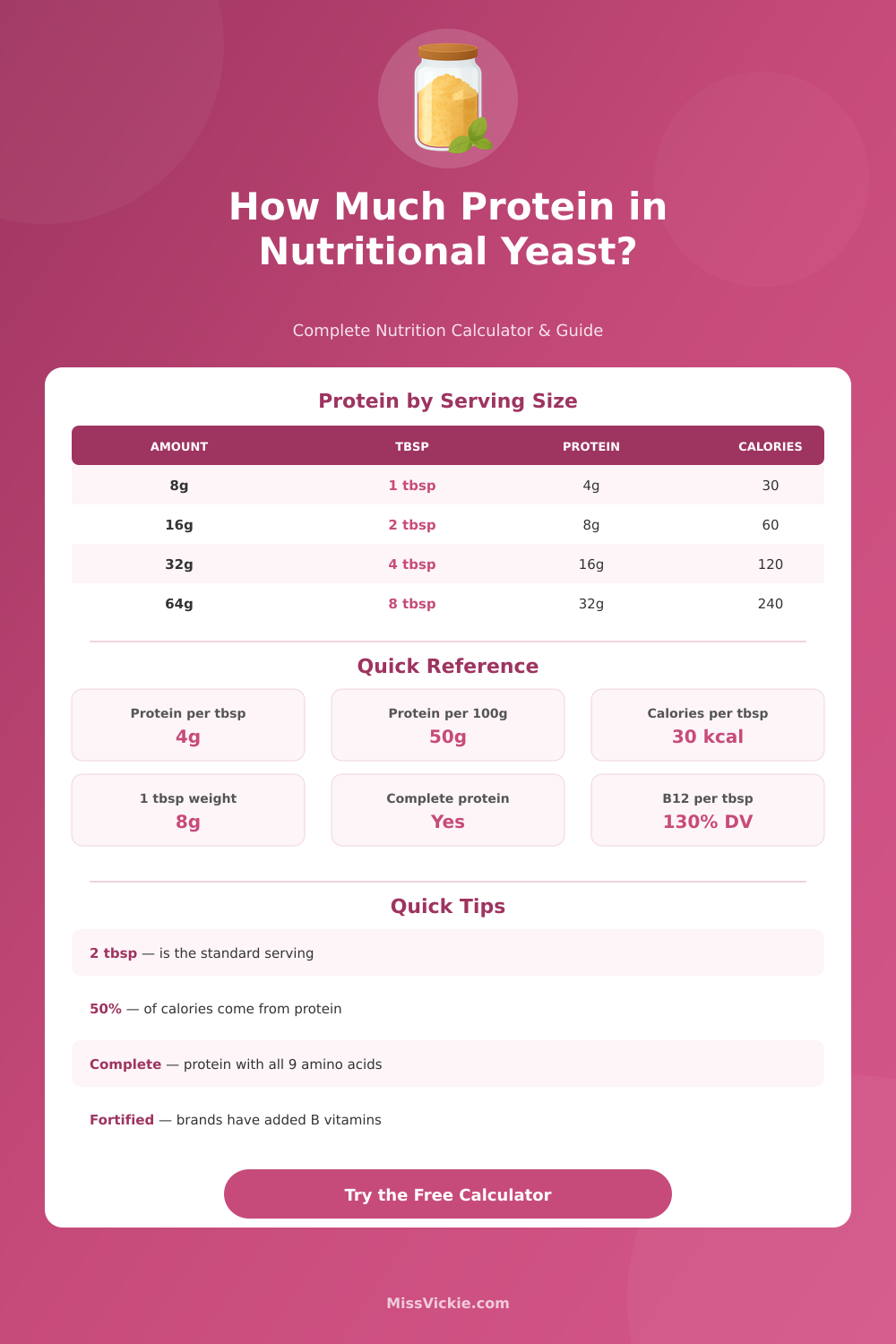
| 1 tablespoon | 8g | 4g | 30 |
| 2 tablespoons | 16g | 8g | 60 |
| 3 tablespoons | 24g | 12g | 90 |
| ¼ cup (4 tbsp) | 32g | 16g | 120 |
| ½ cup (8 tbsp) | 64g | 32g | 240 |
| 1 cup (16 tbsp) | 128g | 64g | 480 |
| 1 ounce | 28.35g | 14g | 105 |
| 100 grams | 100g | 50g | 375 |
| Volume Measure | Weight (Metric) | Weight (Imperial) | Tablespoons |
|---|---|---|---|
| 1 teaspoon | 2.7g | 0.095 oz | 0.33 tbsp |
| 1 tablespoon | 8g | 0.28 oz | 1 tbsp |
| ¼ cup | 32g | 1.13 oz | 4 tbsp |
| ⅓ cup | 43g | 1.5 oz | 5.3 tbsp |
| ½ cup | 64g | 2.26 oz | 8 tbsp |
| ⅔ cup | 85g | 3 oz | 10.7 tbsp |
| 1 cup | 128g | 4.5 oz | 16 tbsp |
| Amino Acid | Amount (mg) | % of Protein | Essential? |
|---|---|---|---|
| Leucine | 580 | 7.3% | Yes |
| Lysine | 510 | 6.4% | Yes |
| Valine | 440 | 5.5% | Yes |
| Isoleucine | 380 | 4.8% | Yes |
| Threonine | 380 | 4.8% | Yes |
| Phenylalanine | 340 | 4.3% | Yes |
| Tryptophan | 100 | 1.3% | Yes |
| Methionine | 120 | 1.5% | Yes |
| Histidine | 180 | 2.3% | Yes |
| Glutamic Acid | 1200 | 15% | No |
| Food (per 100g) | Protein (g) | Calories | Protein per Calorie |
|---|---|---|---|
| Nutritional Yeast | 50g | 375 | 0.13g/kcal |
| Chicken Breast | 31g | 165 | 0.19g/kcal |
| Tofu (firm) | 8g | 76 | 0.11g/kcal |
| Lentils (cooked) | 9g | 116 | 0.08g/kcal |
| Eggs | 13g | 155 | 0.08g/kcal |
| Greek Yogurt | 10g | 59 | 0.17g/kcal |
| Hemp Seeds | 32g | 553 | 0.06g/kcal |
| Peanut Butter | 25g | 588 | 0.04g/kcal |
A single tablespoon of nutritional yeast weighs about 8 grams and delivers roughly 4 grams of protein at only 30 calories. Thats a 50% protein-by-weight ratio, which honestly blew me away when I first checked. Two tablespoons give you 8 grams of complete protein with all 9 essential amino acids.
The information below does not come from any computer or tool used on this page. It bases on real studies, forum talks and cooking experiences from the community, that one finds through the net.
What Nutritional Yeast Is and How to Use It
Nutritious yeast is made up of idle yeast from the type Saccharomyces cerevisiae. It matches to the yeast that bakers or brewers use in its active state. Rather, this nutritious yeast one grows specially to gather and dry.
One grows it on nutritious base, and some brands choose molasses for that. Later it passes through harvest, warming, drying and milling. Because of the killing of the yeast during the production, the final product does not carry alive cells.
That is whole-cell idle yeast, that has both soluble and insoluble elements, so it differs from yeast extract.
This powder yeast receives its name because of the nutrients, that it bears. It is rich in protein, vitamins, minerals and antioxidants. That forms complete protein, and one spoon of it stores around 4.3 grams of protein, 3 grams of carbs, 0.3 grams of fat and no sugar for 30 calories.
Two spoons form a fat-free serving. Moreover it is rich in potassium and bears iron.
Most brands strengthen it with B-vitamins, among them B12. Some brands give more than 500 percent of the daily need of B12 for one serving. Because B12 dissolves in water, it little risks harm, even in big amounts. This is especially useful for folks on plant-based diets, that commonly have few sources of B12. Even so, better use a reliable supplement of B12 than depend only on nutritious yeast.
Also there exist plain variants, that can please more to certain taste buds.
The flavor reminds of cheese with a lightly nutty tone. It does not salt naturally, hence matter to add salt during the usage, like parmesan. Good strategy is take only half of the amount, that recipe requires for parmesan with nutritious yeast.
Otherwise it risks two strong a taste.
It well works sprinkled on popcorn, mixed in soups, mixed with salad dressings, tossed with rice and vegan butter or stirred in a pasta dish. No need to cook it, just add it at the finish of the preparation. One can also mix it with plain nuts to create a dairy-free parmesan-style topping.
People with gout should remove focused yeast of any type. It can create immune reactions or worsen signs in those, that have inflammatory intestinal diseases. It is possible to start with one spoon a day as a good dose.
Studies point, that it offers possible healthbenefits, from reduced cholesterol levels to guarding against cell damage.