🧊 Mussels Per Person Calculator
Find out exactly how many mussels you need for any occasion
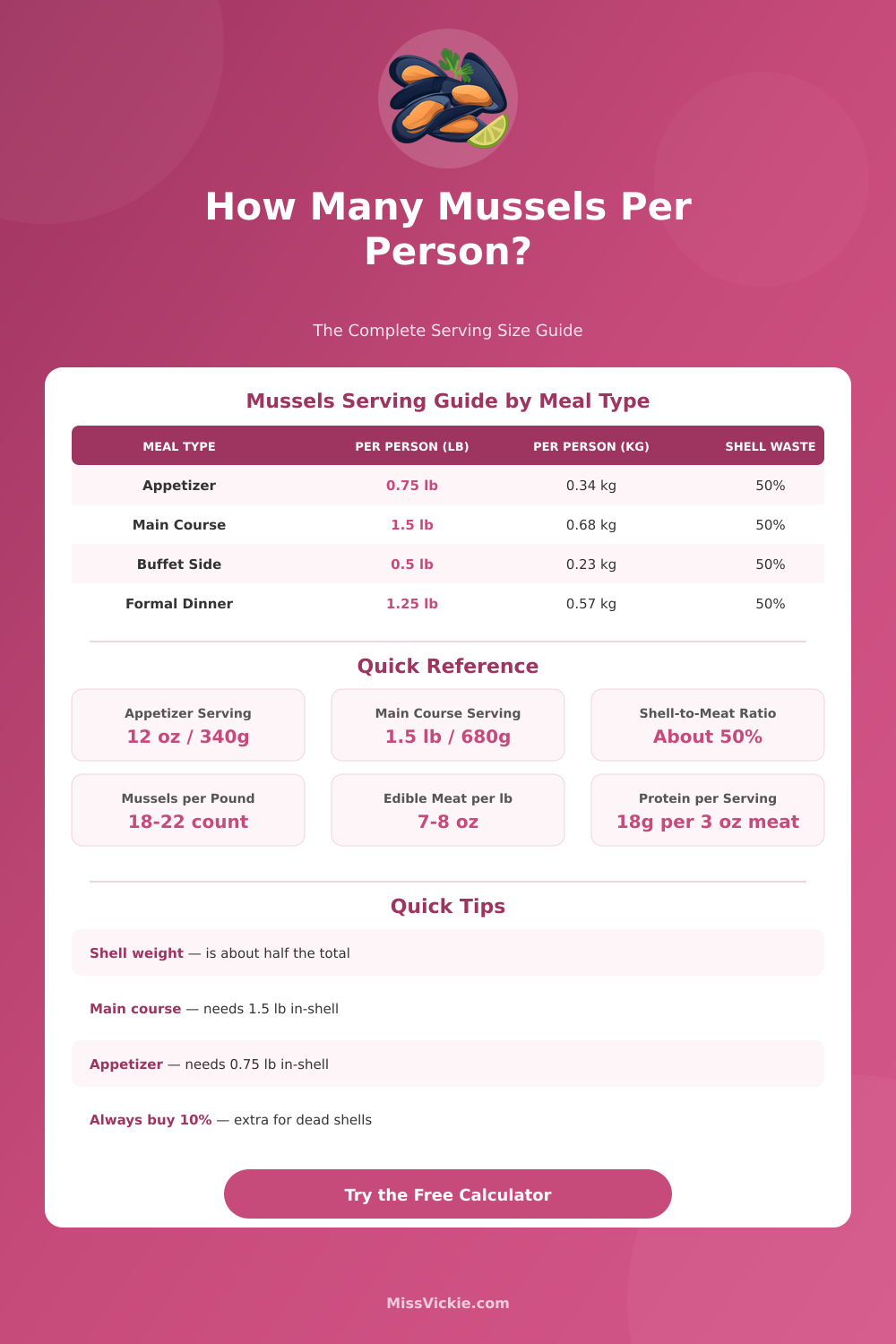
| Meal Type | In-Shell (lb) | In-Shell (kg) | Meat Yield (oz) | Mussel Count |
|---|---|---|---|---|
| Appetizer / Starter | 0.75 | 0.34 | 5–6 | 14–17 |
| Main Course | 1.5 | 0.68 | 10–12 | 27–33 |
| Buffet Side | 0.5 | 0.23 | 3.5–4 | 9–11 |
| Formal Dinner | 1.25 | 0.57 | 9–10 | 23–28 |
| Guests | Appetizer (lb / kg) | Main Course (lb / kg) | Buffet Side (lb / kg) |
|---|---|---|---|
| 5 | 3.75 / 1.7 | 7.5 / 3.4 | 2.5 / 1.1 |
| 10 | 7.5 / 3.4 | 15 / 6.8 | 5 / 2.3 |
| 15 | 11.25 / 5.1 | 22.5 / 10.2 | 7.5 / 3.4 |
| 20 | 15 / 6.8 | 30 / 13.6 | 10 / 4.5 |
| 25 | 18.75 / 8.5 | 37.5 / 17 | 12.5 / 5.7 |
| 50 | 37.5 / 17 | 75 / 34 | 25 / 11.3 |
| 100 | 75 / 34 | 150 / 68 | 50 / 22.7 |
| Measurement | Imperial | Metric | Notes |
|---|---|---|---|
| 1 pound in-shell | 16 oz | 454 g | 18–22 mussels |
| Meat from 1 lb in-shell | 7–8 oz | 200–225 g | ~50% yield |
| 1 kg in-shell | 2.2 lb | 1000 g | 40–48 mussels |
| Meat from 1 kg in-shell | 15.5–17.5 oz | 440–500 g | ~50% yield |
| 1 quart shucked meat | ~1.5 lb | ~680 g | Pre-shucked |
| Size Class | Count per lb | Count per kg | Shell Length |
|---|---|---|---|
| Small | 25–30 | 55–66 | Under 2 in (5 cm) |
| Medium | 18–22 | 40–48 | 2–2.5 in (5–6 cm) |
| Large | 12–16 | 26–35 | 2.5–3 in (6–7.5 cm) |
| Jumbo (Green-lipped) | 8–12 | 18–26 | 3+ in (7.5+ cm) |
Mussels are bivalve molluscs that live in saltwater and freshwater environments. They belong to the same group as scallops, oysters and Mussels. The shells of Mussels have a long and uneven shape what makes them seem different to other edible molluscs that usually are rounder or oval.
One finds Mussels in freshwater lakes, rivers and brooks as well as in the saltwater tidal zone where the sea touches the coast. Until the 1970s and 1980s wild Mussels were the only option. Then one found them growing on island rocks, naval posts and everywhere where they could attach.
Mussels: Where They Live, How to Cook Them, and Why They Are Healthy
Eighty percent of Mussels sold in North America come from Prince Edward Island at the east coast of Canada. Now one grows Mussels also on strings that they attach to. They clean the water from nitrates, that folks dump in the sea through farming activity.
Like this, when one grows Mussels for food, they really help to restroe a bit of the environmental harm caused by farming.
Cooking Mussels at home seems fancy, but really it is simple. Mussels cooked in white wine broth with herbs and lemon fills the mouth with rich flavor. The wine gives depth, the lemon freshens the whole thing, parsley brings grassy taste and a bit of cream makes it creamy.
During the cook, Mussels spill their own salty juice in the pot, what creates tender broth. The famous French dish Moules Marinières is simply fast food in its best form, served with wine and lots of toasted bread too soak the lovely salty broth. Everything lasts only fifteen minutes.
Well scrubbing the shells matters to escape grit in the broth. Mussels that do not close when one taps them, one should dump. All shells that stay closed after cooking, one should toss.
Mussels do not live in the sand, so besides removing the beard, they already should be quite pure.
Fresh Mussels are small and chewy, but mostly soft and similar to scallops, only with less salty taste. They give a sweet and fine feel. The mussel is the simplest shellfish to eat, because the shell opens during cooking.
One serves them usually with a tiny small fork for pulling the meat from it.
Mussels are rich in nutrients. They have great proteins and digest well. They are rich in B-vitamins and minerals like iodine and magnesium, what makes them full of nutrients and low in calories.
Also they are packed with protein and have little fat. For a serving one uses roughly twenty Mussels, what matches closely to one pound with shells. Such amount gives between three and four units of meat.
One pound is enough for one person as main dish or for two folks as a starter. A two-pound bag usually feeds two to four people. One sells Mussels by the pound andthey cost fairly little.