🥛 Protein in Milk Calculator
Calculate exact protein grams for any milk type and serving size
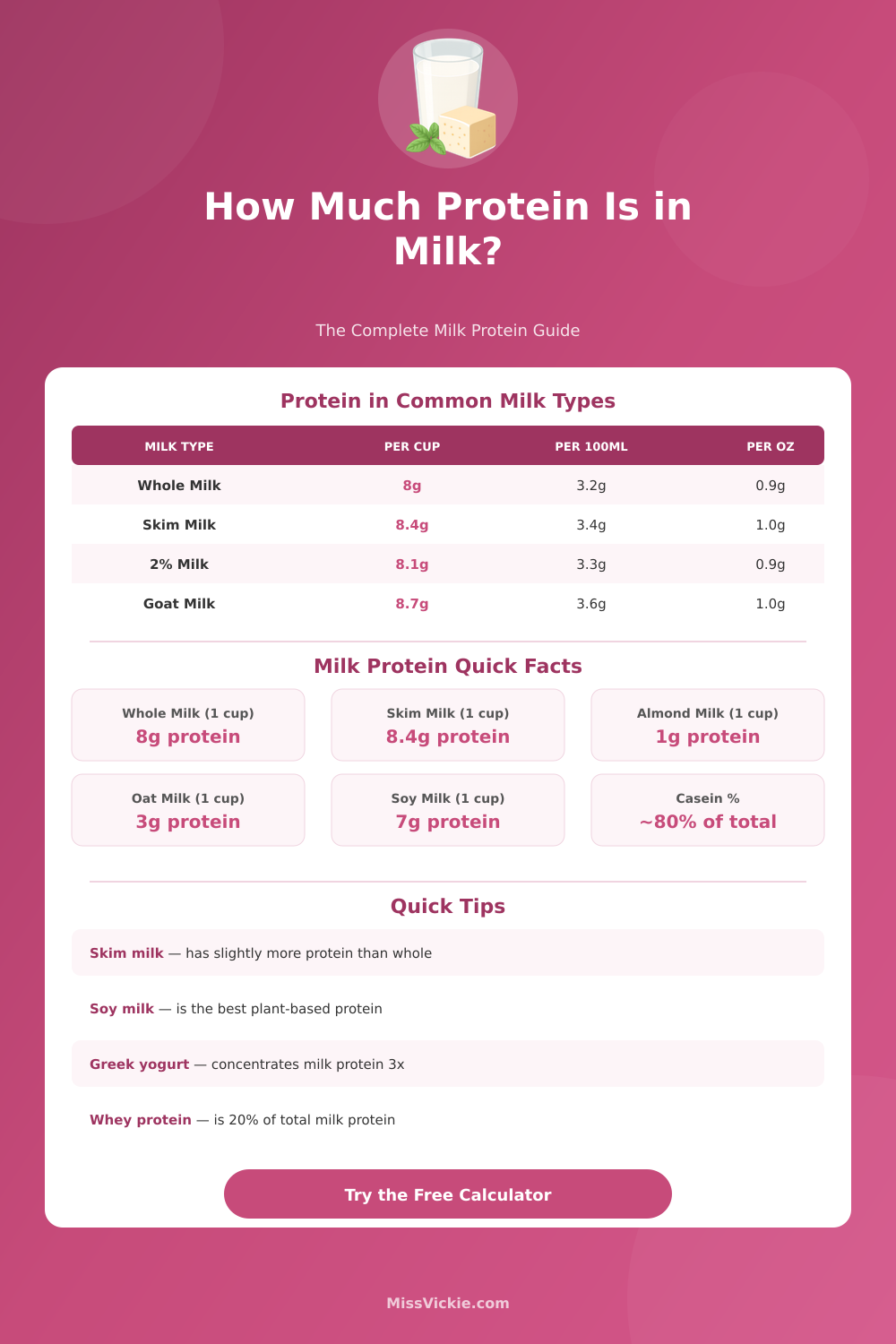
| Milk Type | Protein/100ml | Protein/Cup (240ml) | Protein/fl oz | Calories/100ml | Fat/100ml |
|---|---|---|---|---|---|
| Whole Milk (3.25%) | 3.2g | 7.7g | 0.95g | 61 kcal | 3.3g |
| 2% Reduced Fat | 3.4g | 8.1g | 1.0g | 50 kcal | 2.0g |
| 1% Low Fat | 3.4g | 8.2g | 1.0g | 42 kcal | 1.0g |
| Skim / Non-Fat | 3.5g | 8.4g | 1.03g | 35 kcal | 0.1g |
| Goat Milk | 3.6g | 8.7g | 1.06g | 69 kcal | 4.1g |
| Sheep Milk | 5.4g | 13.0g | 1.6g | 108 kcal | 7.0g |
| Buffalo Milk | 3.8g | 9.1g | 1.12g | 97 kcal | 6.9g |
| Soy Milk (unsweet.) | 2.9g | 7.0g | 0.86g | 33 kcal | 1.6g |
| Almond Milk (unsweet.) | 0.4g | 1.0g | 0.12g | 13 kcal | 1.0g |
| Oat Milk | 1.3g | 3.0g | 0.37g | 45 kcal | 1.5g |
| Coconut Milk (bev.) | 0.2g | 0.5g | 0.06g | 20 kcal | 2.0g |
| Rice Milk | 0.3g | 0.7g | 0.09g | 47 kcal | 1.0g |
| Serving Description | Volume (ml) | Volume (fl oz) | Whole Milk Protein | Skim Milk Protein |
|---|---|---|---|---|
| 1 tablespoon | 15ml | 0.5 fl oz | 0.5g | 0.5g |
| 1 shot (espresso size) | 30ml | 1 fl oz | 1.0g | 1.1g |
| Small glass | 150ml | 5 fl oz | 4.8g | 5.3g |
| 1 cup (standard) | 240ml | 8 fl oz | 7.7g | 8.4g |
| Large glass | 350ml | 12 fl oz | 11.2g | 12.3g |
| 1 pint (US) | 473ml | 16 fl oz | 15.1g | 16.6g |
| 500ml bottle | 500ml | 16.9 fl oz | 16.0g | 17.5g |
| 1 quart (US) | 946ml | 32 fl oz | 30.3g | 33.1g |
| 1 liter | 1000ml | 33.8 fl oz | 32.0g | 35.0g |
| Goal | Protein Target | Cups of Whole Milk | Cups of Skim Milk | Cups of Soy Milk |
|---|---|---|---|---|
| Child (4–8 yrs) | 19g/day | ~2.5 cups | ~2.3 cups | ~2.7 cups |
| Teenager (14–18 yrs) | 52–59g/day | ~7 cups | ~6.5 cups | ~8 cups |
| Adult (sedentary) | 50g/day | ~6.5 cups | ~6 cups | ~7 cups |
| Active Adult | 75–100g/day | ~10–13 cups | ~9–12 cups | ~11–14 cups |
| Athlete / Bodybuilder | 150–200g/day | ~20–26 cups | ~18–24 cups | ~21–28 cups |
Mammals produce milk from their milk glands, it is simply the best natural food for children. Children of mammals fully depend on that rich liquid, until they can eat solids. Mothers prepare this food specially for their children, and for human babies mother’s milk stays the best standard because their bodies handle it well.
One could believe that milk always is white, but that is not entirely true. It can have yellow, creamy, pink or even brown tones, depending on what the creature ate. It sounds strange, when one first hears that.
Why Milk Is Good for Us
Beyond the color differences, milk stores many nutrients, calcium is only one of the many minerals here. That calcium is needed for strong bones, so milk became a basic part of the diet.
In food density, milk truly has weight. One cup, around eight fluid ounces. Gives thirteen different nutrients in one serving.
We talk about protein, potassium, phosphorus and iodine, as well as B-vitamins like B2 and B12. Protein helps especially to strenghten bones and build muscles. Truly, it is full of good things.
Whole milk is suggested for children between one and two years old. Those full fats are useful during that period, because it helps the brain growth and good development. If you search healthy dairy products, choose those with few carbohydrates, escape too much sugar and add protein.
milk ranks among the most useful sold foods. It carries complete proteins, fat and carbohydrates, that matters. The ability to strengthen and enrich it makes it even more flexible.
It truly is won of those foods, that backs people from birth through their whole life.
In cooking and baking, milk is commonly used. Frothed milk works most to reach the silky texture of cappuccino or latte; keeping it cold helps to not cook it while frothing. Evaporated milk works differently, because one prepares it by means of slow evaporation at low temperatures instead of high.
If one boils normal milk directly, the proteins clot up. Milk thickens, yes, but it will not act the same in recipes later.
Recipes for bread commonly benefit from a bit of milk powder mixed, it improves the crust and gives depth. Replace water with liquid milk in the dough to give similar results. Lactose-free whole milk works just as well for baking, because it is only normal whole milk with added lactase enzyme to break down the sugar.
The fat andtexture stays the same.
There is also a beauty brand with the same name Milk, Make-up, that stresses cruelty-free, vegan products with good ingredients. Entirely other topic, clearly.