🥛 Calcium in Milk Calculator
Find out exactly how much calcium you get from any type and amount of milk
| Milk Type | Calcium / Cup | % Daily Value | Calories / Cup |
|---|---|---|---|
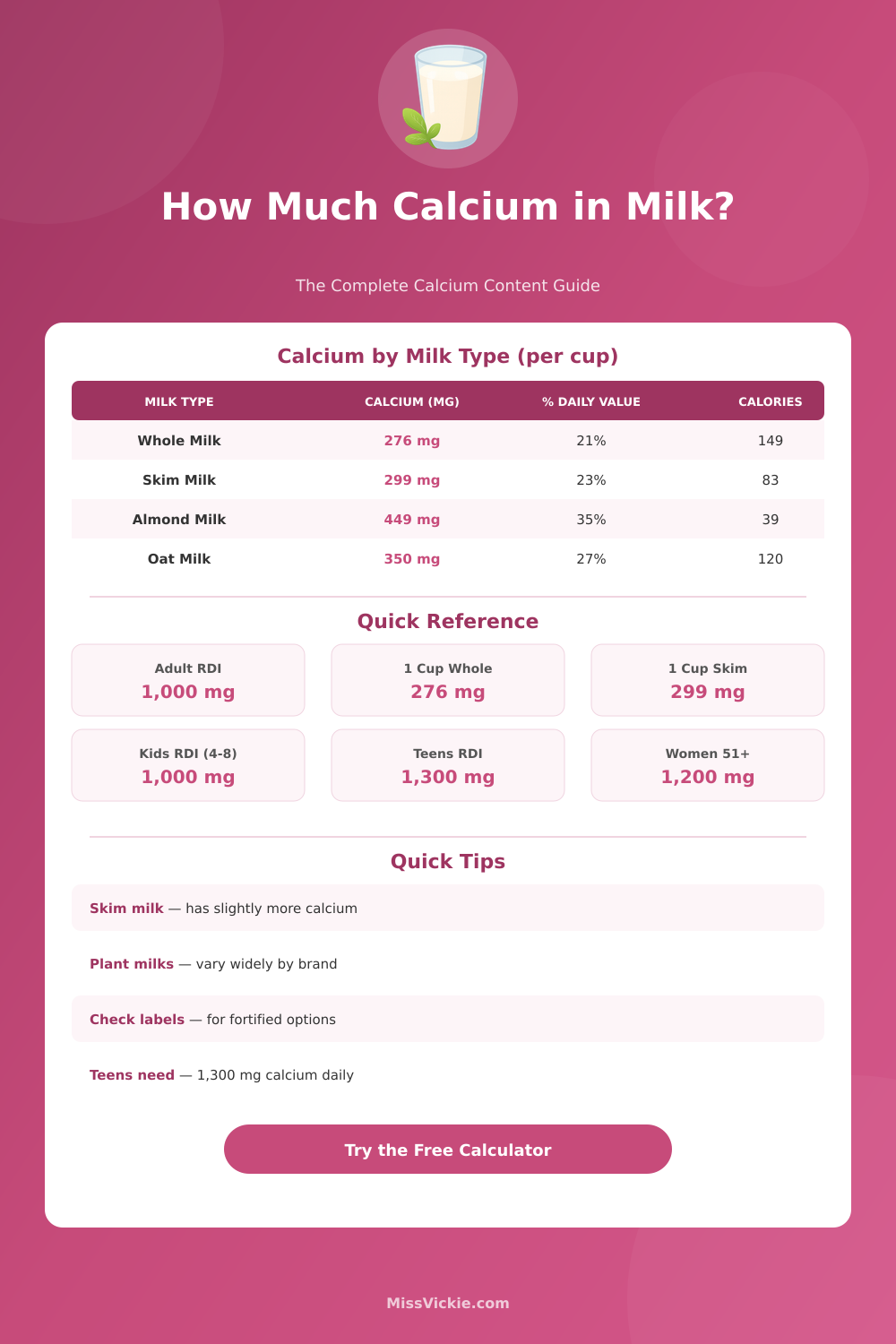
| Whole Milk (3.25%) | 276 mg | 21% | 149 |
| 2% Reduced-Fat | 293 mg | 23% | 122 |
| 1% Low-Fat | 305 mg | 23% | 102 |
| Skim / Fat-Free | 299 mg | 23% | 83 |
| Goat Milk | 327 mg | 25% | 168 |
| Buffalo Milk | 412 mg | 32% | 237 |
| Almond Milk (fortified) | 449 mg | 35% | 39 |
| Almond Milk (unfortified) | 17 mg | 1% | 37 |
| Oat Milk (fortified) | 350 mg | 27% | 120 |
| Soy Milk (fortified) | 300 mg | 23% | 105 |
| Coconut Milk (fortified) | 459 mg | 35% | 76 |
| Rice Milk (fortified) | 283 mg | 22% | 113 |
| Age Group | RDI (mg/day) | Cups of Whole Milk | Cups of Skim Milk |
|---|---|---|---|
| Children 1–3 yrs | 700 mg | 2.5 cups | 2.3 cups |
| Children 4–8 yrs | 1,000 mg | 3.6 cups | 3.3 cups |
| Teens 9–18 yrs | 1,300 mg | 4.7 cups | 4.3 cups |
| Adults 19–50 yrs | 1,000 mg | 3.6 cups | 3.3 cups |
| Women 51–70 yrs | 1,200 mg | 4.3 cups | 4.0 cups |
| Men 51–70 yrs | 1,000 mg | 3.6 cups | 3.3 cups |
| Adults 71+ yrs | 1,200 mg | 4.3 cups | 4.0 cups |
| Pregnant / Lactating | 1,000–1,300 mg | 3.6–4.7 cups | 3.3–4.3 cups |
| Measurement | Milliliters | Fluid Ounces | Cups |
|---|---|---|---|
| 1 Tablespoon | 15 ml | 0.5 fl oz | 0.063 |
| 1/4 Cup | 60 ml | 2 fl oz | 0.25 |
| 1/2 Cup | 120 ml | 4 fl oz | 0.5 |
| 1 Cup (US) | 240 ml | 8 fl oz | 1.0 |
| 1 Glass (metric) | 250 ml | 8.45 fl oz | 1.04 |
| 1 Pint | 473 ml | 16 fl oz | 2.0 |
| 1 Liter | 1,000 ml | 33.8 fl oz | 4.17 |
| 1 Quart | 946 ml | 32 fl oz | 4.0 |
Figuring out the real amount of calcium that one gets from one glass of milk is a task that surprisingly requires careful consideration, and it involves anyone who cares about their diet, cares about the state of his bones or decides between natural dairy milk and fake plant-based replacements. Here steps in the Calculator about Calcium in Milk, considering the huge range of calorie density between various kinds of milks and the various ways folks measure their portions. Whether one is a parent that worries so that the child reaches his daily standard of calcium, a sportsman that adjusts the intake of minerals, or a person that compares dairy milk with that from almonds or from oats, this tool gives you fast safe answers, without the trouble of reading labels about nutrition.
The tool compares values of calcium from the USDA for twenty-three usual types of milk with your chosen amount and unit of measure. It even switches between imperial and metric units. Cups, millilitres, liters, fluid ounces, tablespoons and a standard glass of two hunderd fifty millilitres.
How Much Calcium Is in One Glass of Milk?
One will see the part of your advised daily intake that the portion reaches, the approximate amount of calcium that your body truly absorbs, how many cups of that particular milk are needed to meet your whole daily need and full nutrition, providing proteins, calories, phosphorus and potassium. When one calculates for several portions, the tool ties everything together, making it simple to arrange your daily intake across the meals.
Usually, the body takes only around thirty to thirty-three percent from the calcium offered in milk. That means that one cup of whole milk that has two hundred seventy-six milligrams of calcium truly gives roughly eighty-eight to ninety milligrams to your bones and tissues. The tool considers that, so that one can form expectations that are real.
Besides that, a key factor is the big contrast between fortified and plain plant milks. For instance, almond milk fortified can store four hundred forty-nine milligrams of calcium per cup, beating natural dairy milk; wile the plain form can have only seventeen milligrams. That difference alone can build or break a plan to follow calcium for anyone that follows a diet based on plants.
Always shake packages of plant-based milk well before pouring. The added calcium usually settles down in the container over time, and research showed that even a third of the fortified calcium stays as clumps if the package no one moves. For those that depend on dairy milk, it matters to mention that the fat content has only little effect on the levels of calcium.
In fact, milk without fat gives a bit more calcium per cup than whole milk, because removing the fat part thickens the remaining parts in the same amount. That makes low fat and no fat options equally good just from the viewpoint of calcium. And if one tracks intake for young folk, recall that their advised daily intake is 1,300 mg, thirty percent more than the standard for adults of 1,000 mg.
That bigger demand matches with the strong growth of bone mass, making tracking most useful in those periods.
Pairing milk with foods full of vitamin D can greatly help the absorption of calcium, which is one reason that many store-bought milks are fortified with both elements at once. However, drinking milk together with foods rich in oxalates, like spinach, or with very fibrous foods can slightly lower the rate of absorption. Spreading the intake of milk through the day instead of drinking it all together also raises the total absorption, because the body handles calcium better in small portions of around five hundred milligrams or less at one time.