🍯 Mead Recipe Calculator
Calculate exact honey, water & yeast amounts for any mead batch size and target ABV
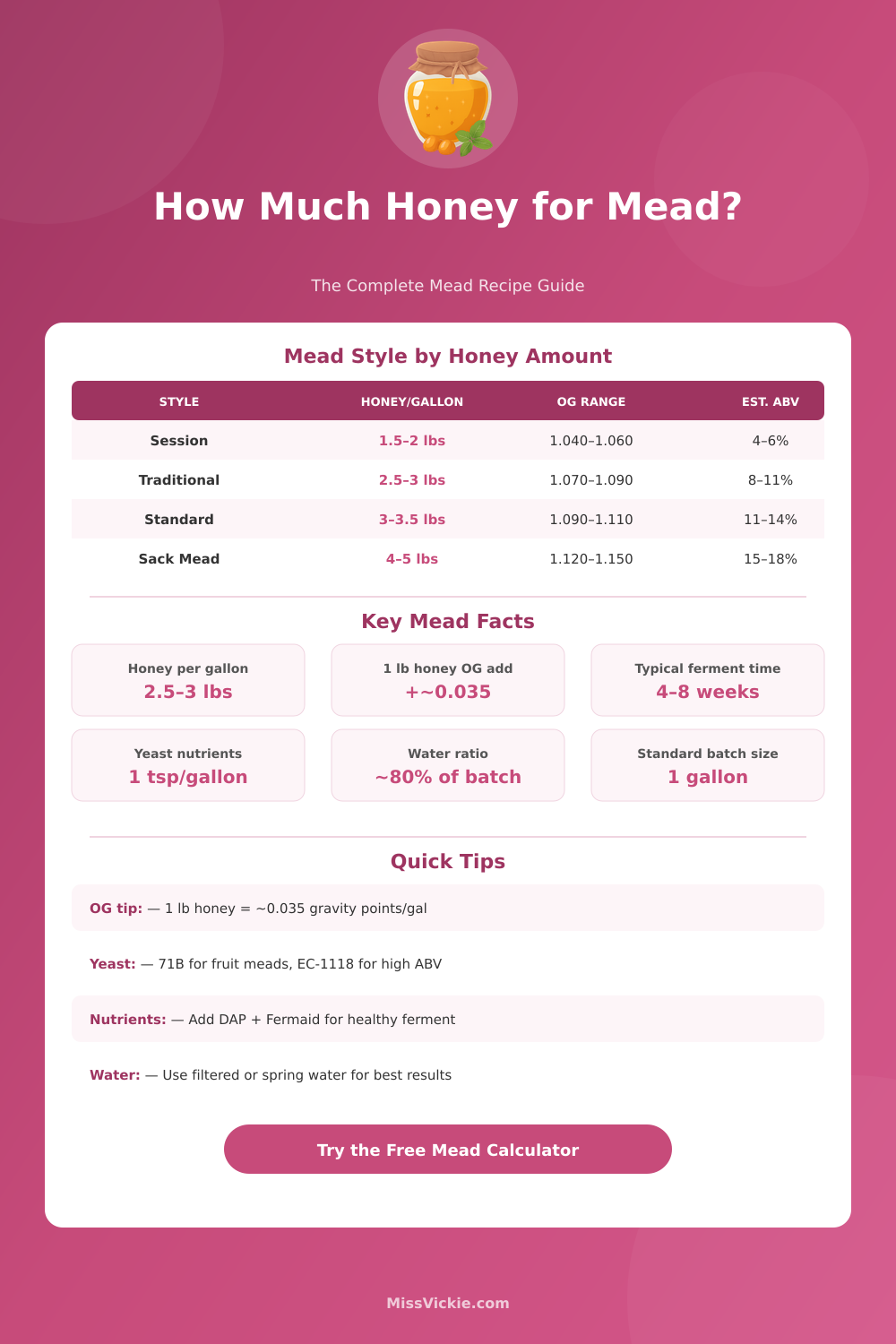
| Style | Honey / Gallon | OG Range | Est. ABV | Sweetness |
|---|---|---|---|---|
| Session Mead | 1.5–2 lbs | 1.040–1.060 | 4–6% | Dry–Semi-Dry |
| Traditional (dry) | 2.5–3 lbs | 1.070–1.090 | 8–11% | Dry |
| Traditional (sweet) | 3–3.5 lbs | 1.090–1.110 | 11–14% | Semi-Sweet |
| Sack Mead | 4–5 lbs | 1.120–1.150 | 15–18% | Sweet |
| Show Mead | 3–4 lbs | 1.100–1.130 | 13–16% | Semi-Sweet |
| Sparkling Mead | 1.5–2.5 lbs | 1.045–1.075 | 6–9% | Dry–Off-Dry |
| Melomel (fruit) | 2–3 lbs | 1.060–1.095 | 8–13% | Semi-Dry |
| Cyser (apple) | 1.5–2.5 lbs | 1.070–1.100 | 9–14% | Off-Dry |
| Bochet (burnt) | 3–4 lbs | 1.095–1.120 | 12–16% | Semi-Sweet |
| Strain | ABV Tolerance | Temp Range | Best For | Nutrient Need |
|---|---|---|---|---|
| Lalvin 71B | Up to 14% | 59–86°F | Fruit meads, melomel | Moderate |
| Lalvin EC-1118 | Up to 18% | 50–86°F | High ABV, sack mead | Low |
| Lalvin D47 | Up to 14% | 59–68°F | Traditional, floral | High |
| Lalvin K1V-1116 | Up to 18% | 50–95°F | Dry meads, cysers | Moderate |
| Lalvin QA23 | Up to 16% | 54–86°F | Floral, fruit forward | Moderate |
| Lalvin RC212 | Up to 13% | 59–86°F | Session, low ABV | High |
| Red Star Cuvee | Up to 18% | 45–95°F | All-purpose, robust | Low |
| Honey (lbs/gal) | Honey (kg/L) | Approx OG | Gravity Points | Est. ABV (dry) |
|---|---|---|---|---|
| 1.0 lb/gal | 0.12 kg/L | 1.035 | 35 | ~4.6% |
| 1.5 lbs/gal | 0.18 kg/L | 1.052 | 52 | ~6.8% |
| 2.0 lbs/gal | 0.24 kg/L | 1.070 | 70 | ~9.1% |
| 2.5 lbs/gal | 0.30 kg/L | 1.087 | 87 | ~11.3% |
| 3.0 lbs/gal | 0.36 kg/L | 1.105 | 105 | ~13.7% |
| 3.5 lbs/gal | 0.42 kg/L | 1.122 | 122 | ~15.9% |
| 4.0 lbs/gal | 0.48 kg/L | 1.140 | 140 | ~18.2% |
| 4.5 lbs/gal | 0.54 kg/L | 1.157 | 157 | ~18%+ (yeast limit) |
Mead is made from alcohol, that one makes by fermenting a mix of honey and water. One commonly calls it honey wine although that name sometimes misleads, because it looks a lot like regular wines. One starts fermentation in the mix of honey and water, that must be kicked by it.
Sometimes one adds other things, for instance fruits, spices, grains or herbs. The level of alcohol ranges between around 3.5% and even more than 18%.
Mead: What It Is, Types and How to Serve It
Mead probably ranks among the most ancient alcoholic drinks that one knows. Actually, historians think it the very first of those, even before wine. It follows mankind during long time, and currently it repeatedly gets popularity.
Various kinds of Mead exist in big number. One calls melomel that, that one makes from fruits together with honey. Metheglin is the name for the version with spices.
Also the Mead with cider bears its own name. It can be sweet, half sweet or dry. One can have it calm, bubbly or slightly sparkling.
Also, it does not always have honey taste, which surprises many folks.
Mead is like wine according to the mode of making and the level of alcohol, but instead of fruit juice it uses honey, mixed with water. One calls that mix from honey and water the “must”. Pure honey stores such amount of sugar, that it does not ferment by itself.
Control the sugar is easy, just add more or fewer honey for each batch, according too the wanted strength or sweetness of the resulting drink.
Making Mead requires only some basic steps. Even so, the main challenge consists in patience. During the first fermentation one commonly adds fruit, because it gives nutrients that help the fermentation.
Usually the fermentation bubbles for at least two to three weeks, and many batches last three to four weeks before one moves to the next phase.
Mead does not handle mistakes during the process as well as others. If something fails, it fails entirely. Also the cost to make Mead beats that of wine or beer.
As one grows honey in big amounts, that is hard, because more bees need to compete with various demands, and the cost does not much adjust.
The serving of Mead depends on its strength. Light Mead with alcohol levels like beer calls for 12 ounces of pour. For middle types between 8% and 15% one uses best wine or whisky glass, with around four units per serving.
Sparkling meads taste well, if one served them cooled at around 45 degrees. For drinks above 8% ABV a glass works well. Also, Meadcoincides surprisingly with salty foods, like olives, roasted nuts, marshmallow and cheese from goats.