🔥 Calorie Maintenance Calculator
Find your TDEE & daily calorie needs to maintain your current weight
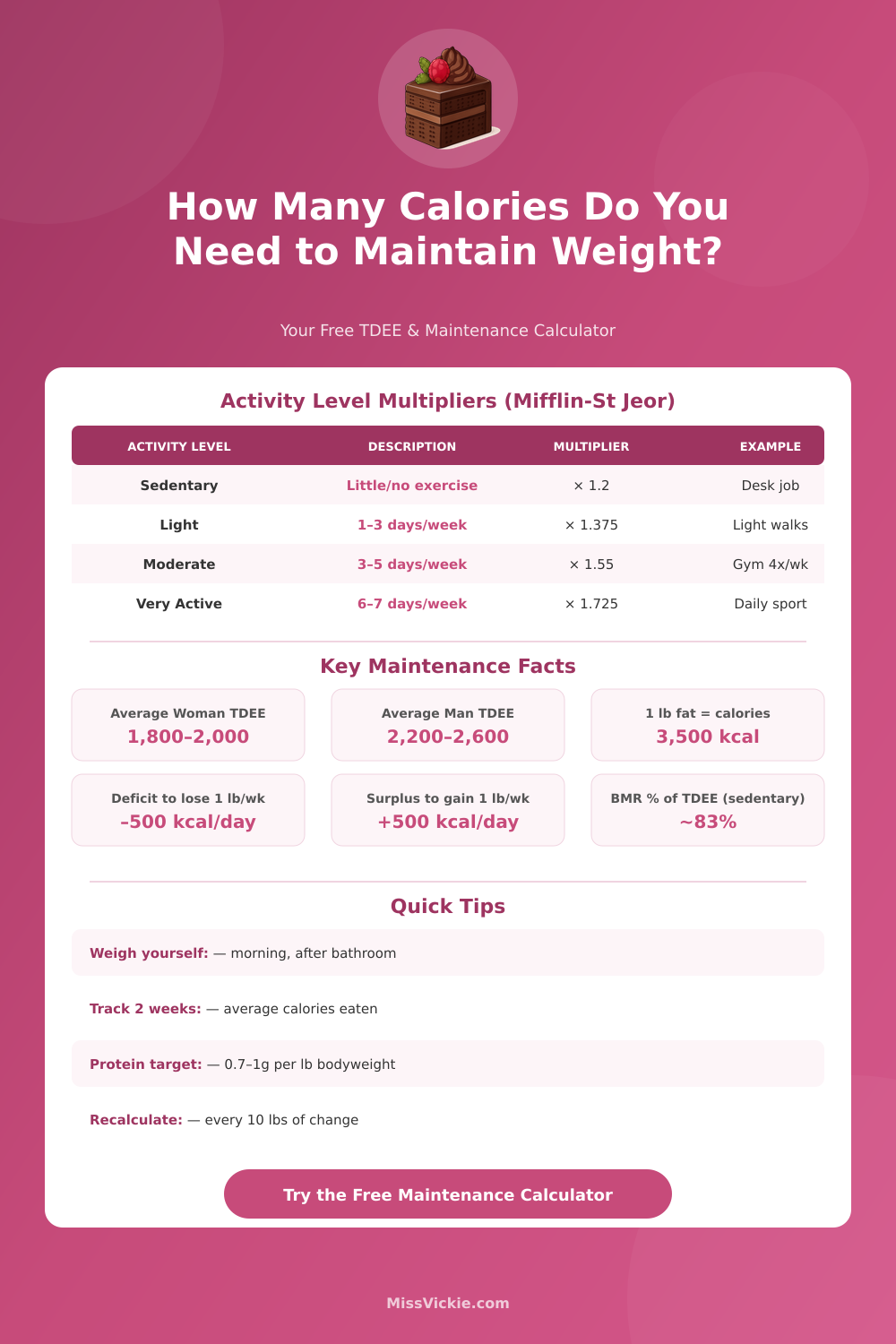
| Activity Level | Multiplier | Weekly Exercise | Typical Profile |
|---|---|---|---|
| Sedentary | × 1.2 | None / minimal | Office job, mostly sitting |
| Lightly Active | × 1.375 | 1–3 days | Casual walks, light gym |
| Moderately Active | × 1.55 | 3–5 days | Regular gym-goer |
| Very Active | × 1.725 | 6–7 days | Daily training / sports |
| Extra Active | × 1.9 | 2×/day or labor job | Athlete, construction work |
| Age Group | Sedentary Female | Sedentary Male | Active Female | Active Male |
|---|---|---|---|---|
| 15–18 years | 1,800 kcal | 2,200 kcal | 2,400 kcal | 3,200 kcal |
| 19–30 years | 1,800–2,000 | 2,400–2,600 | 2,400 kcal | 3,000 kcal |
| 31–50 years | 1,800 kcal | 2,200–2,400 | 2,200 kcal | 2,800–3,000 |
| 51–65 years | 1,600–1,800 | 2,000–2,200 | 2,000–2,200 | 2,600–2,800 |
| 65+ years | 1,600 kcal | 2,000 kcal | 2,000 kcal | 2,400–2,600 |
| Goal | Adjustment | Rate | Notes |
|---|---|---|---|
| Maintain Weight | TDEE × 1.0 | — | Eat at your TDEE |
| Lose Fat (slow) | −250 kcal/day | ∼0.5 lb/week | Sustainable, preserves muscle |
| Lose Fat (standard) | −500 kcal/day | ∼1 lb/week | Most recommended deficit |
| Lose Fat (aggressive) | −750 kcal/day | ∼1.5 lb/week | Short term only |
| Gain Muscle (lean) | +200–300 kcal/day | ∼0.25–0.5 lb/week | Minimizes fat gain |
| Gain Muscle (bulk) | +400–500 kcal/day | ∼0.5–1 lb/week | Faster muscle gain |
| Formula | Best For | Requires Body Fat % | Accuracy |
|---|---|---|---|
| Mifflin–St Jeor | Most adults | No | ★★★★★ |
| Harris–Benedict (revised) | General population | No | ★★★★☆ |
| Katch–McArdle | Athletes / lean people | Yes | ★★★★★ |
A calorie calculator helps to estimate how many calories the body needs daily. That tool can find the right amount to preserve weight, lose or gain weight. They are very handy for anyone that wants to control his diet a bit more well.
Most such calculators start by computing the Basic Metabolic Rate, or BMR. Later one multiplies this value by the level of activity, to reach the Total Daily Energy Use, or TDEE. This TDEE figure shows how many calories the body burns during a day, when one also considers motion.
How Calorie Calculators Work
Some of those calculators apply the equation of Mifflin-St. Jeor, that studies consider more accurate than other methods, for example the formula of Harris-Benedict. Besides that, one version includes scientific data from the NIH’s Body Weight Planner, that bases on information from the National Institute about Diabetes and Digestive and Kidney Diseases.
Like this one can trsut the results more.
There are also calculators that base on dietary standards of the Division of Health and Medicine of the National Academies of Sciences, Engineering and Medicine. They reflect the newest scientific knowledge about food needs. Some programs go further than only calories and deliver information about more then hundred nutrients.
calorie calculators work for men and women equally. Main inputs deal with height, mass, age and activity level. Some allow the user to enter wanted weight together with a time plan, and later project, when one will reach some weight goals.
From the daily amount one can add calories for muscle growth or lower them for weight loss.
Besides daily calorie needs, one finds calculators for recipe nutrition. They break down the ingredients of a recipe, to estimate calories, carbohydrates, protein, fat, sodium and sugar. Some accept usual home units as cups, spoons and scoops, besides metric and American weights.
The user enters a list of ingredients with the number of servings, and the tool delivers nutrition for one serving together with a whole overview.
Databases about food calories form another valuable part of the system. Some base on the National Food Database of USDA and allow to choose from thousands of foods and brands, to see nutrition information including calories, fat, protein, carbohydrates, fiber and sugar. Free online tools can track the calorie entry and give nutrition details for more than two millions of products.
The counting of calories is useful for ongoing weight loss and works most well together with regular motion and wise food choices. Steady programs and calculators also helpwell, because they help focus on targets and control the progress during the time.