🦞 Lobster Cooking Time Calculator
Get precise cooking times for whole lobster, lobster tails & claws by weight & method
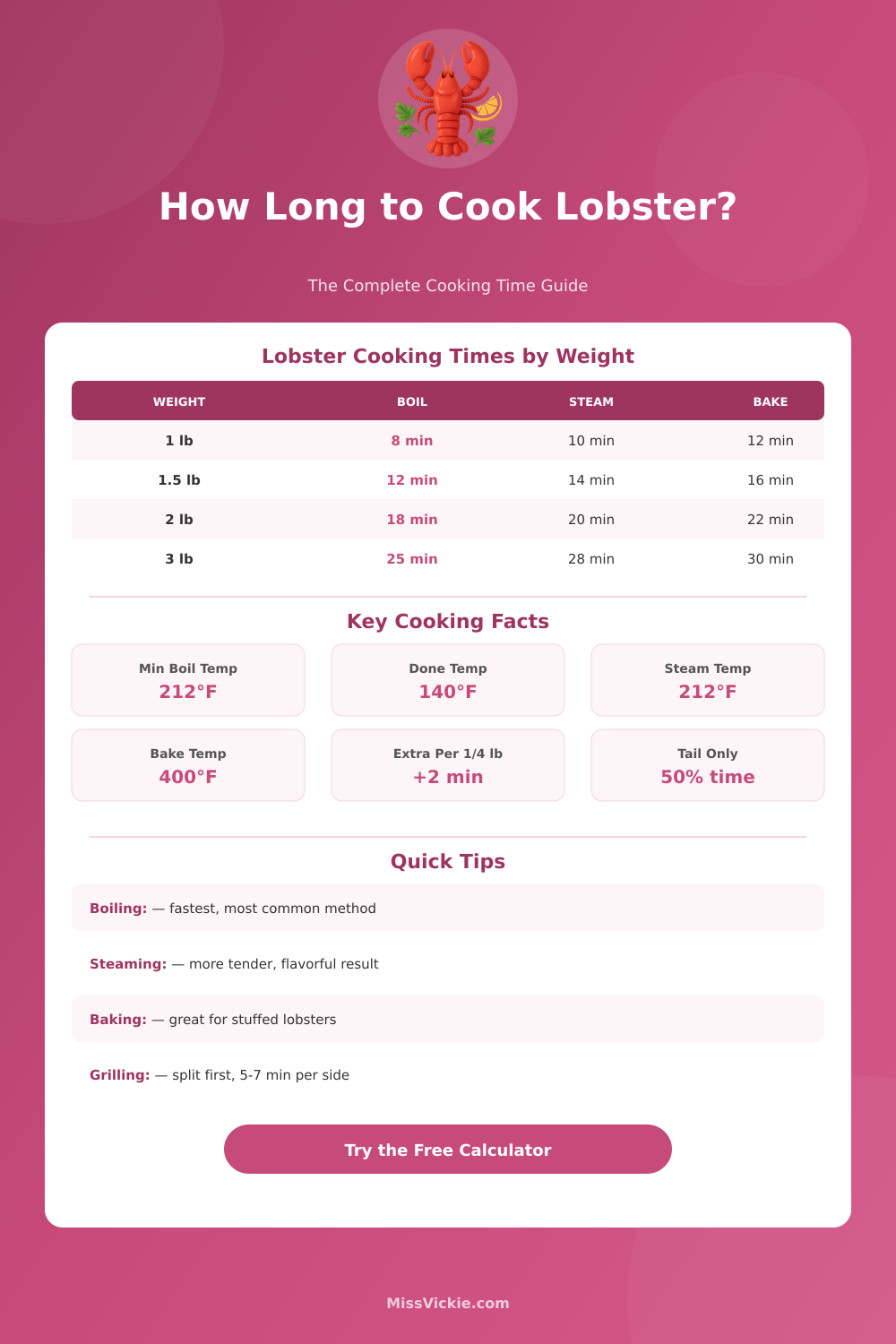
| Weight | Boil | Steam | Bake (400°F) | Grill (Split) |
|---|---|---|---|---|
| 1 lb (450g) | 8–9 min | 10–11 min | 12–14 min | 6–8 min |
| 1.25 lb (570g) | 10–11 min | 12–13 min | 14–16 min | 7–9 min |
| 1.5 lb (680g) | 12–14 min | 14–16 min | 16–18 min | 8–10 min |
| 1.75 lb (795g) | 14–16 min | 16–18 min | 18–20 min | 9–11 min |
| 2 lb (910g) | 18–20 min | 20–22 min | 22–24 min | 10–12 min |
| 2.5 lb (1.1kg) | 22–24 min | 24–26 min | 26–28 min | 12–14 min |
| 3 lb (1.4kg) | 25–28 min | 28–30 min | 30–33 min | 14–16 min |
| 4 lb (1.8kg) | 30–34 min | 34–38 min | 36–40 min | 16–18 min |
| Tail Weight | Boil | Broil | Bake (425°F) | Grill |
|---|---|---|---|---|
| 3–4 oz (85–115g) | 4–5 min | 5–6 min | 8–10 min | 4–5 min |
| 5–6 oz (140–170g) | 5–6 min | 6–8 min | 10–12 min | 5–7 min |
| 7–8 oz (200–225g) | 6–8 min | 8–10 min | 12–14 min | 7–8 min |
| 9–10 oz (255–285g) | 8–10 min | 10–12 min | 14–16 min | 8–10 min |
| 12 oz (340g) | 10–12 min | 12–14 min | 16–18 min | 10–12 min |
| 16 oz / 1 lb (450g) | 12–14 min | 14–16 min | 18–20 min | 12–14 min |
| Whole Lobster | Approx. Meat Yield | % Yield | Servings (4 oz each) |
|---|---|---|---|
| 1 lb (450g) | 3–3.5 oz (90g) | ~23% | 0.75 |
| 1.25 lb (570g) | 4–4.5 oz (120g) | ~25% | 1 |
| 1.5 lb (680g) | 5–5.5 oz (150g) | ~25% | 1.25 |
| 2 lb (910g) | 7–8 oz (215g) | ~27% | 1.75 |
| 2.5 lb (1.1kg) | 9–10 oz (270g) | ~27% | 2.25 |
| 3 lb (1.4kg) | 11–12 oz (330g) | ~28% | 2.75 |
Lobsters form part of the crustaceans from the family Nephropidae, and they really grab the attention when one watches them a bit more closely. All have long bodies with strong tails, by means of that they can hide in splits or caves at the bottom of the sea. Here the weirdest trait: except the four pairs of feet they own three pairs of claws, where the first pair is much bigger than the rest.
Because of that, that they are boneless, they belong to the type Arthropoda and to the subtype Crustacea, so they have bodies shared in segments, outer skeletons and those combined members, that we usually link to the arthropods.
Lobsters: Facts and Cooking Tips
A bit, what really stands out at the Lobster, is the process of shedding. They must remove the old outer skeleton when it becomes too narrow because of growth, and later form a whole new one under it. After the shedidng, they eat almost nothing.
Really wonderful is, that they eat even their own recently removed skeletons, that seems good for survival, although it looks a bit gross.
Lobsters rank between the most famous of the world foods from sea. The best come from areas as the Penobscot Gulf, that sits in the Downeast Gulf of Maine. Many of those lobsters gather by means of hand using careful methods from the alive sea waters.
One can receive fresh Lobster from Maine, that got caught and sent right away in many cases, and bigger orders commonly come with free shipping.
The taste of the Lobster has salty base with tender fish tone and trace of sweetness, that sits in it. About texture, it is thick and quite a bit spongy, almost alike to fish meat, but with that crisp trait, that makes it unique. Here the common mistake: if one leaves the rubber links on the claws during cook, everything goes wrong, and the meat gets rubber taste, that is entirely bad.
Remove them and serve the Lobster in a pool of cool butter, and you will have something special. Even so, overcooking happens very easily because of the size, and one wrong step destroys everything.
About cost, Lobster is not the cheapest option between the sea foods. The amount of meat, that one receives for one dollar, seems a bit pour when one compares it with something as big salmon. Widely one requires around four units of Lobster meat for a serving.
The typical sizes in stores range between one and quarter of pounds or one and half of pounds for alive copies. One-and-half-pound Lobster gives around five until six units of useful meat.
Lobster goes well with many kinds of dishes and flavors. Classic are little pasta done from Lobster, covered by means of Lobster sauce. In Lobster rolls they enclose around four units of meat each one.
Nice other mixes include fried rice with green salad, or asparagus cooked with butter and lemon pepper, even lasagna from seafood covered by means of white sauce. Lobster crepes with asparagus and Lobster soup pie with extra pulp deserves a try.
Cook alive Lobster home? Cool it during eighteen minutes first. Take a big jar and do it full with salt.
Cook it during eight until twelve minutes each pound, or boil during seven until ten minutes each pound for different parts. Really, cook Lobster home is much less terrible than many believe, and it well works forsurprise the family and friends during gatherings.