🥩 Lamb Cooking Time Calculator
Calculate precise roasting times for any lamb cut by weight & doneness preference
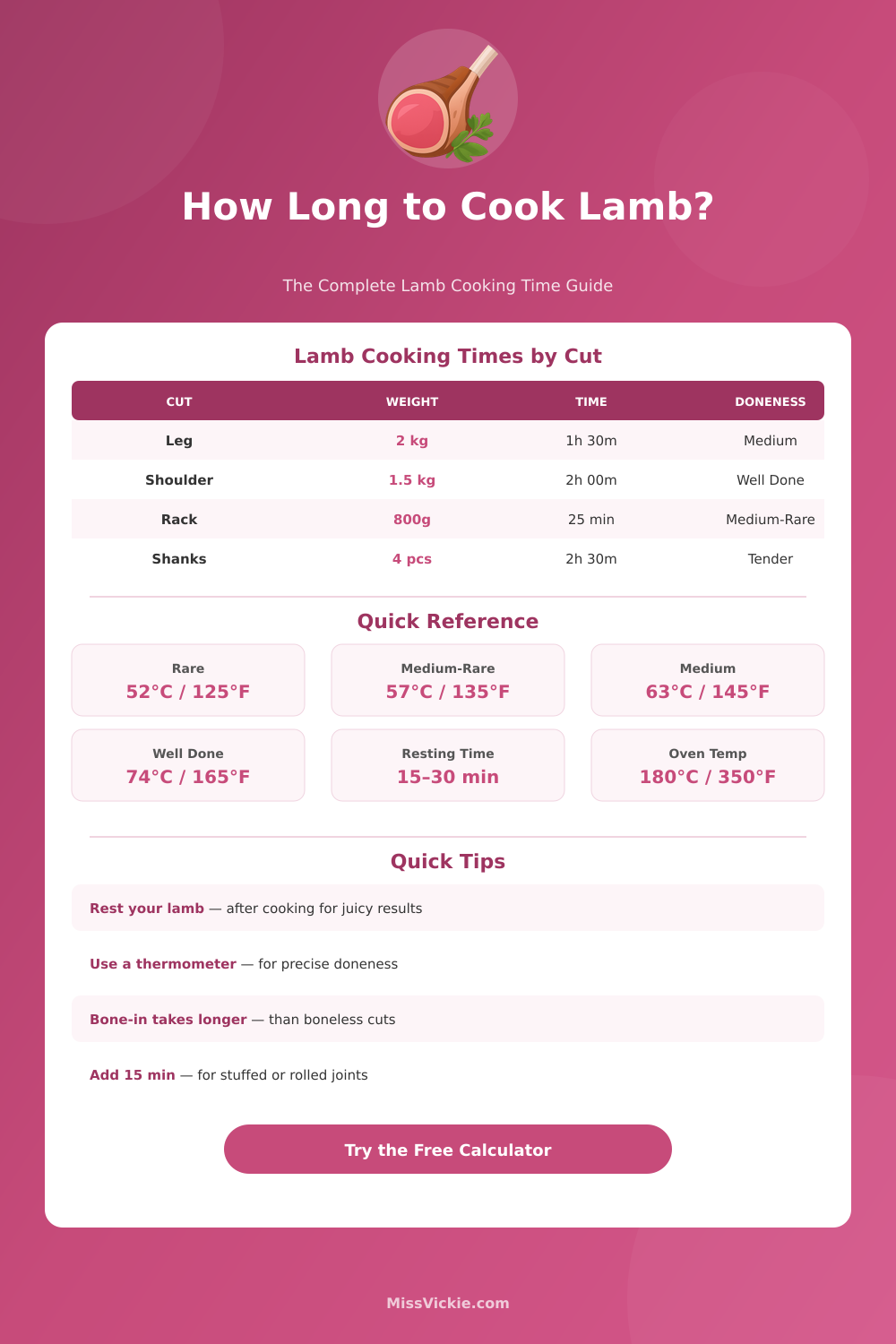
| Cut | Weight | Oven Temp | Rare | Medium | Well Done |
|---|---|---|---|---|---|
| Leg (Bone-In) | 1.5 kg / 3.3 lb | 180°C / 350°F | 55 min | 1h 10m | 1h 25m |
| Leg (Bone-In) | 2 kg / 4.4 lb | 180°C / 350°F | 1h 05m | 1h 25m | 1h 45m |
| Leg (Bone-In) | 2.5 kg / 5.5 lb | 180°C / 350°F | 1h 20m | 1h 40m | 2h 05m |
| Leg (Boneless) | 1.5 kg / 3.3 lb | 180°C / 350°F | 45 min | 1h 00m | 1h 15m |
| Leg (Boneless) | 2 kg / 4.4 lb | 180°C / 350°F | 55 min | 1h 15m | 1h 30m |
| Shoulder (Bone-In) | 2 kg / 4.4 lb | 180°C / 350°F | — | 2h 00m | 2h 30m |
| Rack of Lamb | 800 g / 1.8 lb | 200°C / 400°F | 18 min | 22 min | 28 min |
| Butterflied Leg | 1.5 kg / 3.3 lb | 200°C / 400°F | 25 min | 35 min | 45 min |
| Lamb Shanks | 4 pcs (~1.2 kg) | 160°C / 325°F | — | — | 2h 30m |
| Crown Roast | 1 kg / 2.2 lb | 180°C / 350°F | 30 min | 40 min | 55 min |
125°F
135°F
145°F
155°F
165°F
Resting
Time
Oven Temp
| Kilograms (kg) | Pounds (lb) | Grams (g) | Ounces (oz) |
|---|---|---|---|
| 0.5 kg | 1.1 lb | 500 g | 17.6 oz |
| 1.0 kg | 2.2 lb | 1000 g | 35.3 oz |
| 1.5 kg | 3.3 lb | 1500 g | 52.9 oz |
| 2.0 kg | 4.4 lb | 2000 g | 70.5 oz |
| 2.5 kg | 5.5 lb | 2500 g | 88.2 oz |
| 3.0 kg | 6.6 lb | 3000 g | 105.8 oz |
| 3.5 kg | 7.7 lb | 3500 g | 123.5 oz |
| 4.0 kg | 8.8 lb | 4000 g | 141.1 oz |
Lamb commonly shows on tables around the whole world. It comes from domestic sheep, and there is a simple notion about what happens. The lamb comes from young sheep in its first year.
In the second year one calls it hogget. When the creatures reach older years, that becomes mutton. The tasty distinction relates to lamb.
Lamb: What It Is and How to Cook It
It has a much more sweet taste than mutton which makes sense for younger animals, usually under one year old.
When the meat marks as lamb at the butcher it usually comes from creatures between four months and one year. The most many sheep that ends on plates belong to the younger group, from around ten weeks until six months. One calls young sheep without permanent teeth, especially if under a year, simply lamb.
Here what is about lamb: it certainly can hold itself against beef during a meal. In the kitchen mixing various meats is never a bad notion, and when one well handles the fats, it gives something genuinely seperate and attractive. Religions do not ban it at the table, although many folks favour kosher or halal prepared versions according to their beliefs.
One main reason that lamb does not cook at home in United States that much commonly? Simply folks commonly do not know how to handle it. Different is ordering a delicious roast in a good restaurant, what seems easy, but when one stands before a raw bit with sticking out bones, it looks much more scary than simply frying ribs in a pan.
The available variety genuinely impresses. One finds chops from lamb, legs, roasts, ground lamb, rack and shoulder, many possibilities for use. The shoulder belongs among the most delicious cuts, genuinely almost the lamb match of beef brisket.
It braises perfectly. One disadvantage? Removing the bones itself is tiring work, but a skilled butcher does that in a moment.
Ground lamb, on the other hand, one uses for wonderful hamburgers.
Think about marinades, salt and acid can bee too much for meat that is already naturally tasty. Think well before you season. Lamb legs shine during low and slow cook.
Slow roasting, braising or broiler roasting all work well. Rosemary and garlic stay classics for good reason, and oregano with lemon form a combination that is hardly beat.
Lanolin, that material in the wool, brings a saved taste and fat texture, from that comes the discussed flavor. Many folks find that saved taste unappealing. American lamb is raised in almost every state, what helps customers receive product fresher in weeks than imported.
Australia exports lamb also over there. Some farms feed sheep on salty fields beside the coast in France, Germany, Ireland, Wales, except those windy swept Greek islands. At some farms, the sheep do not require additional livestock, because theyfavour bushes and scrubland anyhow.