🍵 Caffeine in Kombucha Calculator
Estimate your caffeine intake from kombucha tea based on brew type, tea base, and serving size
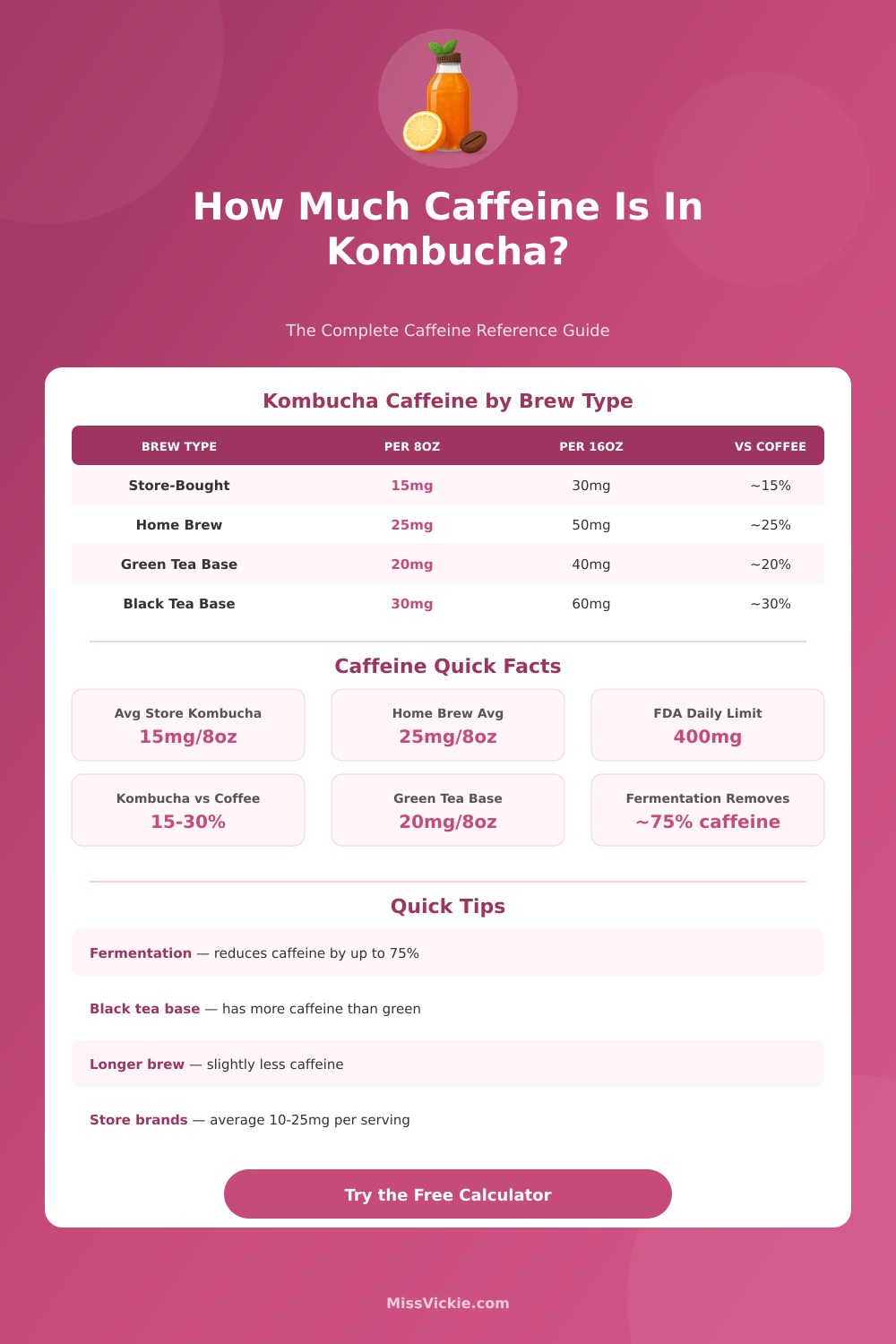
| Beverage | Serving | Caffeine (mg) | % of FDA Limit |
|---|---|---|---|
| Commercial Kombucha | 8 oz / 240ml | 10 – 25 mg | 3 – 6% |
| Home Brew Kombucha (Black) | 8 oz / 240ml | 20 – 40 mg | 5 – 10% |
| Home Brew Kombucha (Green) | 8 oz / 240ml | 15 – 30 mg | 4 – 8% |
| Jun Kombucha | 8 oz / 240ml | 12 – 28 mg | 3 – 7% |
| Brewed Black Tea | 8 oz / 240ml | 40 – 70 mg | 10 – 18% |
| Brewed Green Tea | 8 oz / 240ml | 20 – 45 mg | 5 – 11% |
| Drip Coffee | 8 oz / 240ml | 95 – 165 mg | 24 – 41% |
| Espresso | 1 oz / 30ml | 60 – 75 mg | 15 – 19% |
| Energy Drink | 8 oz / 240ml | 70 – 100 mg | 18 – 25% |
| Decaf Coffee | 8 oz / 240ml | 2 – 15 mg | 1 – 4% |
| Ferment Duration | Caffeine Retained | Black Tea Base (8oz) | Green Tea Base (8oz) |
|---|---|---|---|
| 7 days (short) | ~35% | ~25 mg | ~16 mg |
| 10 days (standard) | ~25% | ~18 mg | ~11 mg |
| 14 days (long) | ~18% | ~13 mg | ~8 mg |
| 21+ days (very long) | ~12% | ~9 mg | ~5 mg |
| Tea Type | Raw Tea (8oz) | After 10-Day Ferment | Reduction |
|---|---|---|---|
| Black Tea | ~65 mg | ~16 mg | ~75% |
| Oolong Tea | ~50 mg | ~13 mg | ~74% |
| Green Tea | ~35 mg | ~9 mg | ~74% |
| White Tea | ~30 mg | ~8 mg | ~73% |
| Black & Green Blend | ~50 mg | ~13 mg | ~74% |
| Herbal (Rooibos etc.) | 0 mg | 0 mg | — |
| Population Group | Daily Limit | Kombucha Servings at 20mg | Notes |
|---|---|---|---|
| Healthy Adults | 400 mg | ~20 servings | FDA guideline |
| Pregnant Women | 200 mg | ~10 servings | WHO recommendation |
| Adolescents (12–18) | 100 mg | ~5 servings | Conservative limit |
| Caffeine-Sensitive Adults | 100–200 mg | ~5–10 servings | Individual variation |
| Children (<12) | Not recommended | — | Avoid caffeine |
The kombucha tea drink is made up of fermented and bubbly black or green tea, that is sweetened. Sometimes one calls it kombucha tea to separate it from the culture of bacteria and yeast, that is used to produce it. One also calls that culture tea mushroom, tea fungus or Manchurian mushroom.
In Latvia one found it in 1913 although one assumes, that it comes from the region at the Russian-Chinese border, once called Manchuria. The Germans spread its use, but it truly does not relate to Japan or to Japanese seaweed tea.
What is kombucha and how to make it
To prepare the drink, one feeds sweet tea by means of SCOBY, which stands for symbiotic culture of bacteria and yeast. During the fermentation, the yeast turns sugar into alcohol. In the traditional way, one chooses dried leaves from black tea as base.
One adds sugar so that it serves as food to the bacteria and yaest. They join in a process called symbiosis. A cellulose mat or skin forms during the whole fermentation.
kombucha tea carries active substances. They are made up of organic acids, amino acids, vitamins, probiotics, sugars, polyphenols and antioxidants. Fermentation does not remove the nutrients of pure tea, for instance riboflavin.
Even sew it slightly reduces the caffeine. Bacteria from kombucha tea can resist other harmful bacteria and funguses, between that E. Coli, S. Aureus, C. Albicans and even H. Pylori.
When one ferments kombucha tea, the quality of tea matters a lot. Black tea gives the most amounts of purines, that make a setting where the bacteria and yeast of kombucha tea live well. More than one home maker mixes black with green tea.
Teas of good grade with many buds and full leaves do not need to be chosen, because the gentle flavors will not last the fermentation. Bitterness of kombucha tea however beats all subtle tastes of tea.
Home making of kombucha tea is very easy. Boil water, add sugar and mix until it fully dissolves. Add tea and leave to draw while the liquid cools to room heat.
Pour into a jar, fill up with fresh water, add starter kombucha tea and lay the SCOBY inside. Cover with cloth and bind it flat. For one batch use around 1.5 cups of starter kombucha tea.
Starter tea is plain kombucha tea, that passed the first fermenting phase.
kombucha tea should not be made in clay or ceramic vases, because acids from tea can release dangerous metals from them. Controlled steps help to stop germs. Amounts for a drink range from 8 to 20 ounces.
Good daily dose is almost 4 ounces. New drinkers start with a small amount and slowly grow to a full 8-ounce serving, while one drinksenough water to stay hydrated.