🍓 Jam Ratio Calculator
Get exact fruit-to-sugar ratios, pectin amounts, and jar yield for any jam batch
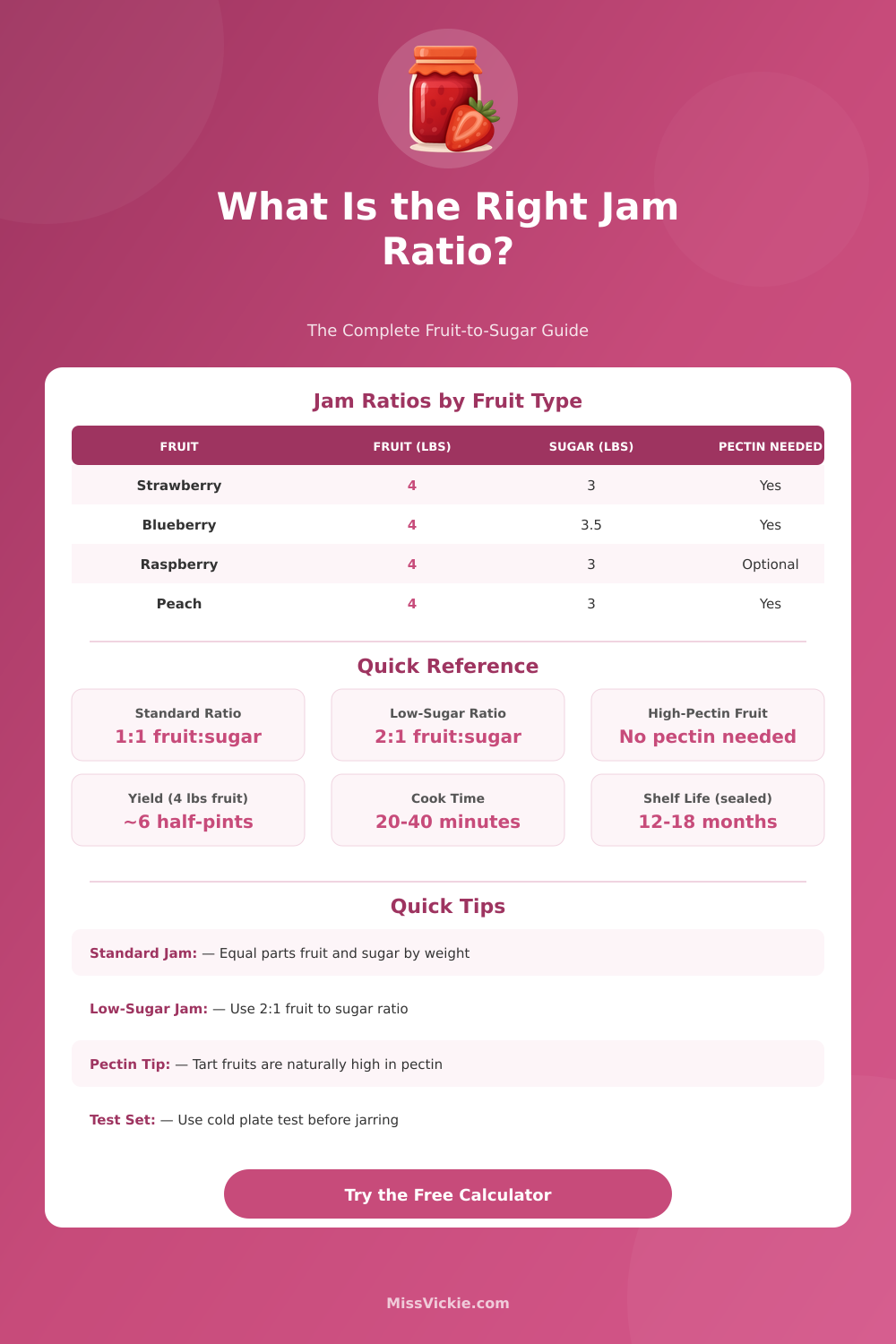
| Fruit | Sugar (Standard) | Sugar (Low) | Pectin | Lemon Juice |
|---|---|---|---|---|
| Strawberry | 4 lbs (7 cups) | 2 lbs (3.5 cups) | 1 packet | 2 tbsp |
| Blueberry | 4 lbs (7 cups) | 2 lbs (3.5 cups) | 1 packet | 2 tbsp |
| Raspberry | 4 lbs (7 cups) | 2 lbs (3.5 cups) | Optional | 1 tbsp |
| Blackberry | 4 lbs (7 cups) | 2 lbs (3.5 cups) | Optional | 2 tbsp |
| Peach | 4 lbs (7 cups) | 2 lbs (3.5 cups) | 1 packet | 3 tbsp |
| Plum | 3 lbs (5.5 cups) | 2 lbs (3.5 cups) | None | 1 tbsp |
| Apricot | 4 lbs (7 cups) | 2 lbs (3.5 cups) | 1 packet | 3 tbsp |
| Cherry | 4 lbs (7 cups) | 2 lbs (3.5 cups) | 1 packet | 2 tbsp |
| Fig | 3 lbs (5.5 cups) | 1.5 lbs (2.75 cups) | Optional | 4 tbsp |
| Grape | 3.5 lbs (6 cups) | 2 lbs (3.5 cups) | None | 1 tbsp |
| Pectin Level | Fruits | Needs Added Pectin | Notes |
|---|---|---|---|
| High Pectin | Plum, Grape, Quince | No | Sets easily on its own |
| Medium Pectin | Raspberry, Blackberry, Fig | Optional | May need help for firm set |
| Low Pectin | Strawberry, Peach, Cherry | Yes (recommended) | 1 packet per 4 lbs fruit |
| Very Low Pectin | Blueberry, Apricot | Yes (required) | Without pectin, jam stays runny |
| Weight | Cups (Granulated) | Grams | Notes |
|---|---|---|---|
| 0.5 lb | ~1 cup | 227g | Small single-jar batch |
| 1 lb | ~2 cups | 454g | Common small batch |
| 2 lbs | ~3.5 cups | 907g | Low-sugar 4 lb batch |
| 3 lbs | ~5.5 cups | 1361g | Medium batch |
| 4 lbs | ~7 cups | 1814g | Standard full batch |
| 5 lbs | ~8.75 cups | 2268g | Large batch |
jam is simply fruit and sugar cooked together until the mix becomes quite dense to spread well. What happens is that one takes whole fruit, cut up or well beaten, and warms it with water and sugar, until it reaches that what jam makers call the “fixed spot“. That magical moment one owes to pectin, whether it naturally presents in the fruit or one added a bit of it.
Home prepared jam is not always easy. The biggest trouble? Ending with something hard as stone, that does not spread correctly.
How to Make Jam
Usually that means that one cooked it too long or turned the fire too strong. Sugar burns surprisingly quickly, when the mix warms, so adding lemon juice from fruits helps to keep the taste of the jar against burning. Honestly, low and slow is the good way for that.
So, the real method? Very simple. One boils the fruit with little water, later adds sugar and boils again until the fixed spot.
The rough attempt is good old effect, one leaves a tiny dose on a frozen plate and checks, whether it wrinkles when one pushes it. Or one takes a thermometer for jam, if one wants to be precise. It bubbles sometimes at first, later more often, when the mix thickens.
Normal time is somewhere around forty until fifty minutes, before the liquid almost exits and the juice of teh fruit disappears.
For good berry jam, here is big advice: leave your berries soaking in sugar before. The sugar must be around 60 until 65 percent of the weight of your berries, strawberries are so juicy and tender, that they require that amount for good results. When that is ready, cook it in small parts on the stove.
Small parts truly give better results.
Here is something nice, what happens during that sugar stage and truly changes the taste of the jam. Wild yeasts, that live on the skin of fruits, can start little rising, until the increasing sugar levels end it. Here is that little secret for making jam, that somehow lost itself along the weigh.
Use fresh fruit, truly sharp and truly ripe, truly matters, when one prepares that.
jam works for more than only toast, truly. It spreads surprisingly on crusty bread, biscuits or croissants. Put it on a sandwich for breakfast.
Add oats and jam in cooked bread, hard task, but totally worth it. Or mix pork chops in apricot jam mixed with dried chilies, and you will have something surprisingly delicious. In the kitchen jam is also flexible: jam filling in biscuits, jam rolls, baked steamed jam pudding or use it as stuffing between two biscuits with butter cream.
Berry jam even can serve as dressing with a nice pink shade.
Talking about food value, a spoon of jam stores around 50 until 56 calories, whose most come directly from sugar. It bestis useful as something, that one enjoys in small amounts, to keep your diet widely balanced.