🔧 Holley Carb Size Calculator
Find your ideal carburetor CFM rating based on engine displacement, RPM & volumetric efficiency
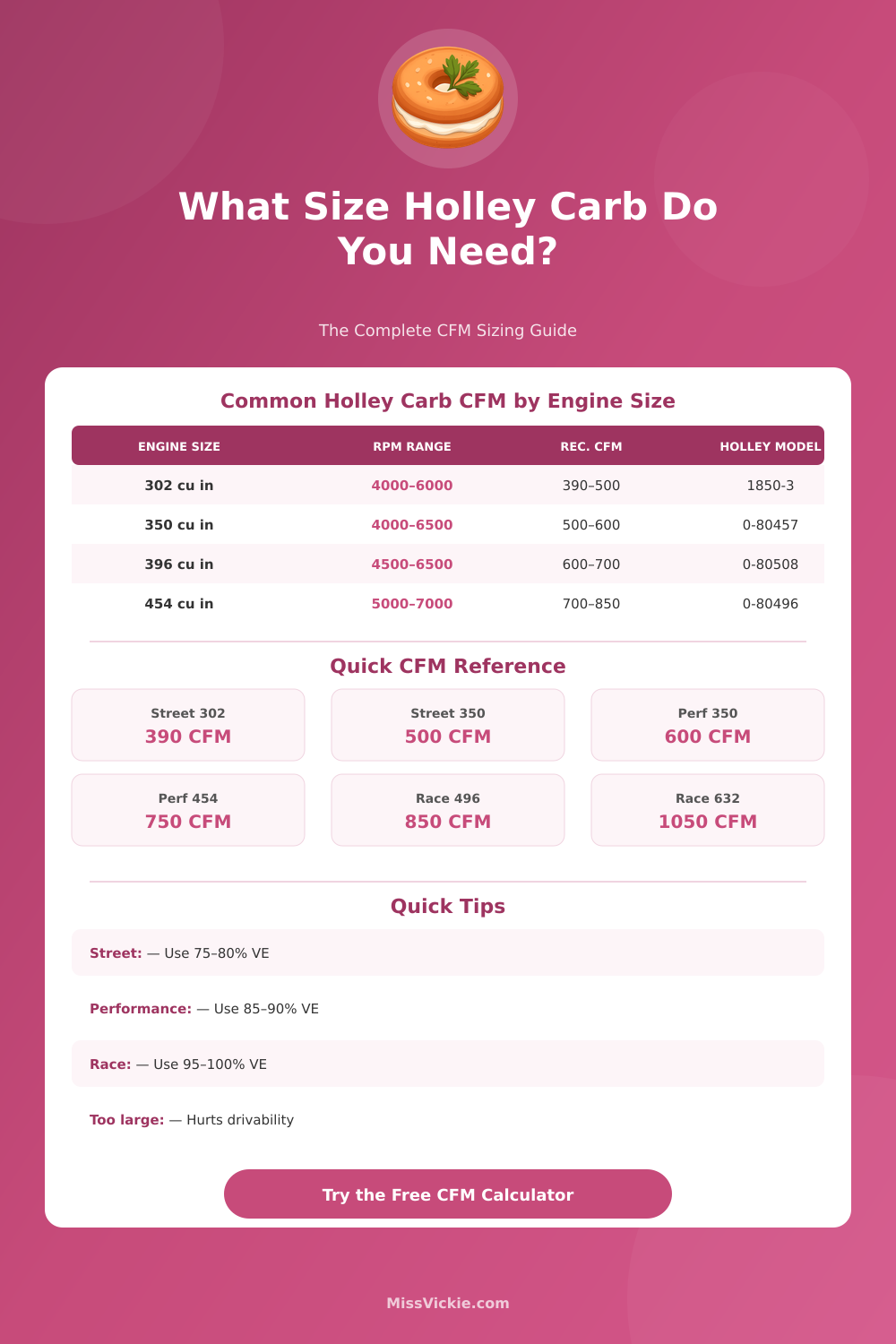
| Engine | Displacement | Use | Rec. CFM | Holley Part # |
|---|---|---|---|---|
| SBC 283 | 283 cu in / 4638cc | Street | 390–450 CFM | 0-4412S |
| SBC 302 | 302 cu in / 4949cc | Street/Perf | 450–500 CFM | 0-80457SA |
| SBC 327 | 327 cu in / 5358cc | Performance | 500–570 CFM | 0-80508S |
| SBC 350 | 350 cu in / 5735cc | Street/Perf | 500–600 CFM | 0-80457SA |
| SBC 383 Stroker | 383 cu in / 6277cc | Performance | 600–650 CFM | 0-80508S |
| BBC 396 | 396 cu in / 6490cc | Street/Perf | 625–700 CFM | 0-80508S |
| BBC 427 | 427 cu in / 6997cc | Performance | 700–780 CFM | 0-80496S |
| BBC 454 | 454 cu in / 7440cc | Street/Race | 750–850 CFM | 0-80496S |
| BBC 496 Stroker | 496 cu in / 8127cc | Race | 830–900 CFM | 0-80507S |
| BBC 632 | 632 cu in / 10358cc | Full Race | 1000–1050 CFM | 0-80687 |
| Application | VE Range | RPM Range | Typical Setup |
|---|---|---|---|
| Stock Street Cruiser | 70–75% | 2000–4500 | Factory cam, stock heads |
| Mild Street Build | 75–80% | 2500–5500 | Mild cam, stock or ported heads |
| Street-Performance | 80–85% | 3000–6000 | Perf cam, aftermarket intake & heads |
| Hot Rod / Muscle Car | 85–90% | 3500–6500 | Aggressive cam, ported heads, headers |
| Track Day / Drag | 90–95% | 4000–7500 | Race cam, race heads, single-plane intake |
| Full Race / Pro Build | 95–110% | 5000–9000 | CNC heads, aggressive cam, ram tuning |
| Holley Model | CFM Rating | Choke | Best For |
|---|---|---|---|
| 0-4412S (2bbl) | 500 CFM | Manual | 4-6 cyl street |
| 0-80457SA | 500 CFM | Electric | SBC 302–350 street |
| 0-1850S | 600 CFM | Vacuum | SBC 350–400 street/perf |
| 0-80508S | 600 CFM | Electric | SBC 350–396 performance |
| 0-3310S | 750 CFM | Vacuum | SBC-BBC street/perf |
| 0-80496S | 750 CFM | Electric | BBC 396–454 street |
| 0-80507S | 830 CFM | Manual | BBC 454–496 performance |
| 0-9380 | 950 CFM | None | BBC 496–540 race |
| 0-80687 | 1050 CFM | None | BBC 540–632 full race |
Formula Used: CFM = (Displacement x RPM x VE%) ÷ 3456 — this is the industry-standard Holley formula.
Dual Carb Setup: Divide total CFM by 2 for each carb when running dual 4-barrels.
Choke Type: Electric choke is recommended for street use; manual or no choke for race applications.
Round Up: When your calculated CFM falls between standard sizes, choose the next size up for performance builds, down for daily drivers.
A Carb is a tool that engines with internal burning use for gasoline, to control and mix the air and fuel that enters the engine. In vehicles it forms part of the fuel system, where it mixes gasoline with air to create burning. In short words it tips liquid gasoline from the tank, mixes it with air and sends that mix to the burning space, where the spark lights it.
A Carb does by mechanics what fuel injectors do by means of electronics. Rather than depend on sensors for air flow and oxygen to guess the right amount of fuel, it relies on laws of fluid mechanics. The main mode implies the Venturi effect or the principle of Bernoulli.
How a Carb Works
Carbs push gasolnie into the incoming air only thanks to the difference of pressure that the motion of air creates, rather than modern fuel injectors that spray it by means of high pressure.
A Carb has two main jobs. It first rules the amount of fuel and air that flows into the engine, to control the turns or RPM of it. Second, it combines fuel with air, so that the engine can work.
Basically, it is a kind of tubes that lets in air and fuel through valves in the engine, mixing them in different amounts to fit various ways of drive. Whether slowly in city traffic or strongly boosting on a long strait way, the Carb must combine the right mix of air and gasoline. Well set, it ensures good boost, saving of fuel and health of the engine.
The ratio between air and fuel in the mix is the most important part. Even little changes in the height can affect how the Carb must be set. They are not devices that one simply installs and uses without issue.
Setting Carbs is a real art that usually needs years of experience to well understand andbest do.
Carbs were used during decades in the car world. Electronic fuel injection began to replace the systems with Carbs in the eighties and nineties. Even so, today one commonly chooses them for powerful cars and other classic models, because they are simple to work on, fix and swap.
They are made up of purely mechanical parts without any electronics or computers. The Carb simply bolts to the upper part of the engine. Parts of a Carb do not cost as much as those of fuel injectors.
Carbs usually are less efficient than fuel injection. The mix of gasoline and air commonly ends up either too rich or too thin. Although in uses with high power, like drag racing or oval track driving, Carbs can compete with electronic fuel injection in engines with natural breathing.
In cases with commonly changing throttle or big loads, they do not offer the same ease of drive.
Depending on the kind of vehicle, a Carb can have two or four barrels. Carbs appear in many types, including single barrel, two barrel, four barrel, spreadbore, downdraft and marine models. The perfect Carb is one whose size is just enough to feed the engine in normal use.
An engine with one barrel and one Carb is simple to take care of and keep clean.