🔧 Holley Carb Jet Size Calculator
Find the correct jet size for your engine — adjust for altitude, fuel type & air/fuel ratio
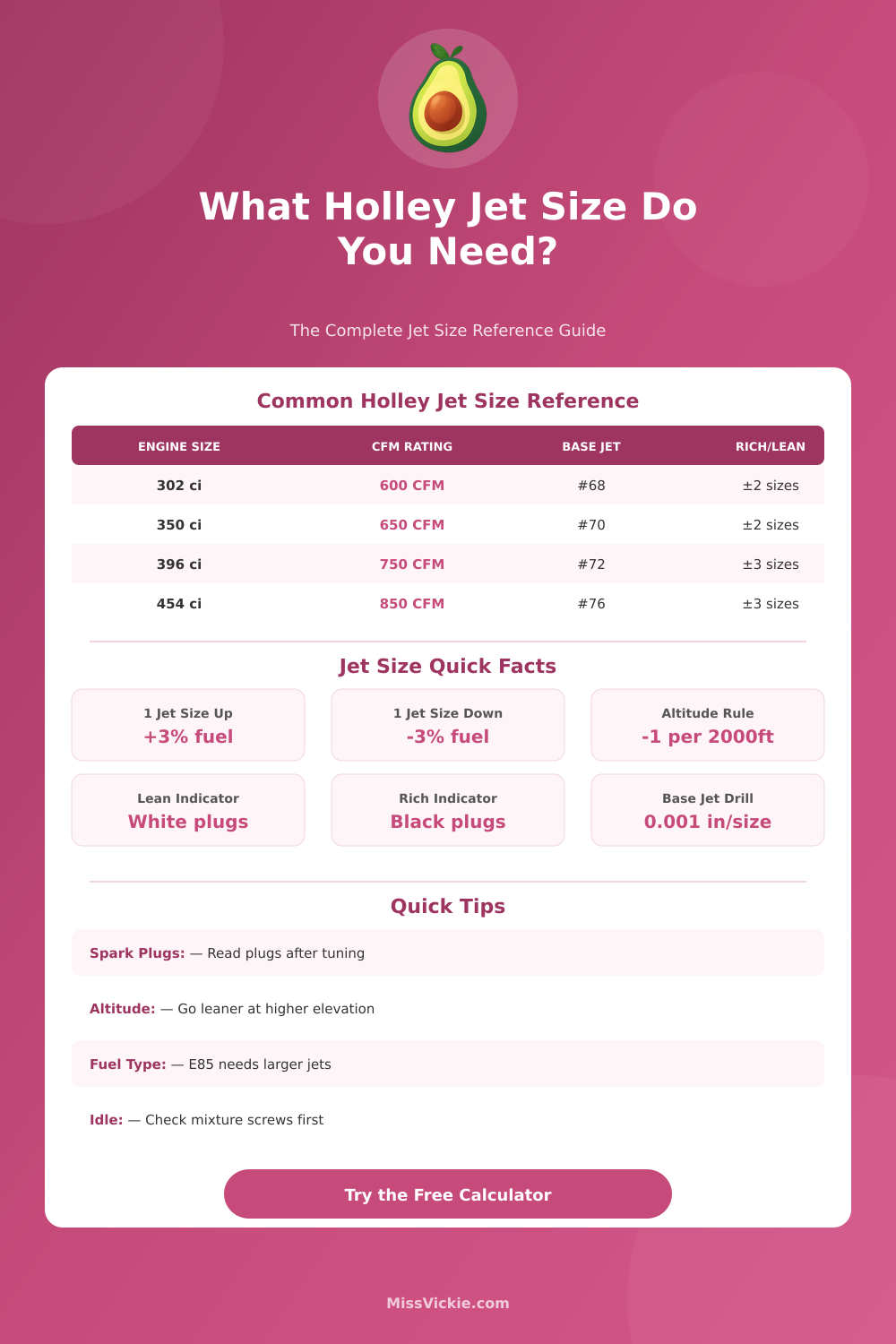
| Engine (ci) | Carb CFM | Primary Jet | Secondary Jet | Build Level |
|---|---|---|---|---|
| 283 ci | 500 CFM | #64 | #65 | Stock |
| 302 ci | 600 CFM | #66 | #68 | Street |
| 327 ci | 600 CFM | #68 | #70 | Street |
| 350 ci | 650 CFM | #70 | #72 | Street Perf. |
| 383 ci | 750 CFM | #72 | #74 | Street/Strip |
| 396 ci | 750 CFM | #72 | #73 | Street Perf. |
| 427 ci | 800 CFM | #74 | #76 | Street/Strip |
| 454 ci | 850 CFM | #76 | #78 | Street/Strip |
| 496 ci | 950 CFM | #78 | #80 | Race |
| 540 ci | 1050 CFM | #82 | #84 | Race |
| Jet # | Drill Size (in) | Drill Size (mm) | Flow Area (in²) |
|---|---|---|---|
| #60 | 0.0600 in | 1.524 mm | 0.00283 in² |
| #62 | 0.0620 in | 1.575 mm | 0.00302 in² |
| #64 | 0.0640 in | 1.626 mm | 0.00322 in² |
| #66 | 0.0660 in | 1.676 mm | 0.00342 in² |
| #68 | 0.0680 in | 1.727 mm | 0.00363 in² |
| #70 | 0.0700 in | 1.778 mm | 0.00385 in² |
| #72 | 0.0720 in | 1.829 mm | 0.00407 in² |
| #74 | 0.0740 in | 1.880 mm | 0.00430 in² |
| #76 | 0.0760 in | 1.930 mm | 0.00454 in² |
| #78 | 0.0780 in | 1.981 mm | 0.00478 in² |
| #80 | 0.0800 in | 2.032 mm | 0.00503 in² |
| #82 | 0.0820 in | 2.083 mm | 0.00528 in² |
| #84 | 0.0840 in | 2.134 mm | 0.00554 in² |
| Altitude (ft) | Altitude (m) | Jet Change | Direction |
|---|---|---|---|
| 0 – 1,999 ft | 0 – 609 m | 0 sizes | No change |
| 2,000 – 3,999 ft | 610 – 1,219 m | –1 size | Leaner |
| 4,000 – 5,999 ft | 1,220 – 1,828 m | –2 sizes | Leaner |
| 6,000 – 7,999 ft | 1,829 – 2,438 m | –3 sizes | Leaner |
| 8,000 – 9,999 ft | 2,439 – 3,047 m | –4 sizes | Leaner |
| 10,000+ ft | 3,048+ m | –5+ sizes | Leaner |
| Fuel Type | Stoich A/F | Jet Adjust vs. Gasoline | Notes |
|---|---|---|---|
| Regular Gasoline | 14.7:1 | Baseline | Standard reference |
| Premium Gasoline | 14.7:1 | 0 sizes | Same jet as regular |
| Race Fuel (110) | 14.7:1 | +0 to +2 | Slight enrichment |
| E10 (10% Ethanol) | 14.1:1 | +1 size | Slightly richer |
| E85 Ethanol | 9.8:1 | +18 to +24 | Much larger jets needed |
Holley Fuel Products form an automotive parts company in Rolling Green, Kentucky. The company was born in 1896 in Bradford, Pennsylvania, thanks to George Holley together with Earl Holley. The four-barrel Carb of Holley rank between the most known parts for fast cars, that were ever built.
Carbs of Holley, for example the well known models 4150 and 4160 strongly link with the bright eras of muscle cars in the 1960s.
Holley Carburetors and Parts for Cars
Holley bid a wide selection of spare parts and improvements for performance of Carbs. Between them find yourself back-up bowls for fuel, valves for power, Jets and many other parts. Carbs Ultra XP and Dominator belong to the highest class.
Moreover, Holley trade high-performance systems EFI, parts for change of LS and products from other popular marks. It issues a catalogue updated yearly, that deatils all Carbs for performance and racing, together with specs for each of them.
For usage in cars and trucks, the two model numbers of Holley most commonly used are 4150 and 4160. One calls the editions of Carbs Holley by means of “list” editions. That list edition works as if an ID for the Carb.
Usually one stamps it on the front side of the tower for choke, to the right of the tube exiting, on most typical Carbs Holley. Carbs of older years, before the middle of the 1960s, commonly have letter “R” at the top, while new models can have “L”, “List” or “0-“. For example, the Holley 3310 with 750 CFM produced won almost during 50 years.
Carbs Holley own several circuits for measuring, that adjust during running of the engine. They cover circuits idle, main for measuring and for power. Sizes of stock Jets at Holley 4160 normally reach edition 64 for main Jets and 67 for secondary.
Valve for power, that blew, can allow fuel to flow always, what creates too rich state. Fix that by means of valve of 6.5 for power helps well for engine of street.
Picking the right size for Carb critically matters. Carb of 750 CFM commonly overloads many engines, what causes trouble in drive, bad use and rough turns in idle. At engine of 350 cubic inches, Carb between 650 and 700 CFM well answers.
Four-barrel Holley of 600 CFM well fits a 302 small-block Ford. Between the most commonly used Carbs is the model 1850 of Holley with 600 CFM. One first installed it on the Ford Thunderbird of 1957, and it yet produces today.
Carbs secondary with vacuum work best at cars of middle weight or heavy, that has automatic gearboxes. They sense the load of the engine, so they handle more than double-pumps. Holley of 750 vacuum secondary, combined with a two-plane intake of high flow and full tuning, form reliablecombination that cuts costs without hurting the quality.