🥛 Calcium in Greek Yogurt Calculator
Find out exactly how much calcium you get from your Greek yogurt serving — and how it contributes to your daily needs.
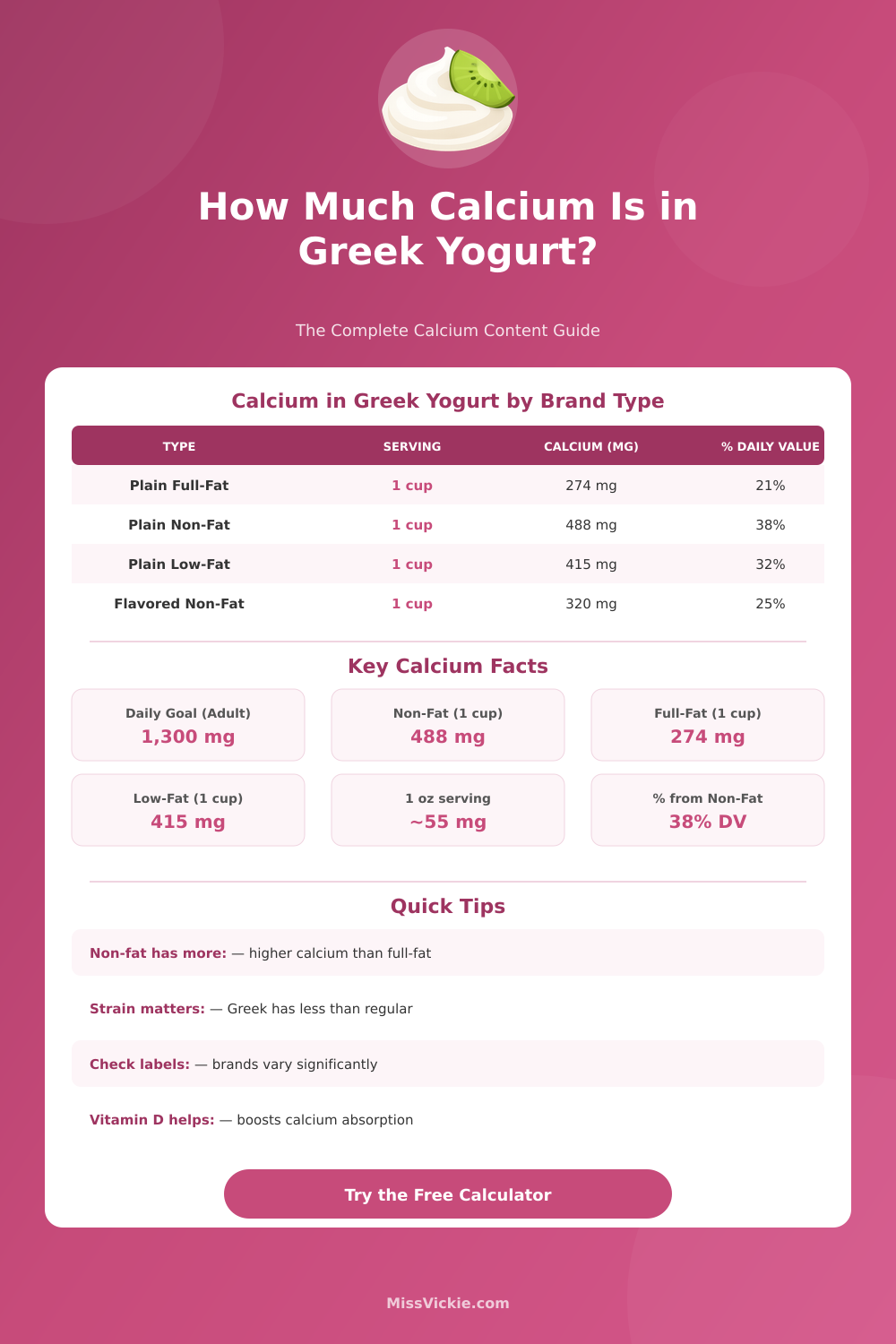
| Greek Yogurt Type | 1 Cup (245g) | 5.3 oz (150g) | 1/2 Cup (123g) | % Daily Value (1 cup) |
|---|---|---|---|---|
| Non-Fat Plain | 488 mg | 299 mg | 244 mg | 38% |
| Low-Fat Plain | 415 mg | 254 mg | 208 mg | 32% |
| Full-Fat Plain | 274 mg | 168 mg | 137 mg | 21% |
| Non-Fat Flavored | 320 mg | 196 mg | 160 mg | 25% |
| Low-Fat Flavored | 278 mg | 170 mg | 139 mg | 21% |
| Full-Fat Flavored | 210 mg | 129 mg | 105 mg | 16% |
| Age / Group | Daily Calcium (mg) | Cups Non-Fat to Meet Goal | Cups Full-Fat to Meet Goal |
|---|---|---|---|
| Children 1–3 yrs | 700 mg | ~1.4 cups | ~2.6 cups |
| Children 4–8 yrs | 1,000 mg | ~2.0 cups | ~3.6 cups |
| Teens 9–18 yrs | 1,300 mg | ~2.7 cups | ~4.7 cups |
| Adults 19–50 yrs | 1,000 mg | ~2.0 cups | ~3.6 cups |
| Women 51–70 yrs | 1,200 mg | ~2.5 cups | ~4.4 cups |
| Men 51–70 yrs | 1,000 mg | ~2.0 cups | ~3.6 cups |
| Adults over 70 yrs | 1,200 mg | ~2.5 cups | ~4.4 cups |
| Common Serving | Grams | Fluid Oz | Tablespoons |
|---|---|---|---|
| 1 Cup | 245 g | 8 fl oz | 16 tbsp |
| 3/4 Cup | 184 g | 6 fl oz | 12 tbsp |
| 1/2 Cup | 123 g | 4 fl oz | 8 tbsp |
| 1/3 Cup | 82 g | 2.7 fl oz | 5.3 tbsp |
| 1/4 Cup | 61 g | 2 fl oz | 4 tbsp |
| 5.3 oz Container | 150 g | 5.3 fl oz | 10 tbsp |
| 7 oz Container | 198 g | 7 fl oz | 14 tbsp |
Greek yogurt has a different make-up it is creamy and rich in proteins. One can use it in sweet or salty foods, or simply eat it naturally. The reason for its more creamy quality compared to average yogurts lies in the preparation.
During the production one removes the serum, what leaves a denser result with bigger protein density for the serving.
Making and Using Greek Yogurt
Thick yogurt usually sells as “Greek yogurt” in North America and as “Greek-style yogurt” in United Kingdom. Even so one eats thick yogurt also widely in the Middle East, Central Asia and the Eastern Mediterranean. In Greece the traditional yogurt actually prepares from sheep milk.
It tends to be more watery and bitter, and less creamy than the Greek yogurt that one sells around the world currently.
Preparing it at home is fairly easy. You only need two things: milk and a bit of store yogurt as starter culture. The store yogurt brings the good bacteria required for the process.
Later, straining average yogurt converts it into Greek. Any special gear is not needed. Simple metal coffee filter in a broad tin works well.
One leaves it in the fridge during some hours, and the result is dense Greek yogurt. The leftover serum even deserves to keep four drink, because it still stores nutrients.
Greek yogurt works to replace sour cream in almost everything. It goes well with marinades, dips, sauces and baked foods. If one mixes flour with Greek yogurt, one gets a base for dough used for bagels, flatbread, pizza bases, garlic knots and others.
One tip to recall: when adding yogurt to sauce, add it after one removes the sauce from the heat. Yogurt does not blend well with heat, so the sauce can end up looking lumpy.
There are a lot of brands available. Between the options are fat-free types and full-thick types. Usually bigger thickness gives better make-up.
For instance, one honey-vanilla option costs around 3.97 dollars for 32 ounces, but stores only 7 grams of protein for a 170-gram serving. Some other brands offer 12 to 17 grams of protein each serving. Some Greek yogurts do not carry preservatives or artificial flavors.
For toppings, warmed frozen berries with a splash of lemon and a bit of sweetener create a fast topping. Roasted oats or granola with cinnamon or cardamom add crunch. Mix cocoa powder with something of sweetener to give a chocolate version.
Honey, peanut butter, cut figs, chia seeds or nuts all work also. There is no single limit date for Greek yogurt, because each brand differs, socheck the date on the package before buying, that is a good idea.