🌾 Gluten in Couscous Calculator
Calculate the exact gluten content in your couscous serving
| Couscous Type | Gluten % (Dry Weight) | Gluten per Cup Cooked | Gluten per 100g Dry |
|---|---|---|---|
| Regular (Semolina) | ~12% | ~8.5g | ~12.0g |
| Whole Wheat | ~13% | ~9.2g | ~13.0g |
| Israeli / Pearl | ~11% | ~7.8g | ~11.0g |
| Lebanese (Moghrabieh) | ~11.5% | ~8.0g | ~11.5g |
| Measurement | Dry Weight | Cooked Yield | Gluten (Regular) |
|---|---|---|---|
| 1/4 cup dry | 44g / 1.6 oz | ~110g / 3.9 oz | ~5.3g |
| 1/3 cup dry | 56g / 2.0 oz | ~140g / 5.0 oz | ~6.7g |
| 1/2 cup dry | 88g / 3.1 oz | ~220g / 7.8 oz | ~10.6g |
| 1 cup dry | 176g / 6.2 oz | ~440g / 15.5 oz | ~21.1g |
| 1 cup cooked | ~63g / 2.2 oz dry | 157g / 5.5 oz | ~8.5g |
| 1 oz dry | 28g | ~70g / 2.5 oz | ~3.4g |
| 100g dry | 3.5 oz | ~250g / 8.8 oz | ~12.0g |
| Grain / Pasta | Gluten per 100g Dry | Gluten-Free? | Notes |
|---|---|---|---|
| Couscous (Regular) | ~12.0g | ❌ No | Made from durum wheat |
| Pasta (Semolina) | ~11.0g | ❌ No | Similar wheat source |
| Bread (White) | ~8.0g | ❌ No | Varies by recipe |
| Bulgur Wheat | ~10.5g | ❌ No | Cracked wheat kernels |
| Quinoa | 0g | ✅ Yes | Common substitute |
| Rice | 0g | ✅ Yes | Naturally gluten-free |
| Millet | 0g | ✅ Yes | Similar texture option |
| Couscous Type | Dry : Cooked Ratio | Water Absorbed | Weight Multiplier |
|---|---|---|---|
| Regular | 1 : 2.5 | ~150% of dry weight | 2.5x |
| Whole Wheat | 1 : 2.4 | ~140% of dry weight | 2.4x |
| Israeli / Pearl | 1 : 2.0 | ~100% of dry weight | 2.0x |
| Lebanese | 1 : 2.2 | ~120% of dry weight | 2.2x |
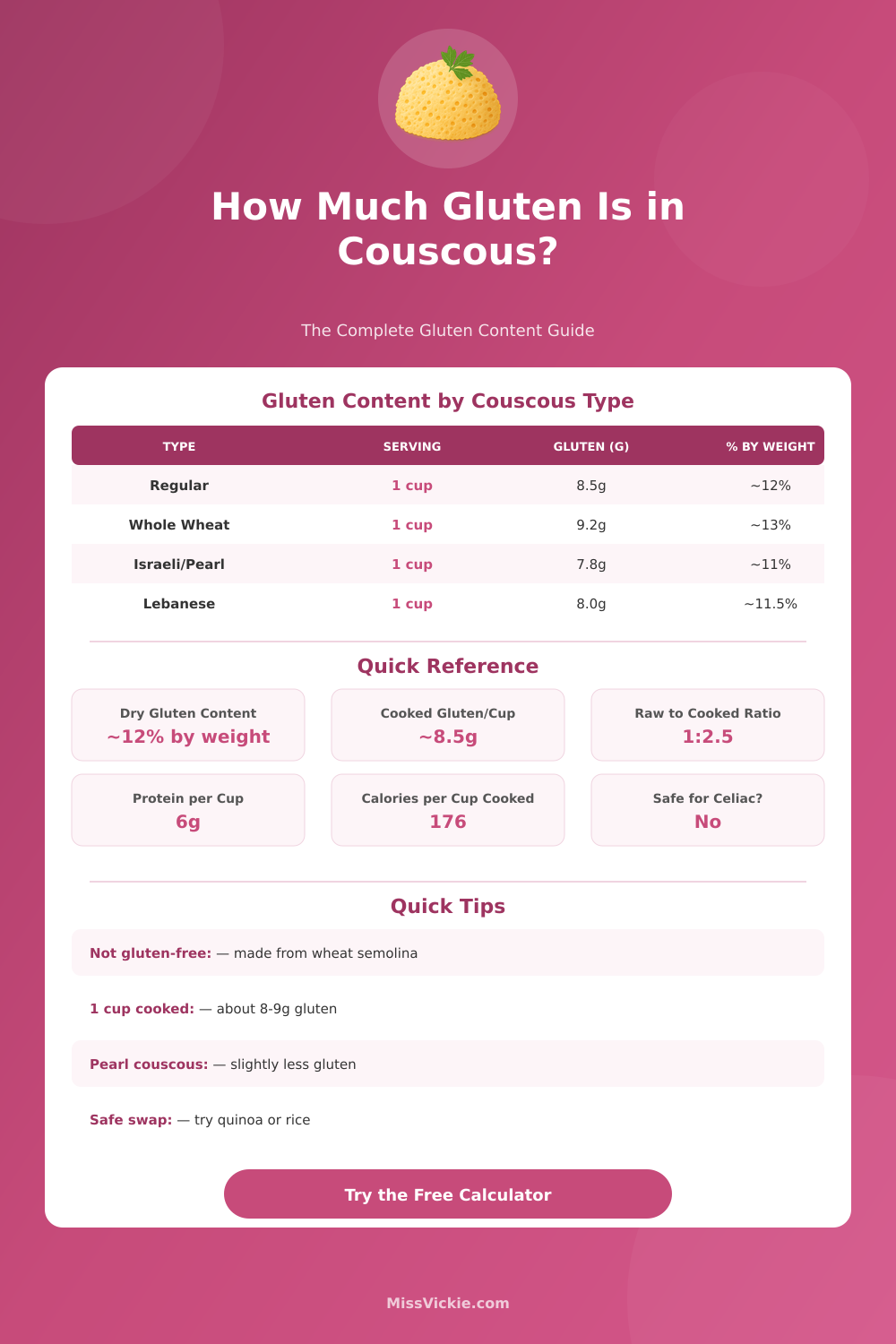
Average couscous has more gluten than one could assume, around 12 percent of the dry mass. That surprised me because white bread usually has only around 8 percent. One serving of cooked couscous, that weighs about 157 grams, holds around 8,5 grams of gluten.
Types from whole wheat can reach even 9,2 grams for the same amount. On the other hand, the Israeli pearl couscous has a bit less, about 7,8 grams. The ratio of raw to cooked is around 2,5 times, so a standard 56-gram dry serving gives around 140 grams ready on the plate.
How Much Gluten Is in Couscous?
About calories, one finds 176 in one cup cooked, with almost no fat at 0,3 grams. In my experience, 100 grams dry carry around 12 grams of gluten (so 3),4 grams for one ounce in the American system. So it certainly does not work for folks with celiac disease.
This information does not come from some calculator or converter. It is based on real experiences from real life, forum talks and discussions in cooking communities, that I found on-line.
Couscous is traditional food from North Africa, prepared from little steamed grains of semolina. It looks like grains, but actually it is a kind of pasta (one of the most little forms), almost as little as orzo. Many folks mess up and mix it with rice or otehr cereals, although it comes from dough of semolina, rolled in tiny balls.
Still, there are arguments about that, whether couscous truly is pasta or has its own category. Some think, that because it consists only of steamed durum wheat, not shaped and processed as standard pasta, it does not fit with the usual definition.
Couscous came from North Africa, probably among the Berbers of north Algeria, and dates at least 800 years back. The Arab word “couscous” likely comes from Berber language. Over centuries it was basic food in that region.
The original form used millet, while semolina is a more modern creation. Even so one finds similar dishes with pearl millet, sorghum, bulgur and other cereals in various parts of the world.
In Morocco the word “couscous” means the hole meal, not only the grain-shaped pasta. Usually it is made up of meat and vegetables cooked together, served above a bed of steamed semolina grains. The classic Moroccan way to prepare involves adding a ladleful of broth from the cooking, mix in a bit of harissa and pour that seasoned broth above the couscous.
By itself couscous is quite plain, in the end it is only steamed pasta. The good taste comes from herbs, spices, nuts and other additions, that one mixes with it. A nice classic combo is dried apricots with almonds.
One can also prepare fresh Mediterranean salad from couscous with chickpeas, various vegetables, herbs and lemon dressing. Another good idea is a savory version filled with garlic, red peppers, green onion, tomatoes, basil and parmesan.
One must note some different kinds. The Moroccan instant couscous is the most common, from very little grains. The Israeli pearl couscous is bigger and allows more creative options.
Light toasting of the pearls in olive oil with garlic before the cook gives rich taste. Finishing with juice of lemon, salt, pepper and parsley is another good idea.
The instant couscous, that one finds in the store, cooks very quickly and is simple. If one serves it plain, without extra cooking steps, use a ratio of 2:1 of water to couscous. After removing from the heat, leave it covered for 5 minutes, so that the steam dries the grains.
And always remember to fluff it, not with a spoon. Forone person about a third of a dry cup works.