🍗 Fried Chicken Sodium Calculator
Calculate the sodium content in your fried chicken by cut, quantity, and preparation style
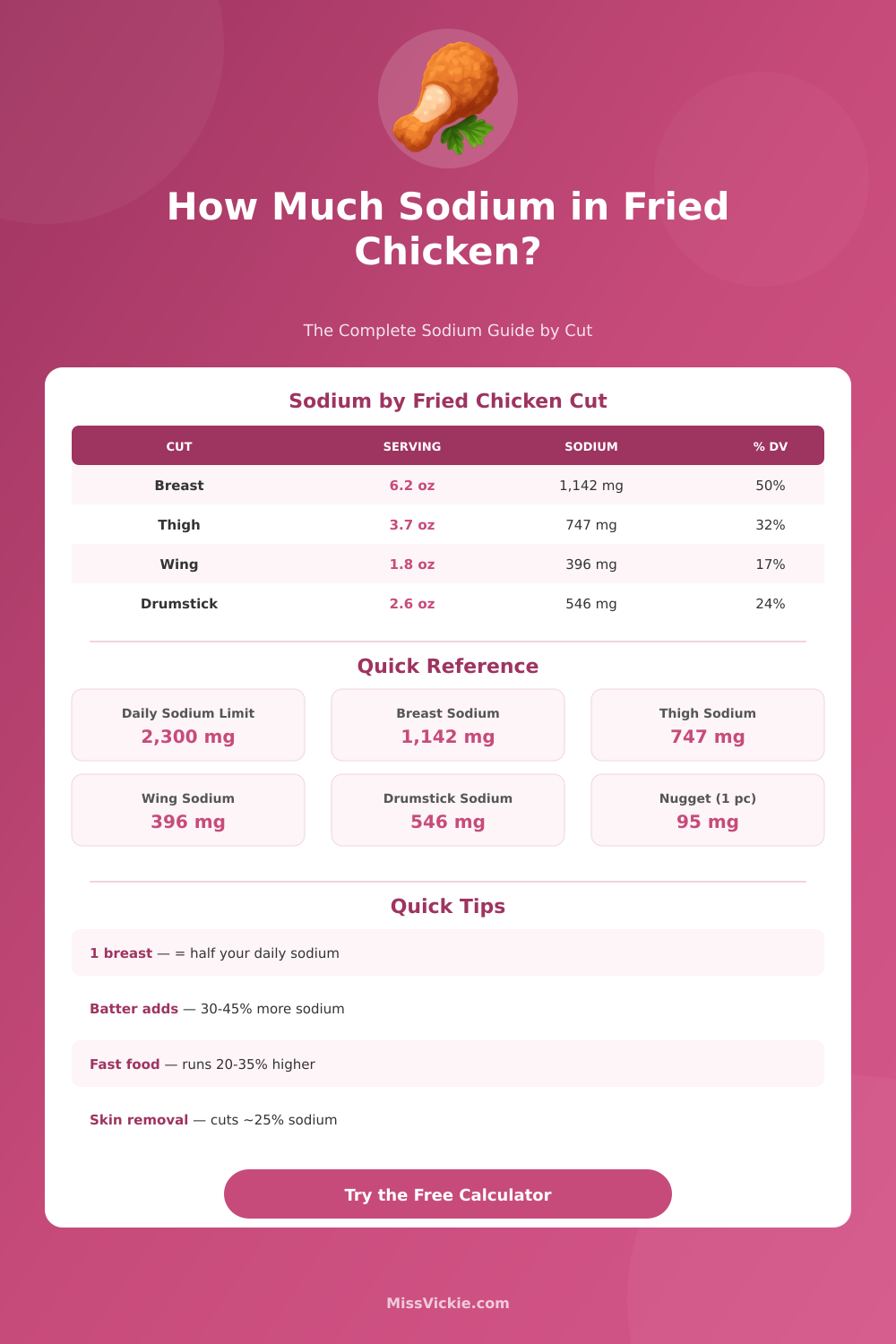
| Cut | Serving (oz) | Serving (g) | Sodium (mg) | % Daily Value |
|---|---|---|---|---|
| Breast (bone-in) | 6.2 oz | 176 g | 1,142 mg | 50% |
| Thigh (bone-in) | 3.7 oz | 105 g | 747 mg | 32% |
| Drumstick | 2.6 oz | 74 g | 546 mg | 24% |
| Wing | 1.8 oz | 51 g | 396 mg | 17% |
| Tender / Strip | 1.4 oz | 40 g | 340 mg | 15% |
| Nugget (1 pc) | 0.6 oz | 17 g | 95 mg | 4% |
| Style | Sodium Modifier | Breast (mg) | Thigh (mg) | Wing (mg) |
|---|---|---|---|---|
| Original Recipe | Baseline | 1,142 | 747 | 396 |
| Extra Crispy | +18–25% | 1,350 | 890 | 475 |
| Spicy / Hot | +25–35% | 1,430 | 970 | 515 |
| Buttermilk Battered | +10–15% | 1,260 | 820 | 435 |
| Guideline | Daily Limit (mg) | 1 Breast = % of Limit |
|---|---|---|
| FDA / Dietary Guidelines | 2,300 mg | 50% |
| AHA Ideal Limit | 1,500 mg | 76% |
| Average US Intake | 3,400 mg | 34% |
| WHO Recommendation | 2,000 mg | 57% |
| Cut | Raw Weight | Fried Weight | Bone / Waste |
|---|---|---|---|
| Breast (bone-in) | 10 oz / 283 g | 7.5 oz / 213 g | ~18% |
| Thigh (bone-in) | 5.5 oz / 156 g | 4.2 oz / 119 g | ~22% |
| Drumstick | 4 oz / 113 g | 3 oz / 85 g | ~26% |
| Wing (whole) | 3.2 oz / 91 g | 2.3 oz / 65 g | ~30% |
| Tender / Strip | 2 oz / 57 g | 1.6 oz / 45 g | ~3% |
| Nugget | 0.8 oz / 23 g | 0.7 oz / 20 g | ~2% |
The information below does not come from some computer program or automatic converter. It is based on actual cooking experiences, discussions in forums and shared knowledge about cooking that one finds on the net.
Fried Chicken is made up of bits of chicken, covered with flour or batter. One can fry it in a pan deep fry, press or even in an air fryer. The covering forms a crispy bark outside, while the meat stays juicy inside.
Tips for Making Crispy Fried Chicken
In the south United States it is classic food, where frying chicken has long been seen as real art. For centuries many people around the globe covered and fried chicken, however the south truly made it popular.
To reach ideal crispness you need a bit of effort. A good trick is to coat the chicken twice with flour before frying. So, cover it once, leave it rest around fifteen minutes to release the humidity, later do the second covering.
That second bark sticks well, because the first absorbs the sugars from the meat. During the whole frying process it matters to keep stable oil temperature.
A mix of fifty percent cornstarch and fifty percent flour for the covering causes a more crispy result. A fry thermometer is very useful for controlling the heat. If you lay too much meat in the oil, the temparature quickly drops and does not recover quickly.
That causes soggy pieces instead of the wanted crispy texture. When the oil smokes, it is too warm, but if the meat does not sizzle in it, the oil is too cold.
Deep frying commonly gives more crispy results then shallow. Another method: fry the chicken until the skin becomes crispy and brown on both sides, later finish in the oven. Some recipes suggest to first cook the chicken partially, cool it and later fry.
So much extra work truly pays off for excellent Fried Chicken.
Buttermilk is a commonly used marinade. Some recipes skip buttermilk and choose eggs with hot sauce and Worcestershire sauce. A simple version needs only five items: chicken, salt, pepper, flour and oil.
Sometimes the simple way works best, and extra spices do not always improve the taste. Basic Fried Chicken tastes good warm or even cold from the refrigerator.
Brining the chicken before frying helps it become thick and juicy with flavor. Batter instead of only flour covering makes the bark not fall off during cooking. Adding a little baking powder in the flour can boost the crispness.
The classic way is to use bones and skin with chicken, soak in buttermilk or egg mix, and cover with flour. Chickenthighs have just the right fat, that melts during frying and gives a rich taste.
New oil does not brown the food as well. Slightly used oil works better and gives the right color. Let the chicken reach room temperature and warm the oil before starting to fry, both steps are key for good results.