🍝 Fresh Pasta Per Person Calculator
Calculate exactly how much fresh pasta you need for any number of guests
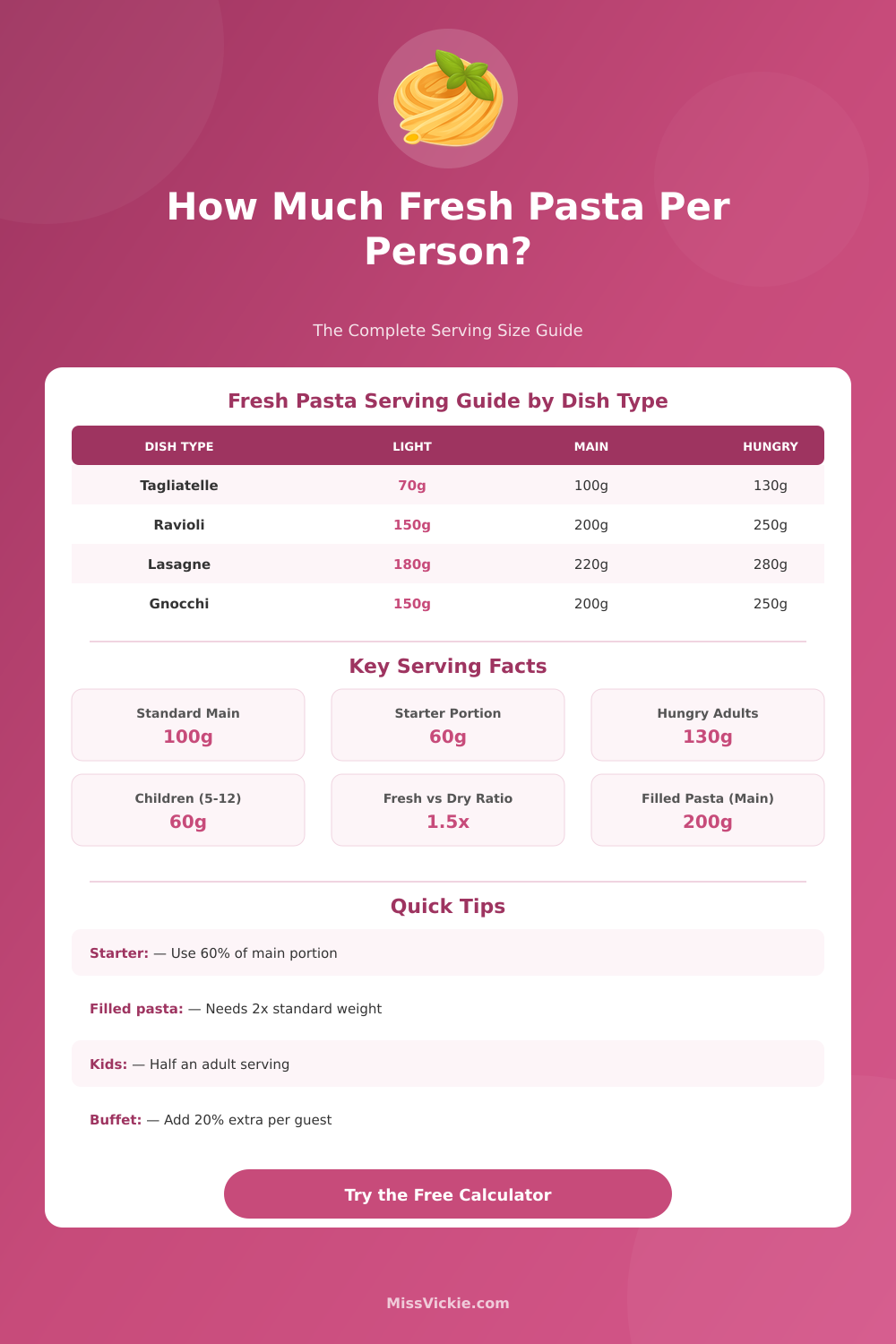
| Pasta Type | Starter | Main (Avg) | Main (Hungry) |
|---|---|---|---|
| Tagliatelle / Fettuccine | 60g / 2.1oz | 100g / 3.5oz | 130g / 4.6oz |
| Pappardelle | 60g / 2.1oz | 100g / 3.5oz | 130g / 4.6oz |
| Ravioli (filled) | 120g / 4.2oz | 200g / 7.1oz | 250g / 8.8oz |
| Tortellini | 100g / 3.5oz | 180g / 6.3oz | 220g / 7.8oz |
| Gnocchi | 120g / 4.2oz | 200g / 7.1oz | 250g / 8.8oz |
| Lasagne sheets | — | 200g / 7.1oz | 250g / 8.8oz |
| Children (any type) | 40g / 1.4oz | 60g / 2.1oz | 80g / 2.8oz |
| Dry Pasta (per person) | Fresh Pasta Equivalent | Cooked Weight (approx.) | Notes |
|---|---|---|---|
| 60g / 2.1oz | 90g / 3.2oz | ~150g / 5.3oz | Starter portion |
| 80g / 2.8oz | 120g / 4.2oz | ~200g / 7.1oz | Light main |
| 100g / 3.5oz | 150g / 5.3oz | ~250g / 8.8oz | Standard main |
| 120g / 4.2oz | 180g / 6.3oz | ~300g / 10.6oz | Hungry adults |
| Guests | Light (80g each) | Average (100g each) | Hungry (130g each) |
|---|---|---|---|
| 2 | 160g / 5.6oz | 200g / 7.1oz | 260g / 9.2oz |
| 4 | 320g / 11.3oz | 400g / 14.1oz | 520g / 18.3oz |
| 6 | 480g / 16.9oz | 600g / 21.2oz | 780g / 27.5oz |
| 8 | 640g / 22.6oz | 800g / 28.2oz | 1.04kg / 2.3lb |
| 10 | 800g / 28.2oz | 1.0kg / 2.2lb | 1.3kg / 2.9lb |
| 20 | 1.6kg / 3.5lb | 2.0kg / 4.4lb | 2.6kg / 5.7lb |
Do fresh pasta at home are easier than most many folks imagine. Suffice to have only four main ingredients: flour, eggs, olive oil and salt. Some succeed with even fewer, only flour and eggs already answer for the effect.
The whole process lasts around one hour from start until finish and you no necessarily require machine for rolling it.
How to Make Fresh Pasta at Home
For fresh pasta the flour genuinely is the star. Choose the right kind matter a lot for the result of your pasta. Whole grain flour operate well, but also the “00” flour with high gluten amount or the durum wheat flour as reliable choices.
Here the secret: mix semolina with “00” flour give other taste in the mouth. One can skip eggs entirely and use semolina with “00” flour and nutritious yeast instead, that mix help for better tension.
The dough address itself as bread dough, later one presses it through rollers until the wanted thickness. The moisture adjusts from time to time. Occasionally end with drier dough, other times it seems more sticky.
When something does not click perfectly, simply dust extra flour quikly or wet the hands under running water to correct. After you roll the sheet, leave it rest for about twenty minutes before cut, that stop it from sticking.
fresh pasta has long traditions in the region Emiliano-Romagna of Italy, where it improved over centuries. Sfogline (women that make pasta), role sheets purely by hand, only with rolling pin. Home pasta making became household custom for many, and their even exists a famous YouTube channel called Pasta Grannies, that shows their tools and teaching ways.
Cook fresh pasta go in a flash compared to dry. Dry pasta requires around ten minutes, but fresh usually cooks in two until five minutes. Some kinds cook even only two or three minutes after they reach boiling water.
For one serving of fresh pasta one estimates around three until four ounces each person.
Fresh and dry pasta no always can replace one the other. Dry are made up of only semolina and water, while fresh include eggs. Each works in its own cases.
Fresh well suit to filled kinds as ravioli or tortellini, and to long shapes as fettuccine or linguine. Dry pasta clearly stand in baked foods and in pots, where more cook time do not make it soft. Actually, classics as carbonara and cacio e pepe seem better with dry pasta…
No doubt.
Tagliatelle always should have eggs, whether bought or homemade. Garganelli is that tube, ridged form from fresh dough, that one rolls out, then cuts in squares and form by hand. For keeping fresh pasta, freeze the dough operate well.
Thaw last around one hour, later rolling and cutting is fast work. Store fresh pasta sometimes carries extras as ascorbic acid, citric acid and sodiumbicarbonate for control bacteria.