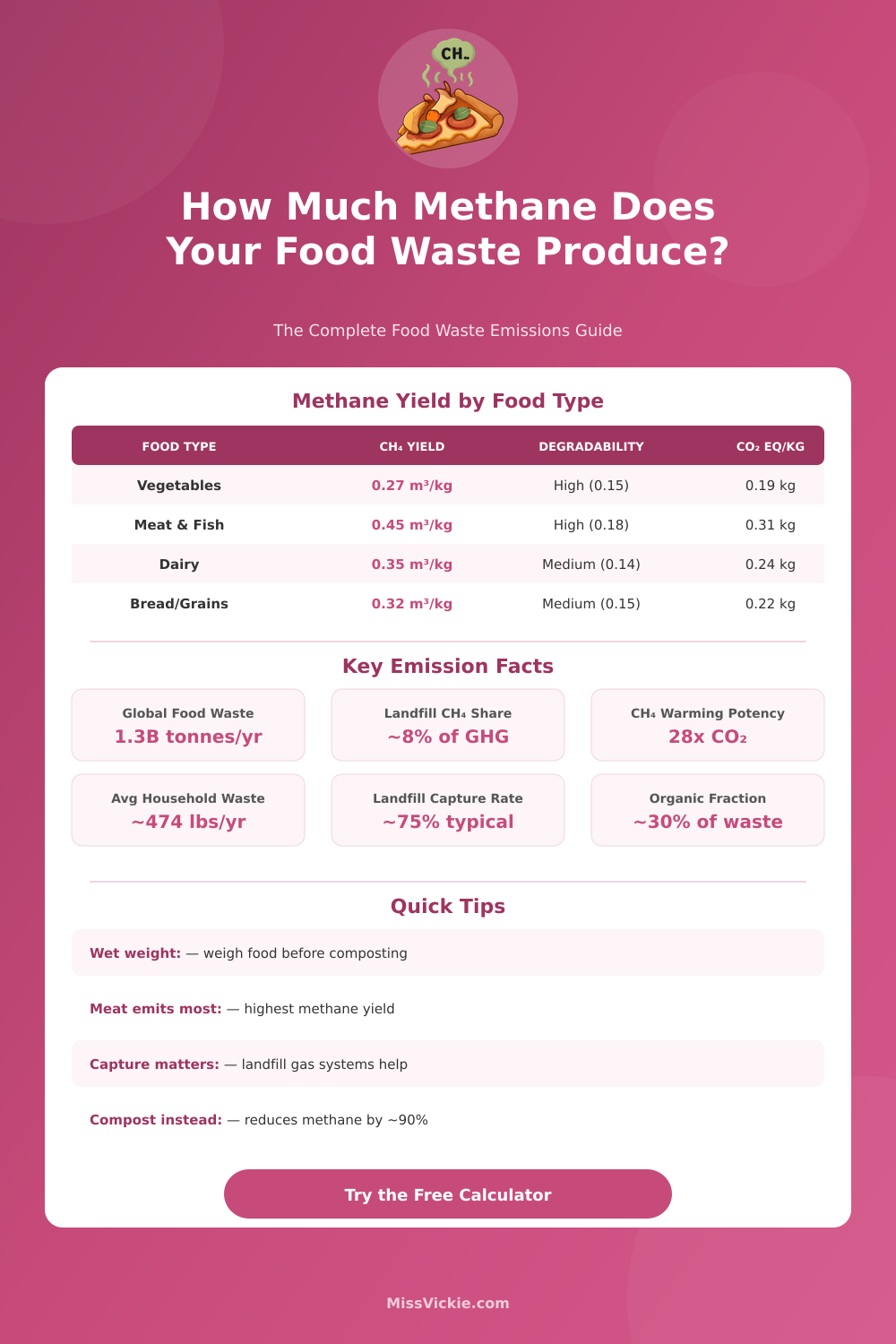
🧪 Food Waste Methane Calculator
Estimate CH₄ emissions & CO₂ equivalent from food waste sent to landfill
| Food Type | CH₄ Yield (m³/kg dry) | Degradable Fraction (DOC) | CH₄ kg per kg waste | CO₂e per kg waste |
|---|---|---|---|---|
| Vegetables & Fruits | 0.27 | 0.15 | 0.108 kg | 0.190 kg CO₂e |
| Meat & Fish | 0.45 | 0.18 | 0.180 kg | 0.313 kg CO₂e |
| Dairy Products | 0.35 | 0.14 | 0.140 kg | 0.243 kg CO₂e |
| Bread, Grains & Pasta | 0.32 | 0.15 | 0.128 kg | 0.222 kg CO₂e |
| Cooked / Mixed Food | 0.38 | 0.16 | 0.152 kg | 0.264 kg CO₂e |
| Liquid Food Waste | 0.22 | 0.12 | 0.088 kg | 0.153 kg CO₂e |
| Source / Scenario | Typical Waste (kg/day) | Typical Waste (lbs/day) | Annual CO₂e (no capture) |
|---|---|---|---|
| Single Person (household) | 0.19 kg/day | 0.42 lbs/day | ~20 kg CO₂e/yr |
| Family of 4 (household) | 0.76 kg/day | 1.68 lbs/day | ~80 kg CO₂e/yr |
| Small Restaurant (50 covers) | 10–20 kg/day | 22–44 lbs/day | ~1,100 kg CO₂e/yr |
| Large Restaurant (200 covers) | 40–80 kg/day | 88–176 lbs/day | ~4,400 kg CO₂e/yr |
| School (500 students) | 35–60 kg/day | 77–132 lbs/day | ~3,200 kg CO₂e/yr |
| Grocery Store (medium) | 50–150 kg/day | 110–330 lbs/day | ~8,000 kg CO₂e/yr |
| Hospital (300 beds) | 60–100 kg/day | 132–220 lbs/day | ~5,500 kg CO₂e/yr |
| From | To Multiply By | Result | Notes |
|---|---|---|---|
| 1 kg food waste | × 2.2046 | 2.2046 lbs | Weight conversion |
| 1 lb food waste | × 0.4536 | 0.4536 kg | Weight conversion |
| 1 kg CH₄ | × 28 | 28 kg CO₂e | GWP100 IPCC AR5 |
| 1 tonne CO₂e | × 1000 | 1,000 kg CO₂e | Metric tonne |
| 1 m³ CH₄ | × 0.717 | 0.717 kg CH₄ | At standard conditions |
| 1 kg CO₂e | × 0.2778 | 0.2778 kWh energy | Methane energy equiv. |
We talk about a really big cause here; the waste of food in the United States is really big. Around 30 to 40 percent of the whole supply of food simply goes away without being eaten. The American country dumps more than any other country in the world reaching almost 60 million tons each year.
This matches to around 325 pounds each person. If one thinks about it, almost a third of all produced food in that country never reaches the mouth.
Big Food Waste in the United States and How to Cut It
The waste happens at every stage of the chain. It exists already at the farms, passes through shipping systems, appears in store shelves and ends in the homes of folks. Mold grows, insects destroy crops, the temperature does not stay under control, everything that helps the problem.
Also losses during cooking expand the cause. Sometimes one simply throws away food waste, whether because of outside flaws or because it too long sat.
The money cost is really heavy. Every year Americans dump around 218 billions of dollars in food, and stores are the main cause of everything. A normal family of four members?
They lose around 1 500 dollars yearly because of food that goes bad or stays uneaten. In Canada the amount is a bit lower, around 1 300 dollars for a family during a year.
In 2019 almost all wasted food from homes, around 96 percent; ended in dumps, burning places or directly in the drains. The waste of water is tied too this case. Around a quarter of the whole water usage of the country goes to the making of food that never gets eaten, what matches to more than 172 billions of dollars in lost water.
Globally one wastes around 2,5 billions of tons of food each year. In West Asia around 34 percent of the served food ends in the mess. Interesting fact: countries with real food shortage waste almost nothing…
Every bit of animal gets used, nothing goes to waste. But if one turns the situation to places where food is plenty, right away the attitude changes fully.
The size of portions really matters. If plates fill, leftovers gather in the fridge and get forgot until they go bad. Smaller portions work better, folks eat less, waste less and stay more happy.
Even so smaller amounts do not always help, because buyers often choose big packages when the price each unit seems better.
Cutting food waste at home comes down to some simple steps. Look in your cabinet, fridge and freezer before going to the store, that alone stops overbuying of cold stuff. Plan the meals for the week to stay sorted.
Freeze the leftovers to stretch their use. Cooking ahead and keeping portions in tins works well for the coming days. A box for stuff that nears its end date also helps.
Tracking what you waste during only six weeks can cause lasting change in the amount that your family dumps, and the impact lasts months. Veggie leftovers can become broth or compost for what reallydoes not get used.