🌿 Food Waste Carbon Footprint Calculator
Discover the CO₂ impact of your food waste — by food type, weight, and frequency
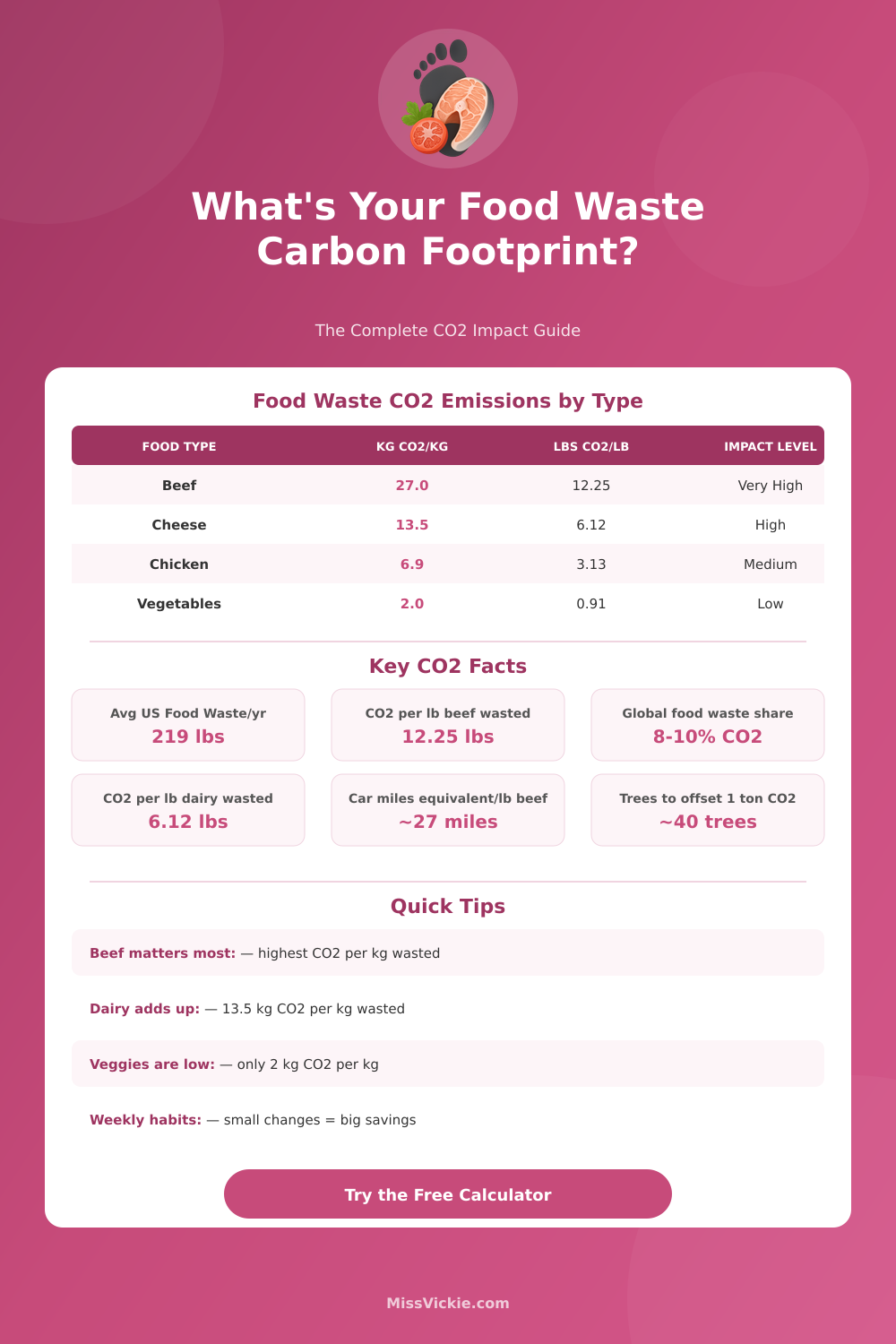
| Food Type | kg CO₂e / kg wasted | lbs CO₂e / lb wasted | Impact Level |
|---|---|---|---|
| Beef / Lamb | 27.0 | 12.25 | Very High |
| Dairy (avg) | 13.5 | 6.12 | High |
| Pork | 12.1 | 5.49 | High |
| Fish / Seafood | 6.1 | 2.77 | Medium |
| Chicken / Poultry | 6.9 | 3.13 | Medium |
| Eggs | 4.8 | 2.18 | Medium |
| Nuts / Seeds | 2.3 | 1.04 | Low |
| Rice / Grains | 4.0 | 1.81 | Medium |
| Bread / Pasta | 1.6 | 0.73 | Low |
| Legumes / Tofu | 2.0 | 0.91 | Low |
| Fruit | 1.1 | 0.50 | Very Low |
| Vegetables | 2.0 | 0.91 | Low |
| Mixed / General | 3.8 | 1.72 | Medium |
| CO₂ Amount | Equivalent Activity | Context |
|---|---|---|
| 1 kg CO₂e | ~4 miles driven (car) | Average passenger vehicle |
| 10 kg CO₂e | ~40 miles driven | One short road trip |
| 100 kg CO₂e | ~400 miles driven | NYC to Boston round trip |
| 1,000 kg CO₂e | ~1 month of driving | Average US monthly car use |
| 1 kg CO₂e | 1 tree absorbs in ~2 weeks | Mature deciduous tree |
| 1 ton CO₂e | ~40 trees for 1 year | Annual tree absorption |
| 1 kg CO₂e | ~1.5 hrs smartphone charging | Symbolic energy context |
| Household Type | Food Waste / Year | Est. CO₂e / Year | vs Global Avg |
|---|---|---|---|
| US Average (1 person) | ~99 kg (218 lbs) | ~376 kg CO₂e | +55% above avg |
| UK Average (1 person) | ~77 kg (170 lbs) | ~293 kg CO₂e | +20% above avg |
| Global Average (1 person) | ~64 kg (141 lbs) | ~243 kg CO₂e | Baseline |
| Zero-waste household | <5 kg (<11 lbs) | <19 kg CO₂e | -92% vs avg |
| Average family of 4 (US) | ~396 kg (872 lbs) | ~1,505 kg CO₂e | +55% above avg |
food waste? It is huge. In United States alone one wastes between 30 and 40 percent of the whole food supply.
Each year the land dumps almost 60 million tons. That averages to around 325 pounds each person yearly. Simply around third of everything that gets produced never gets eaten.
How to Reduce Food Waste at Home
Such loss happens everywhere along the chain. The farms lose food already during production, later in supply networks, stores and finally in homes. Spoiling damage, pest damage, failures of cooling.
All this happens. The kitchen itself causes a lot of waste during cooking. And obviously, some food gets dumped on purpose because of various reasons.
The money cost is truly shocking. Americans dump food worth around 218 billion dollars each year. The retail products?
They are the main cause. For a typical family of four members, such waste matches to around 1 500 dollars yearly. Canadian families are not far behind, they dump food worth 1 300 dollars per year.
Here is where it ends: directly in the worst sites. In 2019, almost 96 percent of the household food waste ended in bins, burners or drains. Until 2023 the situation became even more bad; 31 percent from a massive 237 million tons of the food supply never sold or got eaten.
Only a small part gets donated or saved, but the majority simply goes in bins or burns in burners.
There are also other problems that you cannot ignore. Food waste wastes water also. It swallows around a quarter of the water supply, that is more than 172 billion dollars of wasted water.
Yes this number you cannot ignore.
Portions matter more than many folks know. Bigger portions lead to more leftovers. Those leftovers sit in the refrigerator, forgotten, until one dumps them.
Smaller portions? They work better… Folks eat what one serves to them, and feel full without making so much garbage.
Cutting waste at home is not hard. For instance, do a check of what is already in your pantry, fridge and freezer before going to the store. That alone stops buying too much.
Plan meals for the hole week, and that truly helps. Buy only what you truly can cook and eat before the next shopping trip. Freeze ingredients and ready meals to extend their life.
Cook for several days and divide for later uses; that matters. Pick one evening to eat leftovers, so that they do not slip through your fingers.
Tracking what one wastes is worth the effort. I noticed that simply following the household waste for six weeks, the amount of waste dropped, even months later. Ways to use food waste in cooking help a lot.
That means truly using the whole ingredients: fry the leaves, make tea from herbs. Save veggie scraps for broth, it is simple. Composting takes care of what trulyis not usable.