📊 Food Cost Percentage Calculator
Calculate your food cost %, gross profit margin, and ideal menu price targets instantly
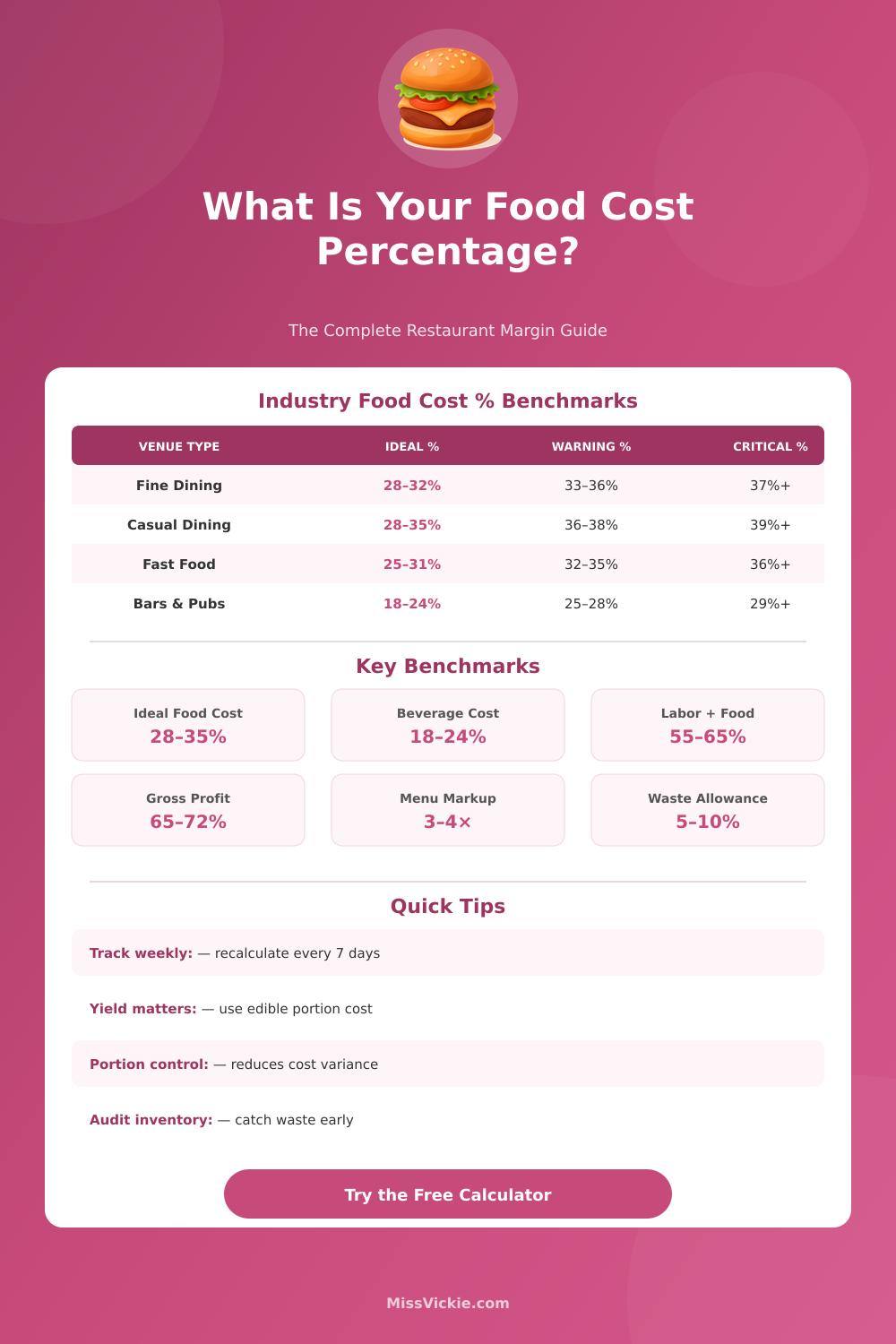
| Venue Type | Food Cost % | Markup Multiplier | Gross Margin % | Status Guide |
|---|---|---|---|---|
| Fine Dining | 28–32% | 3.1–3.6× | 68–72% | ✅ Good: <32% ⚠️ Warn: 33–36% |
| Casual / Bistro | 28–35% | 2.9–3.6× | 65–72% | ✅ Good: <35% ⚠️ Warn: 36–39% |
| Fast Food / QSR | 25–31% | 3.2–4.0× | 69–75% | ✅ Good: <31% ⚠️ Warn: 32–35% |
| Bar & Pub (food) | 22–28% | 3.6–4.5× | 72–78% | ✅ Good: <28% ⚠️ Warn: 29–33% |
| Cafe / Bakery | 25–35% | 2.9–4.0× | 65–75% | ✅ Good: <32% ⚠️ Warn: 33–38% |
| Catering | 27–34% | 2.9–3.7× | 66–73% | ✅ Good: <34% ⚠️ Warn: 35–38% |
| Buffet | 30–38% | 2.6–3.3× | 62–70% | ✅ Good: <36% ⚠️ Warn: 37–42% |
| Protein | Raw Form | Yield % |
|---|---|---|
| Beef tenderloin | Whole loin | 70–75% |
| Chicken breast | Bone-in | 70–78% |
| Salmon fillet | Whole fish | 45–55% |
| Pork loin | Bone-in | 72–78% |
| Shrimp (shell-on) | Raw | 55–65% |
| Ground beef | Raw | 70–75% |
| Duck breast | Skin-on | 65–72% |
| Produce | Raw Form | Yield % |
|---|---|---|
| Onions | Whole | 88–90% |
| Lettuce | Head | 74–80% |
| Broccoli | Head | 61–68% |
| Carrots | Whole | 82–87% |
| Potatoes | Whole | 78–85% |
| Tomatoes | Whole | 90–95% |
| Avocado | Whole | 60–75% |
| Imperial | Metric | Oz | Grams | Common Use |
|---|---|---|---|---|
| 1 oz | 28.35 g | 1 | 28 | Single portion sauces |
| 4 oz | 113 g | 4 | 113 | Burger patty (small) |
| 6 oz | 170 g | 6 | 170 | Chicken breast portion |
| 8 oz (½ lb) | 227 g | 8 | 227 | Standard steak |
| 12 oz (¾ lb) | 340 g | 12 | 340 | Large steak / fish |
| 1 lb | 454 g | 16 | 454 | Bulk protein portion |
| 2.2 lb | 1 kg | 35.2 | 1000 | Wholesale unit |
food cost simply shows how much money is needed to prepare one serving. It includes everything one spends on ingredients during making of food. Important to note is that it covers all purchases for the dish, included in that what does not get used directly.
Also waste, seeds and trimmings belong to it.
Food Cost: What It Is and How to Calculate It
food cost percentage shows the link between spending on ingredients and income that they bring when one sells them as menu items. To count it, one divides the cost of ingredients by the selling price. In the food business one aims usually for 30 to 45 percent of the selling price for the food cost.
Around 25 percent is possible depending on the business. When the target is 33 percent then the whole food cost must be around a third of the selling price.
Here is a quick example. When a rib steak costs 5 dollars to put on the plate and the planned food cost is 35 percent, one divides 5 by 0.35 to get about 14.29 dollars. This way the menu price could land at 15 dollars.
Even so it is about more than only that. One must also think about free given items like bread, ketchup and butter, together with sides like potaotes or vegetables.
Portion control ranks between the easiest and best ways to control food cost. A standard recipe ensures the same result in making and expenses. Costing of menu allows managers to estimate the cost for one serving and set good selling prices.
The cost for one serving simply is the whole cost of the product divided by the number of servings that it gives.
In restaurants the markups can be really big. A hamburger costs around 2.72 dollars for items, but one sells it for about 14.60 dollars. Fajitas cost less than 3.15 dollars to prepare at home, but in a restaurant they reach 20 dollars.
Ramen has a markup of 499 percent. To create a bowl of noodles one needs around 2.34 dollars, but a restaurant asks more then 14 dollars for it.
The two main expenses in restaurants are food and work. They together make up between 45 and 55 percent of the net selling price. Profit counts from selling price less food cost, less labor expenses, less costs of the business.
Running a restaurant needs knowledge about rent, utilities, salaries and a long list of other costs.
Tracking of food cost during restaurant work is one of the most poorly understood parts of the business. Programs like Excel can help track stock to menu costing. Talking with suppliers about discounts for bulk purchases also helps.
Old stock is a big problem that one must watch and that should not affect the food cost. Sometimes the fix is only to raise prices or changethe menu items.