🌾 Flour Weight Converter
Convert cups, tablespoons & ounces to grams for any flour type — bake with precision every time
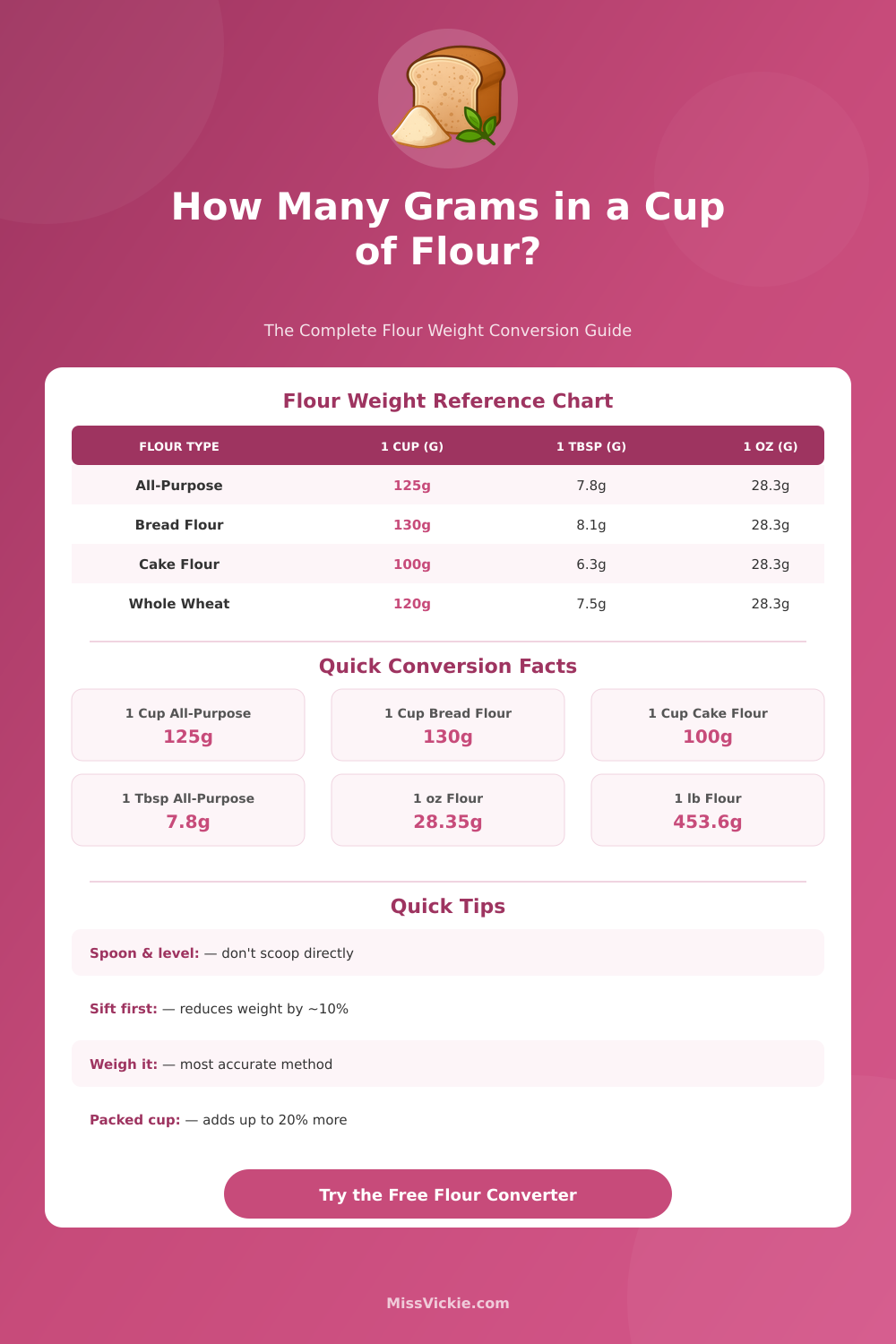
| Flour Type | 1 Cup (g) | 1 Tbsp (g) | 1 oz (g) | 1 Cup (oz) |
|---|---|---|---|---|
| All-Purpose | 125g | 7.8g | 28.35g | 4.4 oz |
| Bread Flour | 130g | 8.1g | 28.35g | 4.6 oz |
| Cake Flour | 100g | 6.3g | 28.35g | 3.5 oz |
| Whole Wheat | 120g | 7.5g | 28.35g | 4.2 oz |
| Almond Flour | 96g | 6.0g | 28.35g | 3.4 oz |
| Coconut Flour | 128g | 8.0g | 28.35g | 4.5 oz |
| Rye Flour | 102g | 6.4g | 28.35g | 3.6 oz |
| Oat Flour | 92g | 5.8g | 28.35g | 3.2 oz |
| Rice Flour | 158g | 9.9g | 28.35g | 5.6 oz |
| Self-Rising | 125g | 7.8g | 28.35g | 4.4 oz |
| Cups | Grams (g) | Ounces (oz) | Pounds (lb) |
|---|---|---|---|
| ¼ cup | 31g | 1.1 oz | 0.07 lb |
| ⅓ cup | 42g | 1.5 oz | 0.09 lb |
| ½ cup | 63g | 2.2 oz | 0.14 lb |
| ⅔ cup | 83g | 2.9 oz | 0.18 lb |
| ¾ cup | 94g | 3.3 oz | 0.21 lb |
| 1 cup | 125g | 4.4 oz | 0.28 lb |
| 1½ cups | 188g | 6.6 oz | 0.41 lb |
| 2 cups | 250g | 8.8 oz | 0.55 lb |
| 3 cups | 375g | 13.2 oz | 0.83 lb |
| 4 cups | 500g | 17.6 oz | 1.10 lb |
Sifted Flour: If a recipe calls for sifted flour, sift before measuring. Sifted flour weighs about 10% less per cup than unsifted flour.
Best Practice: A kitchen scale with grams is the most accurate way to measure flour. A 1-gram difference in small quantities can affect delicate recipes like macarons or croissants.
flour is made up of powder that one makes by means of milling of grains, beans, nuts, seeds, roots or vegetables in a mill. One uses it to create many kinds of foods for instance baked goods, and it helps to thicken various dishes. Especially the flour from cereals, like wheat flour, forms the main part of bread, that stays basic food globally.
Currently the word flour commonly points only to wheat flour, that leads in western lands.
What is flour and the different kinds
Many folks do not know, how many kinds of flour exist. Between the available types there is amaranth, arrowroot, barley, buckwheat, chickpea flour, corn, kamut, nuts, oat, potato, quinoa, rice, rye, soy, spelt, tapioca, teff, wheat and bean flours. Flours from rice, soy, rye, pea and oat work for making breads, cakes and cookies.
Even so only the wheat kernel has the needed gluten, that rises and binds the ckaes, giving to them the airy structure.
The main distinction between flour kinds relates to the protein amount. Two types of wheat deliver flour. One uses the hard winter wheat, rich in proteins, for bread flours.
The pastry flours, from soft wheat, have less proteins. White bread flour one does from hard, protein-rich wheat, where the protein share reaches up to fourteen percent, but usually stays around twelve or thirteen. All-purpose flour mixes hard and soft wheats, with eight to eleven percent of protein.
Pastry flour stores around eight to nine percent of protein and is a bit denser because of the milling.
Good flours stay unbleached and free of bromate and chemical preservatives. For all-purpose flour the best choices depend on the baking preference of folk. One decides according too the protein content, that ranges surprisingly between different brands.
Also unbleached flour deserves to consider.
Any one flour works most for everyday cooks, baking and domestic healthy meals. Every kind has its own traits and uses. Flour or plain taste in baked goods can happen because of too much flour, bad mixed mass, old or stale flour, wrong flour type or recipe amounts, that causes dry crumbs and stresses theflour taste.
The volume measurement of flour surprisingly commonly errs. One cup of flour weighs somewhere of four to six ounce units, according to that, whether it is loosely or flatly filled. Even expert folks differ about the weight of one cup flour.
Mass in certain moisture level can seem wet or drier according to the brand and flour type. Whole wheat flour carries the bran and germ together with the endosperm, during average white flours have only the endosperm. The word flour was written until around 1830 to mean flower, in the sense of being the best part from grains.