🍺 Fermentation Calculator
Calculate ABV, sugar additions, yeast pitching rates & CO₂ production for beer, wine, cider & mead
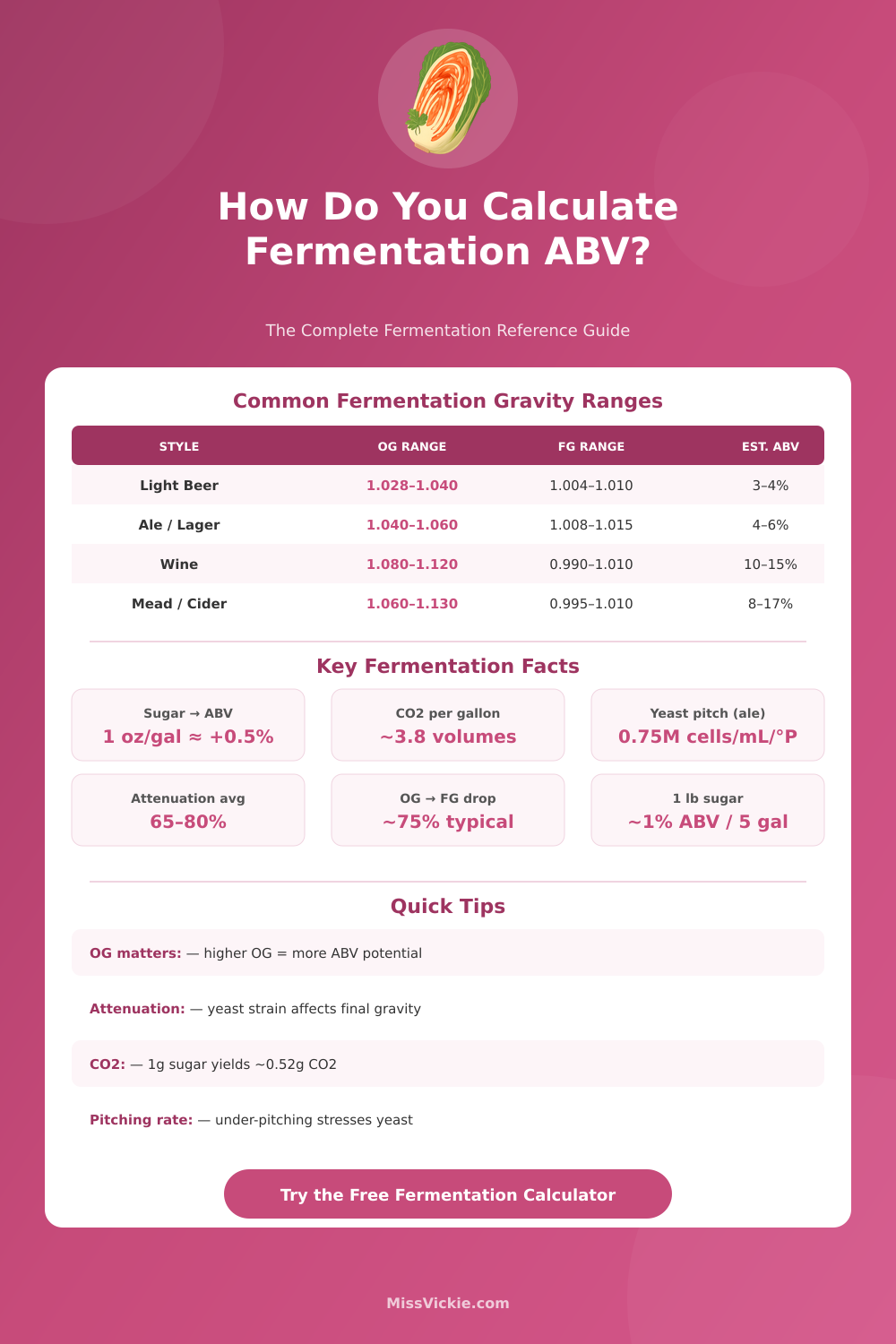
| Fermentation Style | OG Range | FG Range | Typical ABV | Attenuation |
|---|---|---|---|---|
| Light Beer / Session | 1.028 – 1.040 | 1.004 – 1.010 | 2.5 – 4.0% | 70 – 80% |
| Standard Ale / Lager | 1.040 – 1.060 | 1.008 – 1.015 | 4.0 – 6.5% | 65 – 78% |
| IPA / Strong Ale | 1.060 – 1.085 | 1.010 – 1.018 | 6.0 – 9.5% | 68 – 80% |
| Imperial Stout / Barleywine | 1.085 – 1.130 | 1.016 – 1.030 | 8.5 – 13% | 62 – 75% |
| Dry / Hard Cider | 1.045 – 1.070 | 0.998 – 1.010 | 4.5 – 9% | 80 – 95% |
| Table Wine (White) | 1.070 – 1.095 | 0.990 – 1.005 | 9 – 13% | 85 – 95% |
| Table Wine (Red) | 1.080 – 1.110 | 0.992 – 1.006 | 11 – 14% | 85 – 95% |
| Mead (Traditional) | 1.080 – 1.130 | 0.995 – 1.010 | 10 – 18% | 85 – 92% |
| Yeast Type | Pitch Rate (M cells/mL/°P) | Cells Needed (5 gal, 1.050) | Dry Packets | Liquid Vials |
|---|---|---|---|---|
| Ale Yeast | 0.75 | ~142 billion | 1 packet (11g) | 1–2 vials |
| Lager Yeast | 1.50 | ~284 billion | 2 packets | 2–3 vials |
| Wine Yeast | 0.50 | ~95 billion | 1 packet (5g) | 1 vial |
| Champagne Yeast | 0.50 | ~95 billion | 1 packet (5g) | 1 vial |
| Sugar Type | Points per lb per gal | Fermentability | Relative Amount Needed |
|---|---|---|---|
| Table Sugar (Sucrose) | 46 | 100% | 1.00x (baseline) |
| Corn Sugar (Dextrose) | 46 | 100% | 1.10x (add 10% more) |
| Honey | 35 | 95% | 1.25x |
| Dry Malt Extract (DME) | 44 | 75% | 1.60x |
| Liquid Malt Extract (LME) | 36 | 75% | 1.96x |
| Beverage Style | CO₂ Volumes | Description |
|---|---|---|
| English Ales / Cask | 1.0 – 1.5 | Very low, traditional pub style |
| Still Wine / Mead | 0.5 – 1.0 | Minimal to no carbonation |
| American Ales | 2.2 – 2.6 | Moderate, clean finish |
| Lagers & Pilsners | 2.4 – 2.8 | Crisp, higher carbonation |
| Belgian Ales / Saisons | 2.8 – 3.5 | High, lively carbonation |
| Sparkling Wine / Champagne | 5.0 – 6.5 | Very high — commercial method |
Sugar breaks into something totally fresh by means of Fermentation and tiny organisms, that is the main players in that effect. It is a process, what means that oxygen does not need to be there so that it works. Here what happens: organic molecules for instance glucose, divide in two parts, and their electrons transfer to other organic molecules.
That motion of electrons restores NAD+ from NADH, what keeps the whole surrounding cycle. Surprisingly, Fermentation reactions can happen in both oxygen-free and oxygen-rich creatures.
What Fermentation Is and How It Works
Bacteria and yeasts are the real workers here, smashing food parts and forming totally new flavros and useful compounds during the process. Think about it as about controlled breakdown. Instead of allowing food to rot randomly, what only causes waste and harm; Fermentation brakes that and directs it to something useful.
Particular species of bacteria, yeasts or molds are added under precise conditions, turning plain ingredients in truly attractive something.
The main distinction between fermented food and rotted food depends on what germs accomplish the task. When Fermentation happens on purpose, the used bacteria or funguses do not produce anything harmful. Rot, on the other hand?
It is a messy cause wear any something can invade your food, and yes, some of those things could make you ill. Fermentation truly is early digestion that happens outside of your body. A starter culture or salt is added to lead the surroundings in a direction that keeps molds and other dangers away.
This is not a new invention. Wine and beer bubbled for at least 10,000 years. Ancient folks observed the bubbling and noticed what happened.
Civilizations around the world used tiny cultures long before science gave names to them, preserving everything from yoghurt to tempeh while they also improved their nutritious traits. Some Fermentation even releases nutrients that otherwise would stay locked, for instance, fermented millet indeed lowers its content of phytic acid.
Bread baking depends much on Fermentation that does its magic. Without it, you would have only dense, flat block instead of real bread. The yeast eats sugar and starch in the dough, smashing them into carbon dioxide and ethanol.
Sourdough works since the starter culture ferments for long times before it touches the bread dough, creating that rich, sour tastethrough the process.
Sauerkraut and kimchi get their special sour sign from Fermentation also. Modern science seized that ancient skill, Fermentation now allows scientists to lead germs to produce food ingredients, proteins, vitamins and alike fibers with real regularity. It changes the making of foods and everyday products.
Your gut also does its own Fermentation, handling dietary fiber and creating useful stuff like butyric acid during the process.