☕ Espresso Caffeine Calculator
Find out exactly how much caffeine is in your espresso drink — by shots, type & serving size
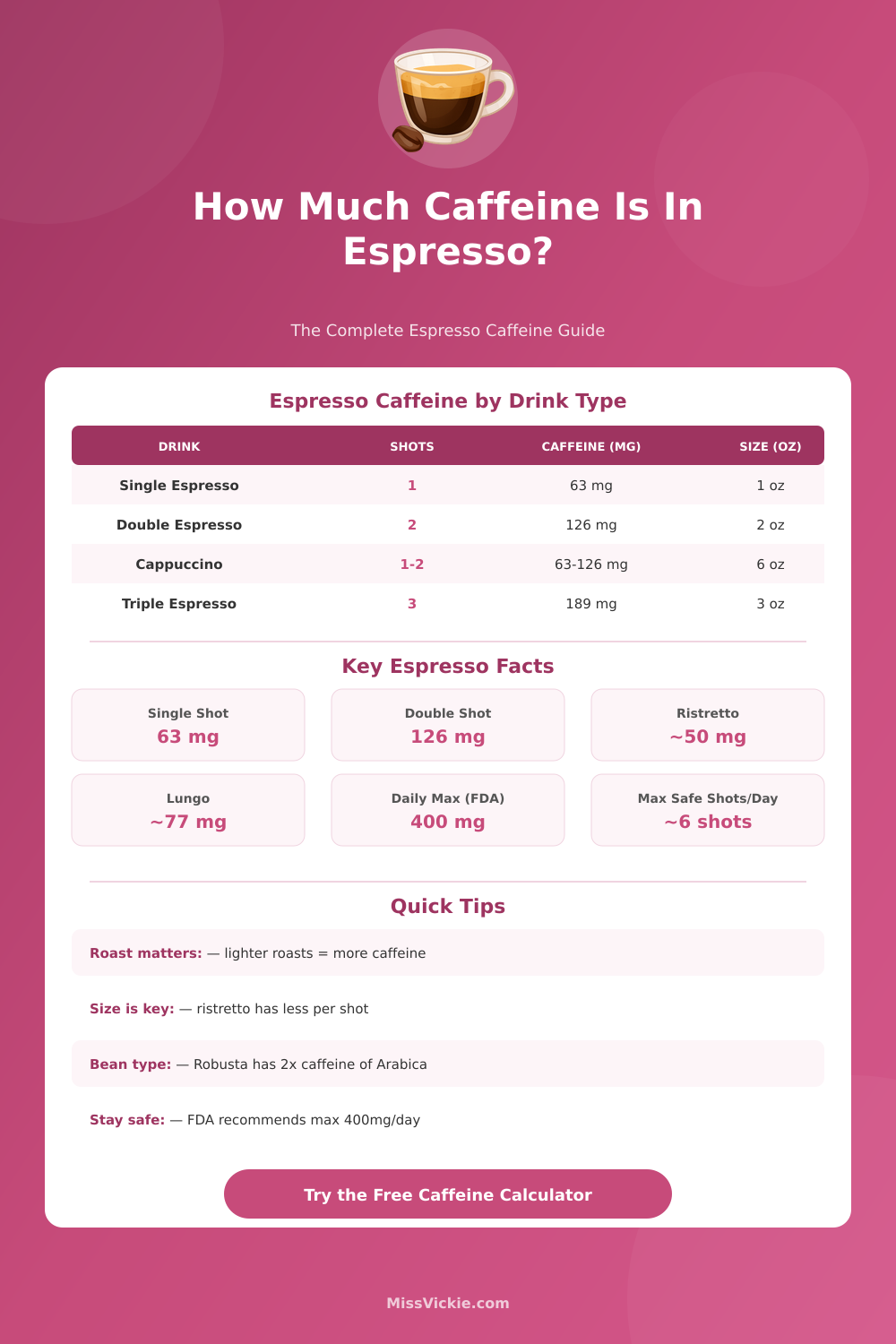
| Drink Type | Shots | Caffeine (mg) | Volume (oz) | Volume (ml) |
|---|---|---|---|---|
| Single Espresso | 1 | 63 mg | 1 oz | 30 ml |
| Double Espresso (Doppio) | 2 | 126 mg | 2 oz | 60 ml |
| Triple Espresso | 3 | 189 mg | 3 oz | 90 ml |
| Ristretto | 1 | ~50 mg | 0.75 oz | 22 ml |
| Lungo | 1 | ~77 mg | 1.5 oz | 44 ml |
| Cappuccino | 1 | 63 mg | 6 oz | 180 ml |
| Latte (single) | 1 | 63 mg | 8–12 oz | 240–360 ml |
| Latte (double) | 2 | 126 mg | 12–16 oz | 360–480 ml |
| Flat White | 2 | 126 mg | 5–6 oz | 150–180 ml |
| Macchiato | 1 | 63 mg | 2–3 oz | 60–90 ml |
| Americano (double) | 2 | 126 mg | 8–10 oz | 240–300 ml |
| Cortado | 2 | 126 mg | 4 oz | 120 ml |
| Bean / Roast | Caffeine per Shot | vs. Standard | Notes |
|---|---|---|---|
| Arabica – Light Roast | 70–75 mg | +10–15% | Most caffeine per gram of grounds |
| Arabica – Medium Roast | 63 mg | Baseline | Standard reference point |
| Arabica – Dark Roast | 56–60 mg | –5–10% | Roasting reduces caffeine slightly |
| Robusta – Any Roast | 100–130 mg | +60–100% | Nearly 2x the caffeine of Arabica |
| Arabica/Robusta Blend | 80–100 mg | +25–55% | Common in Italian espresso blends |
| Decaf Espresso | 2–15 mg | –95%+ | Not completely caffeine-free |
| Shot Type | Volume (oz) | Volume (ml) | Grounds Used | Brew Time |
|---|---|---|---|---|
| Ristretto | 0.67–0.75 oz | 20–22 ml | 7–9 g | 15–20 sec |
| Single Espresso | 1–1.5 oz | 30–44 ml | 7–9 g | 25–30 sec |
| Double (Doppio) | 2–2.5 oz | 60–75 ml | 14–18 g | 25–30 sec |
| Lungo | 1.5–2 oz | 44–60 ml | 7–9 g | 35–45 sec |
| Triple | 3 oz | 90 ml | 21–27 g | 25–30 sec |
Espresso is made from very strong coffee, that one prepares by means of warm water under strong pressure, that crosses very finely ground beans. This is an Italian creation that spread through the whole world as one of the main ways to prepare coffee everywhere. The whole process happens very quickly.
We talk about only 20 to 30 seconds while almost hot water pushes through the grounds at very high pressure.
What Is Espresso and How It Works
Here is something that commonly surprises folks: there is no thing called “espresso-bean” or “espresso-roast”. It is not about the beans themselves. What makes the coffee espresso is the brewing method; one forces water through a small amount of very finely ground coffee in a fast burst.
Coffee brewing splits widely into two groups based on the extraction: soaking method (that is the most used) and pressure-based extraction. Espresso belongs entirely to the second group.
Some kinds of coffee beans, especially the more darkly roasted, really shine when one prepares them as espresso. The machine keeps the water at the right heat and sends it through those very fine grounds at almost 9 bars of pressure. Those little servings give rich intensity, and you really feel the caffeine impact in your whole body.
Double espresso normally has around 2.5 ounces or even less, and one serves it in those lovely little cups. Most folks choose between 1 and 2 ounces for a single serving. One gets it black.
Without milk, and it is topped with that special frothy layer called crema. That thick foam that floats up is one of the typical signs of espresso. A good single espresso uses around 7 to 9 grams of coffee and gives about 14 to 18 grams of liquid.
Want too reach those amounts? It is harder than it seems.
A well prepared serving should hold a bit of every taste. The mouthfeel stays pretty balanced and almost neutral, even though behind this hides a strong feeling on the lips. Fans of espresso live for that aftertaste.
If you have not yet gotten used to the flavor, maybe you will want to drink something between the servings, a cleanser for the palate helps.
How you press the grounds down matters, because it makes sure that the water flows evenly through it. Honestly, there are a lot of parts in play here, the quality of the water, the coffee itself, the heat, the time and how well you grind it. Using good water with some minerals in it makes a real difference.
Flat, dead or salty serving? That commonly points to under-extraction. If it has harsh taste or makes your mouth pucker, you probably have over-extraction.
In Italy, drinking espresso seems like a pretty simple thing. It comes quickly, costs almost nothing and a few spoons of sugar remove the bitterness. There is beauty in knocking back a little espresso at the cafe and going on with your day.
Here is the interesting part though: a typical 8-ounce cup of regular brewed coffee holds around 96 milligrams of caffeine. So, although espresso is more focused by volume, a single serving probably hasfewer caffeine than a whole cup of regular coffee.