🍵 Earl Grey Tea Caffeine Calculator
Estimate your total caffeine intake from Earl Grey tea by cups, steep time & brand
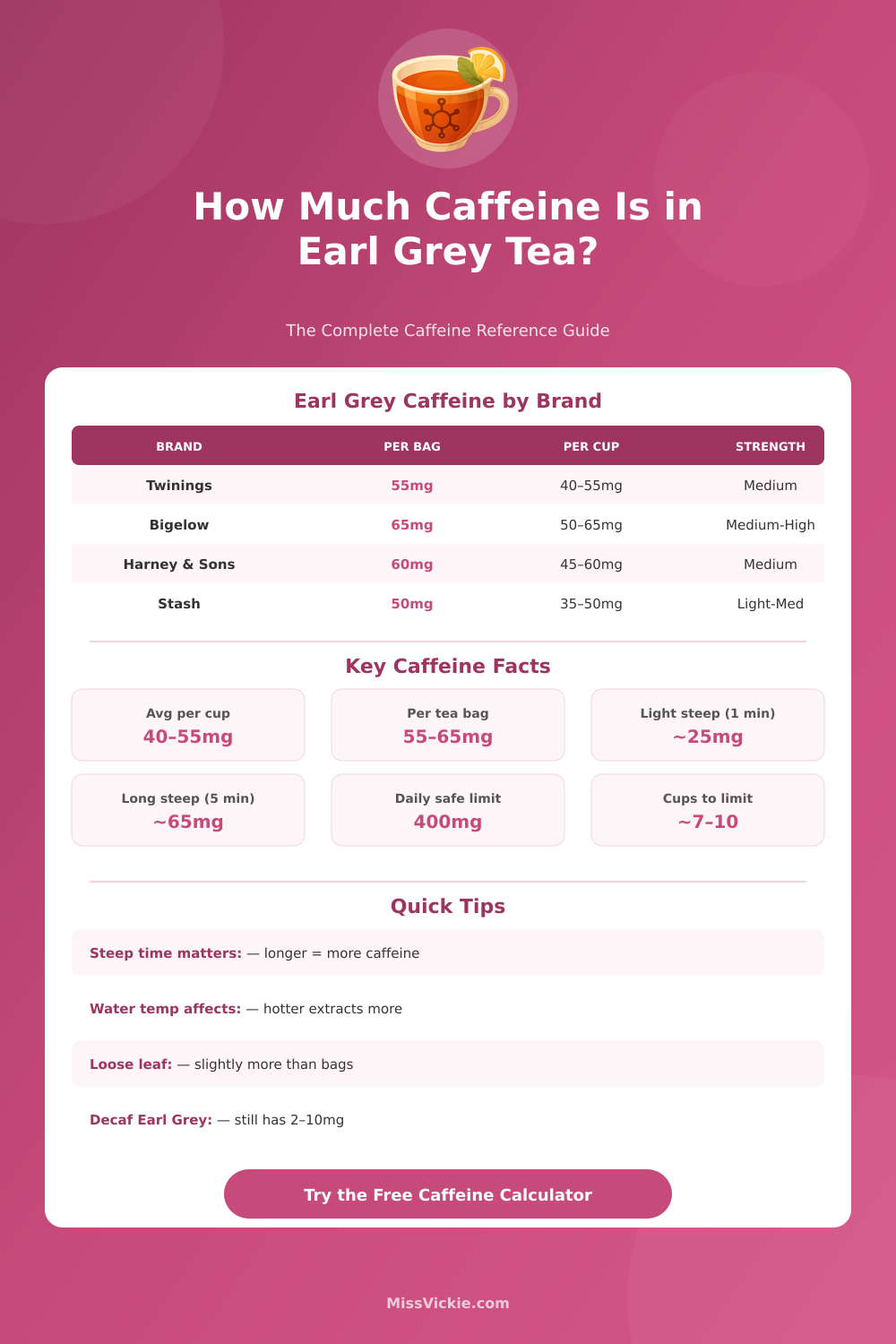
| Brand / Type | Per Tea Bag | Per 8 oz Cup (3 min steep) | Caffeine Level |
|---|---|---|---|
| Twinings Earl Grey | 55 mg | 40–55 mg | Medium |
| Bigelow Earl Grey | 65 mg | 50–65 mg | Medium-High |
| Harney & Sons | 60 mg | 45–60 mg | Medium |
| Stash Earl Grey | 50 mg | 35–50 mg | Light-Medium |
| Tazo Earl Grey | 55 mg | 40–55 mg | Medium |
| Yorkshire Tea Earl Grey | 65 mg | 50–65 mg | Medium-High |
| Loose Leaf Earl Grey | 60–75 mg | 55–75 mg | Medium-High |
| Decaf Earl Grey | 2–10 mg | 2–10 mg | Very Low |
| Generic / Average | 50–60 mg | 40–55 mg | Medium |
| Steep Time | Caffeine Extracted | % of Total Available | Flavor Profile |
|---|---|---|---|
| 1 minute | ~25 mg | ~45% | Light, floral |
| 2 minutes | ~35 mg | ~63% | Mild bergamot |
| 3 minutes | ~47 mg | ~85% | Balanced, classic |
| 4 minutes | ~54 mg | ~98% | Full-bodied |
| 5 minutes | ~60 mg | ~100% | Strong, tannic |
| 7+ minutes | ~65 mg | ~100%+ | Bitter, very strong |
| Beverage | Serving Size | Caffeine (mg) | vs. Earl Grey |
|---|---|---|---|
| Earl Grey Tea | 8 oz | 40–55 mg | — Baseline |
| Green Tea | 8 oz | 25–35 mg | ~40% less |
| Black Coffee | 8 oz | 95–200 mg | ~3–4x more |
| Espresso | 1 oz shot | 63 mg | Similar per oz |
| Cola (Coca-Cola) | 12 oz | 34 mg | ~35% less |
| Energy Drink | 8 oz | 80 mg | ~70% more |
| Decaf Coffee | 8 oz | 2–15 mg | ~90% less |
| Herbal Tea | 8 oz | 0 mg | No caffeine |
Earl Grey tea ranks as one of the most known tea blends globally. It is made of black tea, that gets taste from bergamot oil. That pleasant oil is taken from the bark of the bergamot orange a tiny citrus fruit coming from the Mediterranean.
That oil gives Earl Grey its unique taste and fresh citrus smell. Even so, many Earl Grey blends choose to use false flavors or chemical oils instead of real bergamot, because that costs less.
All About Earl Grey Tea
The tea got its name from the British prime minister Charles Grey, the second earl Grey, that served between 1830 and 1834. According to one story, a Chinese tea master prepared the first Earl Grey tea as a gift for him. Chinese tea masters had an old custom of adding flowers, fruits and scents to their teas during the making.
One otehr legend talks about a thankful Chinese leader, whose child was saved by Lord Grey from drowning. Even so the blend was prepared from dried black Indian and Sri Lankan teas, while green tea enjoys bigger fame in China than black. So it seems a bit unlikely that the recipe came from China.
One usually uses black tea from Assam, Darjeeling, Keemun or Ceylon as base. They give it strength along with smooth, honey, earthy or woody hints. Earl Grey tends to be soft and well balanced, with hints of citrus, spice, malt and smoke.
It brews into a cup of medium body with a fresh finish. One can enjoy it plain or with milk and sugar.
There are many versions. Many tea brands offer a big range, and their are also many kinds of Earl Grey. Some appear as green teas or rooibos blends.
Classic Earl Grey marks only the first step, there are also cream, lavender and Russian versions. Some blends mix bergamot with geranium and rose hints. Lady Grey forms a similar mix, that adds orange and lemon zest to the bergamot.
A popular drink from Earl Grey is the London Mist, that simply is a milky version. It combines strong Earl Grey with heated milk, vanilla and honey or brown sugar, topped with cinnamon. Adding lavender syrup instead of the usual sweetenervworks very well.
Earl Grey works well for baking. It flavors banana bread, tea breads, cookies, sticky rolls and cakes. The bergamot oil keeps its impact in recipes, giving its nice citrus taste.
A classic Earl Grey tea loaf combines the tea with dried fruits like currants and sultanas and goes well with butter.
Does a pinch of salt in the cup truly help to boost the taste on days when the tea lacks force? It forms a simple trick backed by science.