🏰 Disney World Food Cost Calculator
Estimate your total park dining spend per person & for your whole group
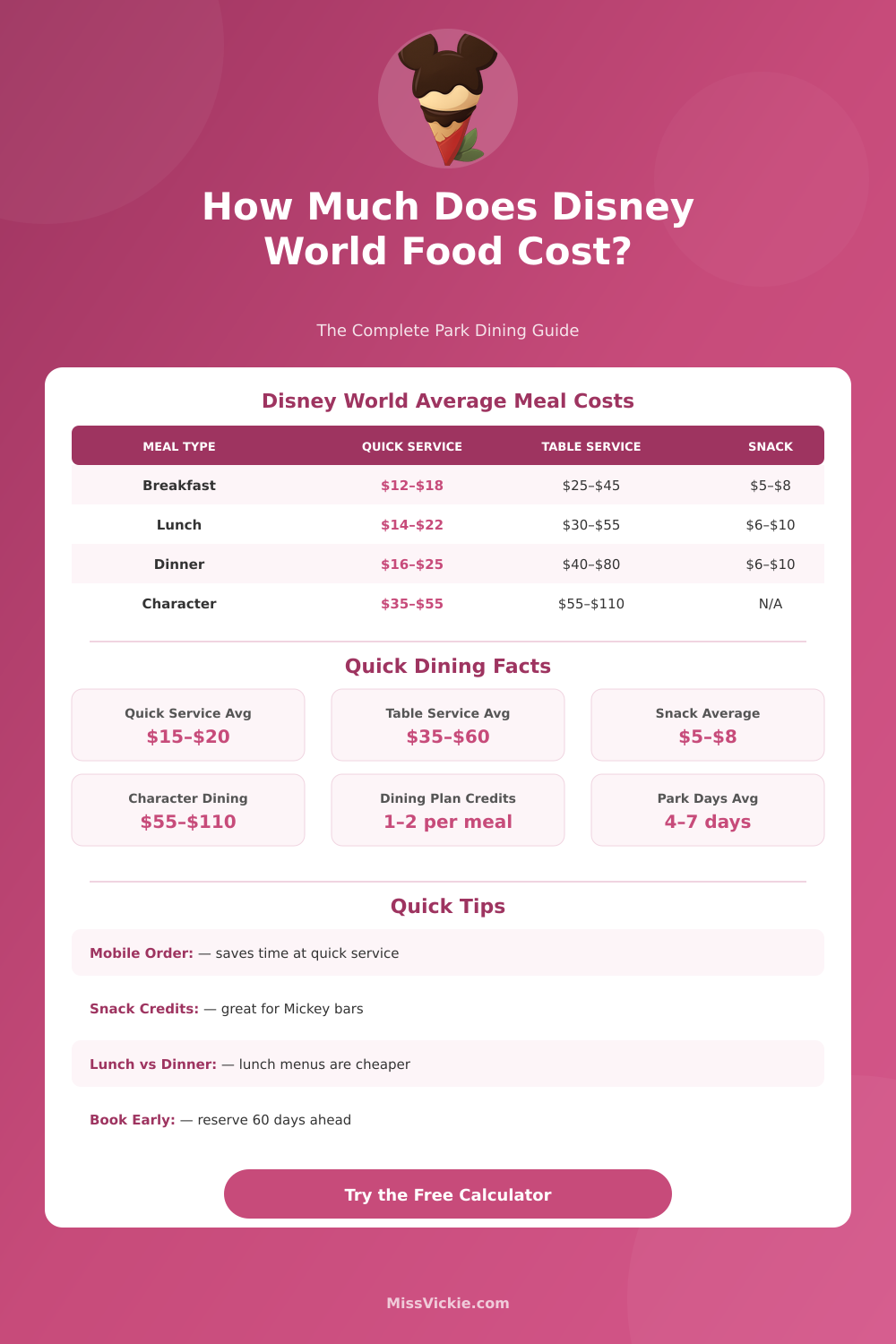
| Meal Type | Category | Adult Avg | Child Avg | Notes |
|---|---|---|---|---|
| Breakfast | Quick Service | $12–$18 | $8–$12 | Combo meals incl. drink |
| Breakfast | Table Service | $25–$45 | $15–$25 | Buffets are flat-rate |
| Lunch | Quick Service | $14–$22 | $9–$14 | Combo meal |
| Lunch | Table Service | $30–$55 | $18–$28 | Cheaper than dinner menu |
| Dinner | Quick Service | $16–$25 | $10–$16 | Entree + side |
| Dinner | Table Service | $40–$80 | $20–$35 | Excl. gratuity |
| Dinner | Signature | $80–$150 | $35–$60 | Victoria & Albert's etc. |
| Character Dining | Breakfast | $35–$55 | $22–$35 | Buffet style |
| Character Dining | Lunch/Dinner | $55–$110 | $30–$55 | Chef Mickey, CRT etc. |
| Snacks | Mickey Bar / Churro | $5–$7 | $5–$7 | Iconic Disney treats |
| Snacks | Dole Whip / DOLE | $6–$9 | $6–$9 | Adventureland staple |
| Beverages | Soft Drink / Water | $4–$6 | $3–$5 | Refillable mugs avail. |
| Plan Name | Price / Night | Meals Included | Snack Credits | Best For |
|---|---|---|---|---|
| Quick-Service Dining Plan | ~$57/adult | 2 QS/day | 2/day | Budget travelers |
| Disney Dining Plan | ~$94/adult | 1 QS + 1 TS/day | 2/day | Mixed dining fans |
| Deluxe Dining Plan | ~$119/adult | 3 meals/day | 2/day | Foodies + splurgers |
| No Dining Plan (OOP) | Pay as you go | Flexible | N/A | Light eaters |
| Style | Adult / Day | Child / Day |
|---|---|---|
| Budget | $50–$70 | $30–$45 |
| Moderate | $80–$110 | $45–$65 |
| Table Service | $110–$150 | $60–$90 |
| Splurge | $150–$250+ | $80–$130 |
| Park | Dining Density | Best QS Spots |
|---|---|---|
| Magic Kingdom | High | Columbia Harbour |
| EPCOT | Highest | World Showcase |
| Hollywood Studios | Medium | Backlot Express |
| Animal Kingdom | Medium | Satu'li Canteen |
| Snack | Price (USD) | Location | Snack Credit? |
|---|---|---|---|
| Mickey Premium Ice Cream Bar | $6.50 | All Parks | Yes |
| Dole Whip Float | $7.49 | Magic Kingdom | Yes |
| Mickey Pretzel | $6.29 | Magic Kingdom | Yes |
| Churro | $5.79 | All Parks | Yes |
| Mickey Waffle (Breakfast) | $12–$18 | Resort Hotels | QS Credit |
| Frozen Butterbeer Style | $8–$10 | Springs + Resorts | Yes |
| Popcorn Bucket (refillable) | $15–$25 | All Parks | No |
| LeFou's Brew | $5.99 | Fantasyland (MK) | Yes |
| Currency | Code | Approx. Rate | $100 USD = |
|---|---|---|---|
| Euro | EUR | 0.93 | €93 |
| British Pound | GBP | 0.79 | £79 |
| Canadian Dollar | CAD | 1.36 | CA$136 |
| Australian Dollar | AUD | 1.53 | A$153 |
| US Dollar | USD | 1.00 | $100 |
Food cost in short shows how much money you spend on ingredients and supplies during a set time. It comes down mainly to that, to compare expense for goods with income from finished foods. Usually one presents it as a share, here your food cost percentage.
What does food cost percentage exactly mean? It describes the link between spending of a restaurant on foods and drinks against income that those products bring, when clients order them. Tracking and improving that pattern helps you better reach maximum profit in your business.
How to Calculate Food Cost Percentage
In other words, it directly affects your whole finances and bottom line.
Here is the key cause of restaurant food cost… It is made up of tracking every ingredient that goes into a recipe, and honestly it ranks between the most commonly misunderstood parts of restaurant management. Those calculations can seem scary, especially if you are a chef that prefers to focus on the creative side of cooking.
To count food cost in percentages, follow some basic steps. Add expense for fresh products bought during the period to the stock that you had at first. Later subtract the remaining stock at the end of the time.
For that you need starting stock value, purchases in the set period and final stock. After you found used food and subtracted staff meals, you have the food cost of sold items for that period.
While costing a particular dish, consider all ingredients (including waste). Slices, cores, scraps, everything that adds to food cost, not only what ends up on the plate. For instance take butter (if it costs four dollars per pound), that does around 25 cents per unit.
Add all ingredient expenses to get the whole plate cost.
The math itself is simple: divide ingredient cost by sale price. Assume a plate costs five dollars to prepare, and you want 35 percent food cost. Divide five by 0.35, and you get a menu price of about 14 dollars and a bit.
It is a old rule, that works well in practice, a third of price covers food, second third labor, and the third everything else plus profit. One chef, that I no, kept his food cost at around 25 percent.
Standard recipes help to keep everything steady and predictable through set steps. Costing a menu means managers estimate real price of every part and fix items later. Good management of expenses depends on portion control, that truly is one of the simplest and strongest tools that you have.
Costing a portion is basic math, simply divide whole item cost by number of portions. A dish at twenty dollars, that gives four portions? So five dollars for one portion.
Other factors also matter. Those “free” products like bread, ketchup, butter, they affect your patterns more than one assumes. It is worth talking with suppliers about discounts for big orders or repeat purchases of stable products.
Old stock from prior menus deserves a separate mark, so that it does not weighcurrent calculations. Sometimes you simply change prices or rework menu items.