🌾 Couscous Protein Calculator
Calculate protein and full nutrition for any serving of couscous
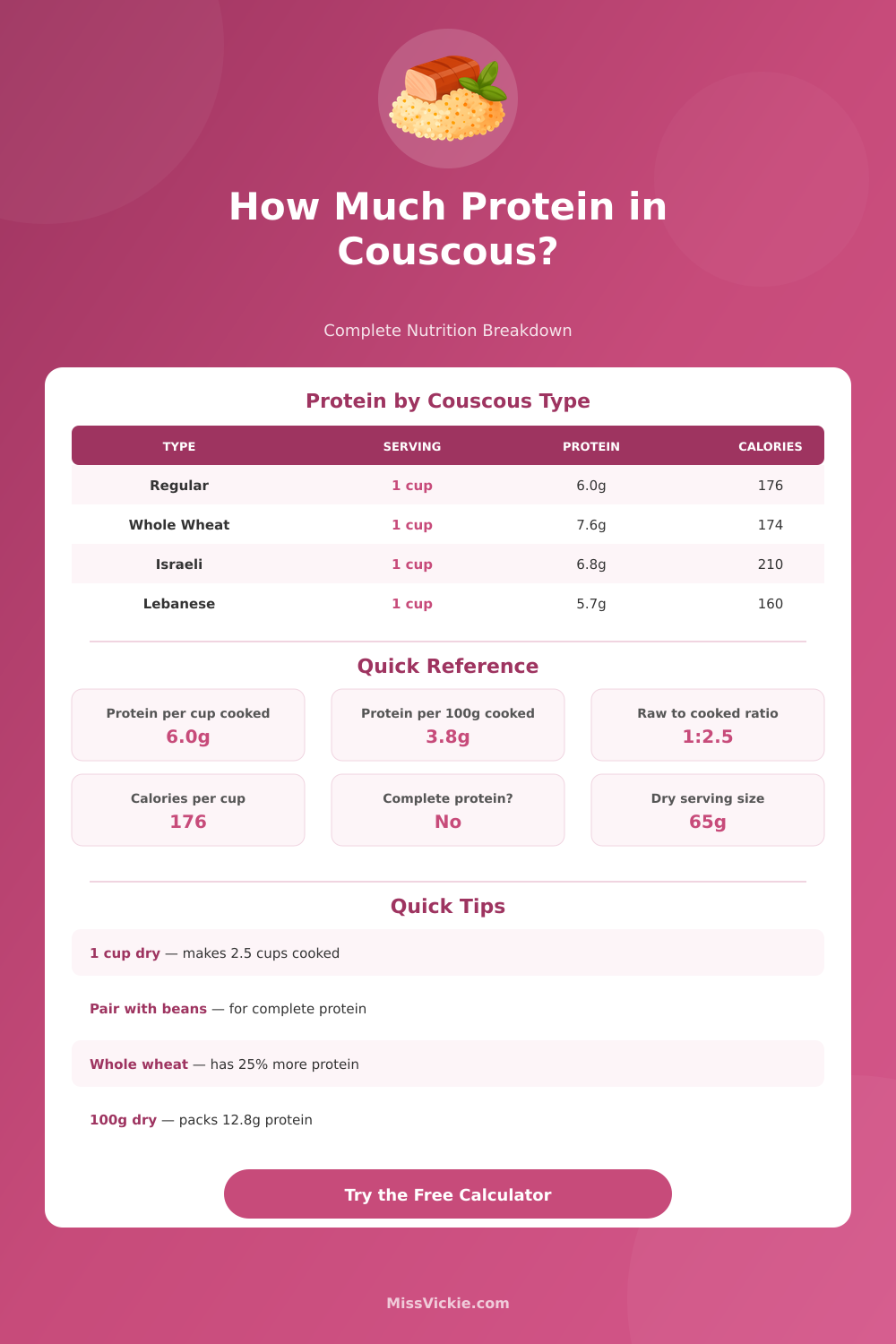
| Type | Protein | Calories | Carbs | Fat |
|---|---|---|---|---|
| Regular (Moroccan) | 6.0g | 176 | 36.5g | 0.3g |
| Whole Wheat | 7.6g | 174 | 35.2g | 0.4g |
| Israeli (Pearl) | 6.8g | 210 | 41.2g | 0.9g |
| Lebanese | 5.7g | 160 | 33.0g | 0.2g |
| Serving | Cooked Weight | Dry Equivalent | Protein (Regular) |
|---|---|---|---|
| Small side | 90g (3.2 oz) | 36g (1.3 oz) | 3.4g |
| Standard side | 157g (5.5 oz) | 65g (2.3 oz) | 6.0g |
| Large side | 235g (8.3 oz) | 95g (3.4 oz) | 9.0g |
| Main course | 314g (11.1 oz) | 130g (4.6 oz) | 12.0g |
| 1 tablespoon cooked | 10g (0.35 oz) | 4g (0.14 oz) | 0.4g |
| Dry Amount | Cooked Yield | Ratio | Protein (Regular) |
|---|---|---|---|
| ¼ cup (43g) | ⅔ cup (105g) | 1 : 2.5 | 5.5g |
| ½ cup (87g) | 1¼ cups (210g) | 1 : 2.5 | 11.1g |
| 1 cup (173g) | 2½ cups (420g) | 1 : 2.5 | 22.1g |
| 100g | 250g | 1 : 2.5 | 12.8g |
| 1 lb (454g) | 2.5 lbs (1135g) | 1 : 2.5 | 58.1g |
| Grain | Protein | Calories | Fiber |
|---|---|---|---|
| Couscous (regular) | 3.8g | 112 | 1.4g |
| Quinoa | 4.4g | 120 | 2.8g |
| Brown Rice | 2.6g | 123 | 1.8g |
| White Rice | 2.7g | 130 | 0.4g |
| Bulgur | 3.1g | 83 | 4.5g |
| Pasta | 5.8g | 131 | 1.8g |
Couscous cannot hold the main position in the world of proteins, even so it clearly deserves a place in the team. For one cup of cooked version it delivers around 6 grams which is not entirely poor. The denser kind reaches strongly 12.8 grams for 100 grams, but when one cooks it in water, that absorbs and drops the amount to about 3.8 grams for 100 grams.
Weird as that works, right?
How much protein is in couscous?
The whole wheat version strengthens it quite a lot, so that one reaches almost 7.6 grams for one cooked cup. The Israeli pearl couscous sits a bit in the middle with 6.8 grams. I must say, that I did not expect such range between the various kinds.
Compared with 4.4 grams of quinoa for 100 grams cooked, the regular couscous stands at 3.8, but it still beats white rice with only 2.7 grams. If one serves a main dish with around 314 grams of cooked couscous, that gives directly 12 grams of protein from itself.
The information that follows does not come from any calculator or converter. Here the truly agreed knowledge, that I gathered talking with home cooks, searching in online forums and pushing the shared cooking sense of the net.
Couscous belongs to those old North African bases, that already during centuries stay in use. Those tiny orange balls are actually a kind of pasta, no grain, prepared by means of rolling of semolina dough in little bite-sized pieces. It can seem like grain, but technically it is a form of pasta, although one cooks and serves it more similarly too rice.
Is something of debate about that, whether couscous counts as pasta or no. Some reckon, that it is simply semolina, that is dried, not fully processed as usual pasta. But the general agreement seems, that it truly is a pasta form, only extremely small. The way one prepares it only strengthens the mix…
One steams and loosens it like rice.
The couscous that we know today probably started with the Berbers in the north of Algeria, before the 13th century. The Arab word “couscous” has Berber roots, and traditional couscous was actually made from millet, not from the semolina that we adjusted to. Today, pearl millet, sorghum and bulgur cook similarly in other parts of the world.
In Morocco “couscous” does not limit to the pasta-like grains; it means the whole symbolic food. That includes meat and vegetables cooked in delicious broth, served on a bed of steamed couscous. Traditionally one steams the couscous above the hot stew, later pours a bit of that rich broth on top, mixed with a bit of harissa.
By itself, couscous is a very neutral base. It is simply steamed pasta, so it depends on sauces, spices, nuts and other extras to get real flavor. Some liked ways include a mix of sweet and salty with apricots and almonds, or Mediterranean salad with chickpeas, vegetables, lemon and parmesan.
One can also prepare a tasty version with garlic, peppers, tomatoes and basil.
There is the usual couscous and the Israeli or pearl, that is a bit bigger. The kind from grocery shops cooks very quickly and easily, just boil water, pour it on and loosen with a fork. No spoons allowed, because they simply do not work for that.
About portions, around a third cup of regular couscous for one person is a good guideline. It goes well with various proteins, from chicken and lamb to fish, or one canleave it vegetarian. And do not forget, that one always can add it in soups at the end for extra texture and nourishment.